


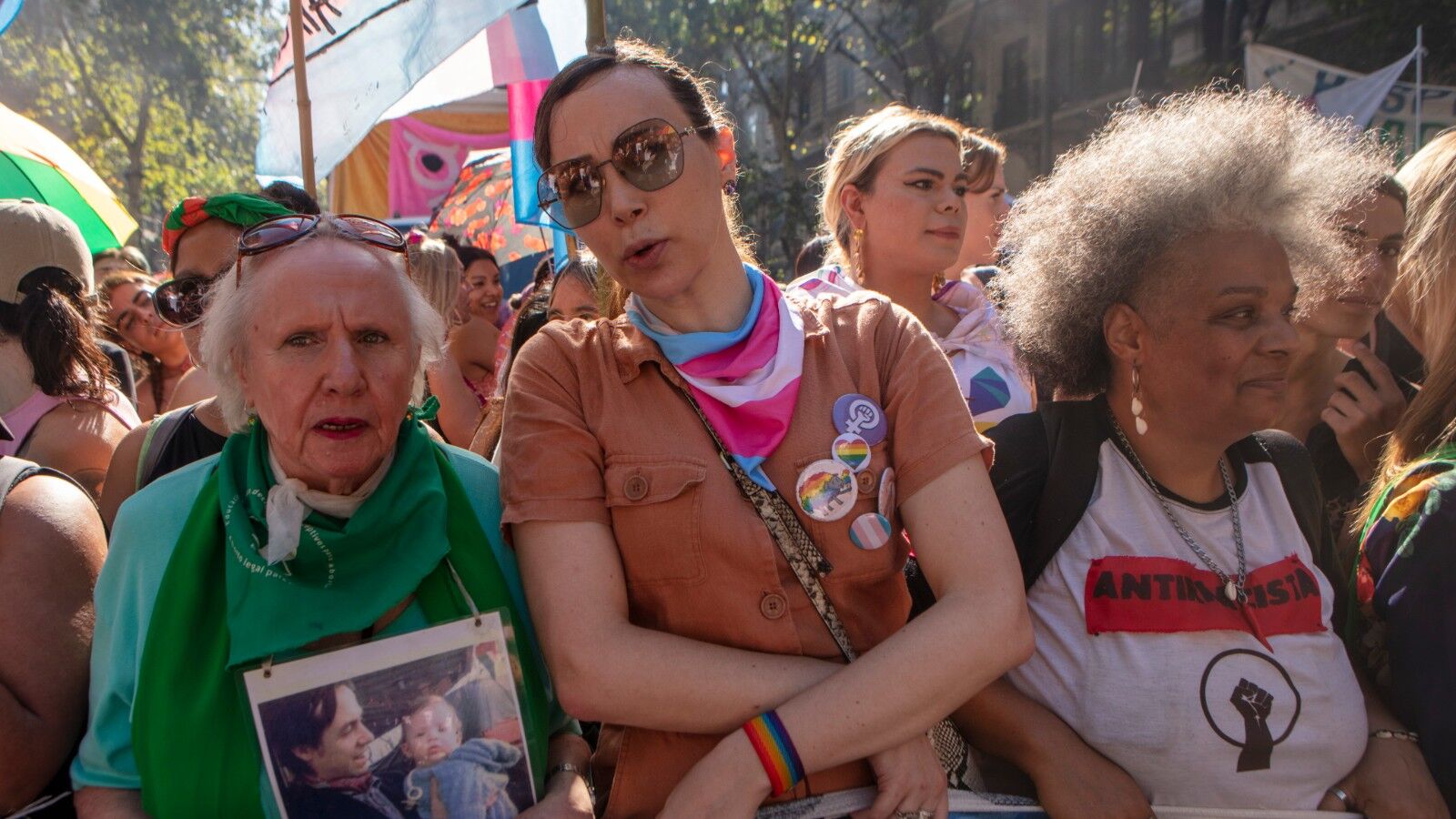
Buenos Aires Pride marched to Argentina’s Congress on Saturday, Nov. 7, the day before Pope Leo XIV arrived, and pop star María Becerra closed the night on the main stage.
“We’re living through times when showing your identity means living in fear,” Becerra told the crowd, Revista Gente reported. She finished the speech with the line printed on her white one-shoulder T-shirt: “La inclusión no es una opción, es un derecho,” or “Inclusion isn’t an option, it’s a right.” (Quotes from Spanish-language sources are Gayety’s translations.)
Thousands of people turned out, BAE Negocios reported. In September, Mayor Jorge Macri’s city government had barred “events, diversions, or acts in public places” from Nov. 6 to 13 because of the papal visit and proposed Nov. 21 for Pride instead, according to the Buenos Aires Herald and BAE Negocios.
“The march is a federal enterprise that has been in the making for months,” organizers answered, according to the Herald. On Sept. 25 they announced a deal with the city to keep Nov. 7, crediting “dialogue, organization and a shared political will,” Ámbito reported.
Buenos Aires Pride Keeps Nov. 7, Loses Plaza de Mayo
After that dispute with the city, the route got shorter and skipped the march’s usual pass through Plaza de Mayo, EFE reported. The Casa Rosada sits on that square, and Milei welcomed the pope there on Sunday.
Floats lined up on Cerrito, beside Avenida 9 de Julio, and the column was set to head up Avenida de Mayo at 4 p.m., La Nación reported. “Pride is love. It’s what fascists can’t stand,” marcher Sol Santillán told the paper.
The organizing committee’s motto was “Cuando el odio avanza, el orgullo en las calles es resistencia” (“When hate advances, pride in the streets is resistance”). The Línea Histórica, a second bloc, went with “¡El orgullo al poder! ¡El odio al carajo!” (“Pride to power! To hell with hate!”), Perfil reported. Marchers chanted “Basta de transfobia,” or “Enough transphobia,” according to EFE.
Bosques de Palermo Attack on Trans Women Drove the Demands
Justice for trans women attacked less than a week earlier was the march’s main demand, Diario Río Negro reported. María Rachid, president of the Argentine LGBT+ Federation, called that attack an organized “hunt,” the Buenos Aires Times reported.
Trans women working in the Bosques de Palermo were attacked with sticks, stones and traffic cones by a group of young people, according to the Times. Revista Noticias said the attackers got around mainly on bicycles. Macri said he wouldn’t allow “crimes to go unpunished.”
Andrea Scanga, a city prosecutor who handles discrimination cases, opened an investigation, and at least six women were hurt, according to Revista Noticias.
“What happened the other day to our sisters is the violence we trans women live with every day,” Natali Rivero told La Nación at the march. Her word was “compañeras,” which can also mean comrades. She also said, “But today I’m proud to be here, happy, celebrating.”
A document read from the stage linked the attack to the president’s words: “El odio que se dice desde un atril presidencial baja a la calle.” That’s “The hate spoken from a presidential lectern comes down to the street,” according to Río Negro and Filo.news.
In a January 2025 speech in Davos, President Javier Milei said, “In its most extreme version, gender ideology simply and plainly constitutes child abuse,” the Herald reported.
“We know very well who governs us,” organizers said Saturday, according to BAE Negocios, naming “a government that closed INADI,” the national anti-discrimination agency.
They called for “Reconocer es Reparar” (“To Recognize Is to Repair”), a bill that would give older travesti and trans women a pension, Infobae reported. Diario Panorama reported they also want repeal of Decree 62/2025, Milei’s order barring people under 18 from gender-affirming hormones and surgery.
A federal appeals court suspended that restriction in July with an interim order, without ruling yet on whether it’s constitutional, Perfil reported. The Argentine LGBT+ Federation, which brought the challenge, said the order applies nationwide.
María Becerra and La Joaqui Speak Out From the Marcha del Orgullo Stages
Singer La Joaqui closed the stage named for activist Nadia Echazú. “Ojalá a la gente le diera tanto miedo tener un hijo golpeador como un hijo gay,” she said, according to La Gaceta. Roughly: “I wish people were as afraid of having an abusive son as a gay son.” Río Negro, which quoted the line with slightly different wording, reported an ovation.
“I’m very happy to be here. I feel honored,” she said, according to La Gaceta.
Becerra started after 11 p.m. on the Carlos Jáuregui stage, in front of Congress. Her set included “Automático” and “Discoteka,” Río Negro reported, and Filo.news added “Hace Calor.”
“Today we have a lot to celebrate, but still a lot to defend,” she said, per Revista Gente.
She’d announced the show in October, telling followers she’d be “bancando los trapos como siempre,” Argentine slang that literally means holding up the banners, Infobae reported. The full sentence: “See you there, we’re going to give it everything, doing our little bit and standing up for the cause like always.”
Pope Leo XIV’s Schedule in Buenos Aires, From Jorge Newbery to Ezeiza
The pope arrived from Montevideo at 4:33 p.m. local time Sunday (11:33 a.m. PT), and Milei met him on the runway at Jorge Newbery Airport, the Herald reported. The Argentina leg’s motto is “Welcome everyone. Go and proclaim,” Vatican News reported.
Milei then received him at the Casa Rosada, where the two met privately for about 40 minutes, EFE reported. Leo has said church teaching on sexuality is unlikely to change soon.
Chef Narda Lepes, calling people to Saturday’s march, said there’d be love to spare, “hasta para el papa,” or “even for the pope,” Minuto Uno reported.
His Monday Mass is set for 11:30 a.m. at the Monument to the Spaniards in Palermo, according to the Vatican schedule published by the Herald. He leaves for Lima from Ezeiza on Wednesday, Nov. 11, at 2 p.m.


