


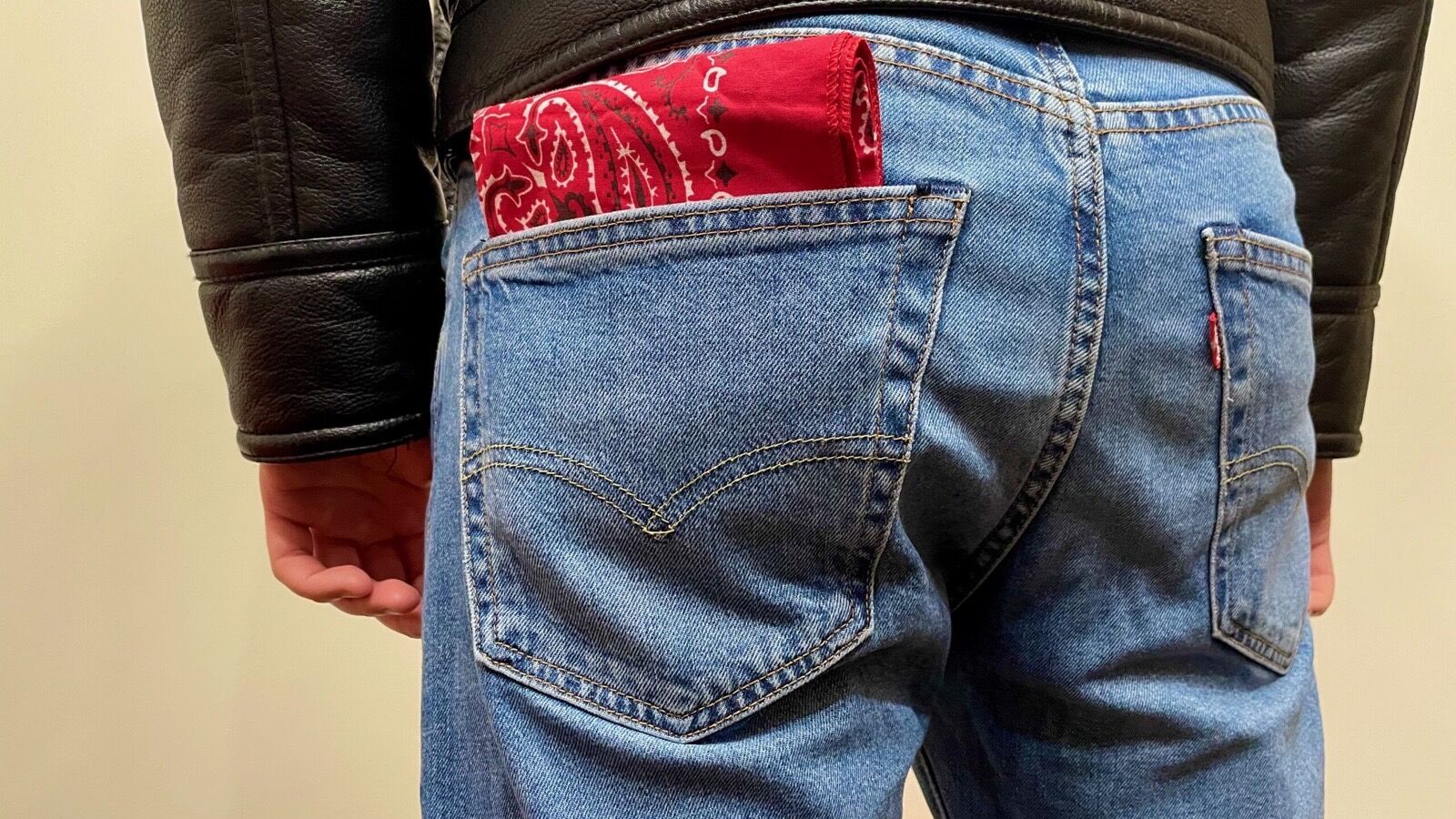
The hanky code is a system of colored bandanas worn in a back pocket to signal sexual interests. The color names the activity, and the pocket names the role: left usually means top or active, right usually means bottom or passive. It took off in 1970s gay leather bars and is still used at kink events today.
Jump to: Color chart · History · Flagging etiquette · Common questions
In 1977, San Francisco photographer Hal Fischer photographed gay male styles in the Castro and Haight-Ashbury, including men wearing blue and red bandanas in their back pockets. The work, Blue Handkerchief, Red Handkerchief, now sits in the Museum of Modern Art’s collection, and its captions explain the hanky code with a wink: the guy might also just need to blow his nose. That joke is still the best summary of flagging. The signal was loud to people who knew it and invisible to everyone else.
Below you’ll find a hanky code colors chart and the four competing origin stories. You’ll also get the queer women’s side of the history, plus how to flag today without a mix-up at the bar.
How the Hanky Code Works: Color Plus Pocket
Every hanky sends two messages at once. The color tells people what you’re into, and the side of your body tells them which part you like to play. A navy bandana on the left reads as “I top.” The same bandana on the right reads as “I bottom.”
The left and right rule grew out of an older habit. Before bandanas, gay men in leather and biker circles clipped a ring of keys to one side of the belt, and SF Gay History describes keys on the left or right as the original top or bottom tell. Hankies simply added color, which meant a lot more detail.
There’s no single official rulebook, though. A chart tells you how a signal has been used; it cannot tell you what a particular person means. Ask. Even familiar colors have acquired different meanings over time, as leather historian Jordy Jones explains in his history of the code.

Hanky Code Colors Chart: Left and Right Meanings
This chart brings together a core group of colors and some later additions. SF Gay History records a list published by leather author Larry Townsend in 1983. An earlier chart survives in the 1980 edition of Bob Damron’s Address Book. Shades and definitions vary, so use this as a starting point for a conversation.
On a small screen, scroll the chart sideways to compare both pockets. Meanings vary, and flagging never establishes consent.
| Bandana color | Left pocket meaning | Right pocket meaning |
|---|---|---|
| Dark blue (navy) | The wearer prefers the top, or insertive, role in anal sex. | The wearer prefers the bottom, or receptive, role in anal sex. |
| Light blue | The wearer prefers receiving oral sex from a partner. | The wearer prefers giving oral sex to a partner. |
| Black | The wearer prefers giving consensual pain during sadomasochistic, or S&M, play. | The wearer prefers receiving consensual pain during S&M play. |
| Grey | The wearer prefers tying up a consenting partner during bondage play. | The wearer prefers being tied up during consensual bondage play. |
| Red | The wearer prefers the insertive role in fisting, a sexual practice involving a hand. | The wearer prefers the receptive role in fisting. |
| Yellow | The wearer prefers urinating on a consenting partner during urine play, also called watersports. | The wearer prefers receiving urine during consensual watersports. |
| Orange | The wearer signals openness to different activities, traditionally described as “anything goes.” | The wearer signals “nothing now,” meaning they are looking without seeking sexual activity. |
| Kelly green | The wearer offers sexual services in exchange for payment. | The wearer is looking to pay for sexual services. |
| Hunter green | The wearer identifies with a daddy role in an adult relationship or encounter. | The wearer is interested in an adult partner who identifies as a daddy. |
| Purple | The wearer prefers performing body piercings on a consenting partner. | The wearer prefers receiving body piercings. |
| White | The wearer prefers giving a partner manual genital stimulation, commonly called a hand job. | The wearer prefers receiving manual genital stimulation from a partner. |
| Pink | The wearer prefers using sex toys on a consenting partner. | The wearer prefers a partner using sex toys on them. |
| Brown | The wearer prefers the giving role in scat play, a fetish involving feces. | The wearer prefers the receiving role in scat play. |
| Black and white check | The wearer signals a preference for safer sex; the pattern has the same meaning in either pocket. | The wearer signals a preference for safer sex; the pattern has the same meaning in either pocket. |
A few colors break the pattern. Orange is the famous one: left means “anything goes,” while right means “nothing now.” The black and white check is a safer-sex signal. Historian J. Raúl Cornier places its emergence most likely in the early 1990s in research published by Queer History Boston, formerly The History Project. A checkered hanky expresses a preference. It tells you nothing about someone’s HIV status and does not guarantee safer sex.
The shade matters, too. Kelly green and hunter green send different messages. Longer charts grew increasingly elaborate: Jones notes that a 1993 manual by Trevor Jacques listed 71 colors and objects, some of them jokes. Nobody needs to treat that as a vocabulary test before going out.

Who Invented the Gay Hanky Code? Four Competing Stories
Nobody knows for sure, and anyone who says otherwise is probably selling bandanas. Historians and archivists point to several stories that don’t all fit together.
Gold Rush Square Dances in San Francisco
The oldest story starts after the 1848 Gold Rush, when San Francisco had far more men than women. At dances, men partnered with each other, and a blue bandana marked the man leading while red marked the man following, according to SF Gay History. It’s a charming tale with very little documentation, so treat it as folklore rather than fact.
A Village Voice Joke About Keys
The second story puts the birth of the modern code in New York around 1970 or 1971. A Village Voice writer supposedly joked that colored hankies would say more than keys on a belt loop, and readers took the bit seriously. The Saint Foundation records the claim. It remains an origin story, not an established invention date.
The Trading Post Versus Alan Selby’s Bandana Surplus
Then there are the shop-counter stories. The Saint Foundation quotes Fischer’s account of San Francisco’s Trading Post promoting bandanas around 1971 and handing out cards decoding the colors. In another telling, leather pioneer Alan Selby said he and his partners at Leather ’n’ Things launched an expanded code in 1972 after a supplier doubled their bandana order. They needed to move the stock.
Selby was working in London then. He later founded Mr. S Leather in San Francisco in 1979, as the GLBT Historical Society’s exhibition about his life explains. Jones, one of that exhibition’s curators, recounts the surplus story in Vestoj but also identifies details that do not fit the historical record. It is a good story with unresolved problems.
Biker Clubs and Bandanas on the Bike
A fourth thread is less tidy. Art historian Andy Campbell told Metro Weekly in 2026 that some evidence ties hankies to gay motorcycle clubs, where bandanas were already useful for wiping down bikes. That offers another route into the code, without giving us a single inventor.
From Photos to Travel Guides: How Hanky Charts Spread
Printed charts turned an insider wink into a shared language. In 1977, Fischer published Gay Semiotics, which MoMA describes as a “lexicon of attraction.” The Saint Foundation’s copy of Bob Damron’s Address Book shows a color chart in its 1980 edition. Those surviving objects give us firmer dates than the competing origin stories.
Britain had its own tradition of protective secrecy in Polari, the coded slang used by gay men. Bandanas belonged to a wider world of gay symbols and codes, though each developed in its own setting.
How Lesbians and Queer Women Flagged
Queer women in the leather scene adopted and rewrote the code by the late 1970s. Samois, a San Francisco lesbian S/M collective founded in 1978, issued its reader What Color Is Your Handkerchief? in 1979. The Leather Hall of Fame’s history of Samois names Gayle Rubin and Patrick Califia among its 17 founding members.
The adaptations went further in print. On Our Backs ran a women’s hanky code in 1984, written by Califia and Rubin. It included signals for breast play and menstruation, with silk hankies offered by mail in 18 colors, according to Feeld’s history of flagging.
Bandanas are not the only objects used to flag. Feeld’s guide to flagging describes carabiners clipped left or right and “femme flagging” with one or two nails painted a different color. As with a hanky, those choices can have other meanings. A manicure is not a substitute for asking.
Bandanas After the AIDS Crisis and Dating Apps
Cornier’s research for Queer History Boston connects a decline in flagging during the mid-1980s with the AIDS crisis. The code persisted in BDSM spaces, and later fetish fashion carried its colors into other forms of clothing and gear.
Phones now handle some of the same introductions. In a 2026 post about the code, dating app ROMEO compares bandanas with the tags and filters people use on their profiles. The technology has changed; the wish to signal an interest before starting a conversation is familiar.
The Bandana Comeback: Hanky Nights, Art and Merch
The bandana never fully disappeared. Gary Wasdin of Chicago’s Leather Archives & Museum told Metro Weekly in 2026 that the code was in vogue again at leather and fetish events such as Mid-Atlantic Leather Weekend. That is a useful reminder that dating apps did not retire the back pocket.
Archivists have joined in, too. Boston’s History Project held a flagging party fundraiser in 2018, bringing the old code into a new night out.
The merch has followed. Opening Ceremony and LadyLand sold a Hanky Code collection for Pride 2018. Silver Sprocket announced Archie Bongiovanni’s Yes I’m Flagging for spring 2020. Scholars take the code seriously as well: Campbell’s 2020 book Bound Together examines leather history and contemporary art.
Flagging Etiquette: How to Wear a Bandana Today
Flagging is flirting with extra steps, so manners matter. These are the habits I’d start with.
- Treat a hanky as an opener, not a contract. You still need clear consent. A color tells someone what you might like, not what they’re owed.
- Ask out loud. “Are you flagging?” is a perfectly good line, and it saves everyone from guessing whether that red bandana is just an outfit choice.
- Check the local dialect. Shades and meanings vary by city and scene. If you’re traveling to a leather event, look for the venue’s own chart or ask a bartender.
- Think twice before wearing a hanky as pure fashion. A navy bandana poking out of your jeans at a leather bar might be read as a signal. If someone asks, explain what you mean.
- Respect a right-side orange. It can mean “not now.” Respect any refusal, regardless of what someone is wearing.
- Know the history you’re wearing. These signals helped people find each other when being found by the wrong person was dangerous.
Explore more queer history in Gayety’s culture coverage.
Hanky Code Meaning FAQ: Pockets, Colors, Modern Use
What does a hanky in the left back pocket mean?
In the hanky code, a bandana in the left back pocket usually signals the top or active role for whatever the color stands for. A navy hanky on the left means the wearer tops in anal sex, for example. Meanings can shift by city and scene, so treat it as a conversation starter and confirm with the person before assuming anything.
What does a dark blue or navy hanky mean?
Dark blue, often called navy, is the hanky code color for anal sex. Worn in the left pocket it says the wearer likes to top, and worn in the right pocket it says the wearer likes to bottom. It’s one of the oldest and most widely recognized colors, alongside red, which appeared on many of the earliest printed charts.
What does an orange hanky mean in the hanky code?
Orange is the wild card. On the left, the conventional meaning is “anything goes.” On the right, it is “nothing now.” Neither color nor pocket placement grants consent, and different charts can vary. Confirm what the wearer means.
Is the hanky code still used today?
Yes. It remains part of leather, kink and fetish culture, including events such as Mid-Atlantic Leather Weekend. Colors also appear on other gear, while apps carry some of the information that people once signaled with a back-pocket bandana.
Did lesbians use the hanky code?
Yes. Lesbian leather communities adapted it by the late 1970s. The San Francisco collective Samois published a 1979 reader titled What Color Is Your Handkerchief?, and the magazine On Our Backs printed a women’s hanky code in 1984 with colors specific to queer women’s sex lives. Other forms of flagging include carabiners and painted nails.
What does a black and white checkered hanky mean?
A black and white checkered bandana signals a preference for safer sex. Research published by Queer History Boston places its emergence most likely in the early 1990s. It carries the same meaning in either pocket. The signal does not establish someone’s HIV status or replace a conversation about consent and protection.


