


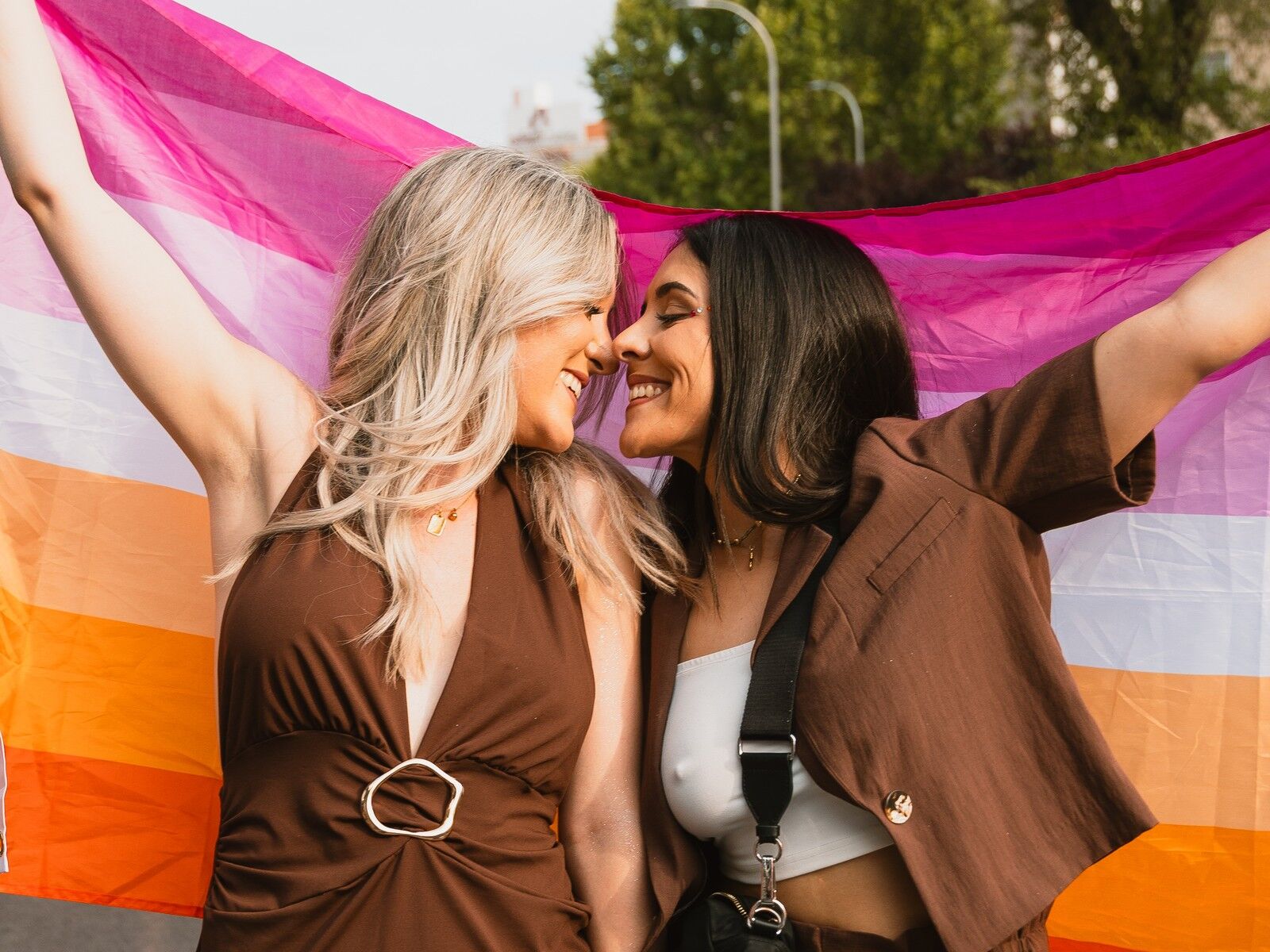
The sunset lesbian flag has orange stripes above a white band and pink stripes below it. Count five bands or seven, depending on the version. Emily Gwen introduced the design in 2018, as Outright International documents. That answers the quick identification question. The history takes a little longer. There’s an axe, a lipstick kiss and a dispute over who gets represented. I’ve put the designs side by side below, because “the lesbian flag” can mean several quite different images.
Lesbian Flag Designs, From Labrys to Sunset
| Flag | Year | Creator | What it looks like | Context |
|---|---|---|---|---|
| Labrys flag | 1999 | Sean Campbell | Double-headed axe over an inverted black triangle on violet | Historical design, still used by some lesbians |
| Lipstick lesbian flag | 2010 | Natalie McCray | Seven stripes from dark magenta through white to red, with a red kiss mark | Emphasizes feminine lesbian identity |
| Pink flag | After 2010 | Unclear | The lipstick flag’s stripes without the kiss | Variant without the lipstick mark |
| Sunset flag, seven stripes | 2018 | Emily Gwen | Dark orange to dark rose, white in the center | Seven-stripe sunset design |
| Sunset flag, five stripes | Simplified variant of the 2018 design | Adaptation of Gwen’s design | Five of Gwen’s seven stripes | Simplified sunset design |
Lesbian Flag Colors and What Each Stripe Means
Start at the top with dark orange. The colors get paler toward the white middle, then deepen through pink to dark rose. Every stripe in the seven-band design has a meaning; Outright lists all seven. For anyone drawing their own version, I’ve added Flag Color Codes’ hex values. Paste the full code, starting with #, into your design app’s color field. Printed fabric can look different from a glowing screen, so treat these as digital references.

| Stripe (top to bottom) | Meaning | Hex code |
|---|---|---|
| Dark orange | Gender nonconformity | #D52D00 |
| Orange | Independence | #EF7627 |
| Light orange | Community | #FF9A56 |
| White | Unique relationships to womanhood | #FFFFFF |
| Pink | Serenity and peace | #D162A4 |
| Dusty pink | Love and sex | #B55690 |
| Dark rose | Femininity | #A30262 |
Look closely at the white stripe’s wording: “unique relationships to womanhood.” I wouldn’t shorten that to “women.” The longer phrase makes room for lesbians whose experiences of gender differ. Femininity gets its own stripe at the bottom. Gender nonconformity gets one at the top. There’s space for both in the same flag.
The Five-Stripe Version
To get from seven bands to five, remove the second orange and the dusty pink. Keep dark orange, light orange, white, pink and dark rose. Spread those five across the flag at equal widths. That’s the simplified version shown here. Outright includes it alongside Gwen’s seven-stripe design, rather than identifying it as a separate lesbian identity. A five-striped badge and a seven-striped banner can belong in the same display.

The 1999 Labrys Flag and Its Black Triangle
The labrys is the white double-headed axe. Sean Campbell, a gay man, placed it on this flag in 1999. His design puts a black, downward-pointing triangle behind the axe and violet around it. The weapon had lesbian associations long before that flag existed. The Horniman Museum traces its adoption by lesbians to the 1970s, alongside its association with the mythological Amazons. So 1999 dates the flag, not the beginning of the symbol.
Violet might seem like an unexpected backdrop for an axe. There’s a much softer reference behind it. The Horniman connects the color with Sappho’s description of a lover wearing violets. It also describes women giving each other the flowers to express sapphic desire during the mid-20th century. Flowers and a weapon share this one small rectangle. I like that the design holds both.
The triangle needs more care. Nazis marked prisoners they called “asocial” with black triangles. Some imprisoned lesbians fell into that category; others faced different classifications. The US Holocaust Memorial Museum’s account of lesbians under Nazism explains those differences. It says the regime did not systematically persecute lesbians as a group. Calling the black triangle a badge that all lesbian prisoners wore would get that history wrong.
There’s a contemporary argument around the axe, too. Oxford’s Pitt Rivers Museum discusses its second-wave feminist and trans-exclusionary associations. The same account includes adaptations using trans flag colors. That’s a reason to ask what a particular flag means to its owner. The design alone cannot supply their answer. Our article on reclaiming the word dyke explores another symbol whose meaning depends heavily on who uses it.
The 2010 Lipstick Lesbian Flag and Its Pink Stripes
A kiss in the upper-left corner identifies the lipstick lesbian flag. Natalie McCray introduced it in 2010, according to the Horniman Museum. Pink and red stripes run around a white center. The name tells you its emphasis: feminine lesbians. That specificity becomes a problem when someone presents it as a flag for every lesbian. Butch and gender-nonconforming lesbians have objected to that claim of representation.
You may also find the same pink stripes without the kiss. Removing the mark makes a plainer flag, but doesn’t erase where its stripes came from. The Horniman records this variation and the backlash over bigoted comments on McCray’s since-deleted blog. I’d keep that context attached when reproducing either version. A history guide can show a design without recommending it for everyone’s Pride banner.
What the Sunset Flag’s Meanings Include
For a broad lesbian Pride display, I’d choose Gwen’s sunset design. The Horniman describes its inclusion of butch, trans and gender-nonconforming women. Its meanings make that choice easier to explain, particularly the dark orange stripe for gender nonconformity. Nonbinary people who identify as lesbians can use it, too. There’s no need to prove you fit someone else’s idea of femininity before picking up this flag.
Raising the Orange and Pink Flag on Lesbian Visibility Day
Want a date to put on the calendar? Lesbian Visibility Day falls on April 26. In 2026, New York’s LGBT Community Center opened Lesbian Visibility Week with a flag raising. A community event can be much smaller than that. Pick a film from our lesbian movie guide, invite friends and leave room to talk. For more of the visual history, follow our guides to LGBTQ+ symbols and Pride flags.
Lesbian Flag FAQ: Meaning, Creators and Versions
What do the lesbian flag colors mean?
Read the seven-stripe sunset flag downward: gender nonconformity, independence, community, unique relationships to womanhood, serenity and peace, love and sex, femininity. The table above pairs each meaning with its color and hex code.
Who created the lesbian flag?
Which design? Emily Gwen created the sunset flag in 2018. Sean Campbell designed the labrys flag in 1999. Natalie McCray’s lipstick version followed in 2010. Naming the design avoids crediting one person with all three.
Is there an official lesbian flag?
There isn’t one universally adopted lesbian flag. The Horniman’s history covers competing designs, and both five- and seven-stripe sunset versions remain recognizable. “Official” is a stronger claim than those sources support.
Why is the lipstick lesbian flag controversial?
Two issues follow it: its emphasis on feminine lesbians and criticism of its creator’s comments. The Horniman documents both. Removing the lipstick kiss changes the picture, but leaves its connection to McCray’s design.
Can nonbinary lesbians use the lesbian flag?
Yes, if lesbian is how they identify. Gender nonconformity and unique relationships to womanhood are already among the sunset flag’s meanings. Neither its five-stripe nor its seven-stripe version requires everyone carrying it to have the same gender experience.


