


Opinion and analysis. Ballot language and reporting reviewed Oct. 27, 2026.
During my 2024 PRIDE interview with Mercury Stardust, she explained why she keeps her medical transition private. After publicly saying she did not want to change her voice, she began considering vocal feminization. People reminded her that her earlier stance had helped them accept their own voices.
“I don’t talk about my HRT, I don’t talk about my surgeries,” she told me.
I respect that boundary. Being visible shouldn’t cost someone the right to make a private decision. That’s the question connecting these ballot measures for me: Who gets a say in a trans person’s life?
The medical proposals reach into some of the most intimate details of a transition: surgeries, hormones and puberty blockers. I think those decisions belong with the young person, their parents and their medical team. It surprises me that states have the time to focus this much on individual transitions.
Voters in five states will decide these six measures on Nov. 3. Arizona, Colorado, Nebraska and Washington have sports proposals. Colorado and Missouri have medical restrictions. Missouri also combines its trans-care proposal with a vote to reverse abortion protections.
The six 2026 trans rights ballot measures at a glance
| Measure | What approval would change |
|---|---|
| Arizona Proposition 318 | Expand sports restrictions, regulate access to athletic facilities and broaden legal claims. |
| Colorado Proposition 134 | Set sex-based eligibility rules for school and college sports. |
| Colorado Proposition 135 | Ban specified surgeries for minors and prohibit funding or insurance coverage for them. |
| Missouri Amendment 3 | Constitutionally restrict trans youth medical care and replace the 2024 abortion-rights amendment. |
| Nebraska Initiative 442 | Put restrictions on girls’ and women’s school sports into the state constitution. |
| Washington Initiative 638 | Exclude trans girls from girls’ interschool sports and require provider-signed sex verification. |
These are the six proposals covered here. Other ballot questions may also affect LGBTQ+ people. Voting no stops the change being proposed. It does not wipe away restrictions already in law.
What I’ve learned from trans people and their families
Working in LGBTQ+ media, I have met so many trans people, both young people and adults. By and large, the people I’ve met have been informed about their transitions. They’ve thought about the risks and potential benefits and made conscious decisions about what they believe is best for them. That’s my experience, not a claim about every family.
I know things can go wrong, and families need to understand the risks. Yes, we’re talking about minors. Their age matters, and so does their voice in what happens to them. My concern is how much authority these measures would give the state over those decisions.
But “leave it to families” needs a qualification. Some young people don’t have support at home. In my 2021 PRIDE interview with FOLX Health founder A.G. Breitenstein, we discussed LGBTQ+ youth homelessness. Breitenstein described a young lesbian honor student who suddenly lost the safety of her home. Family support cannot be taken for granted.
Later in that conversation, Breitenstein described the uneven access to knowledgeable clinicians for trans youth. Having a supportive family helped. So did living near the right medical resources. Those were observations from 2021, years before these ballot proposals.
Those conversations complicate the idea that every young person has a family and doctor ready to help. A young person still needs somewhere safe to turn if their family rejects them. They deserve qualified medical guidance and a voice in their own care.
That is what I want voters to keep in mind through the legal details below. These proposals differ in scope, enforcement and how hard they would be to reverse. The families affected will have to live with those differences long after Election Day.
The Associated Press reports that 27 states already restrict trans participation in girls’ and women’s school sports. Colorado and Washington voters now face restrictions that have not advanced through their Democratic-led governments.
Missouri Amendment 3 combines two major health care decisions
Under Missouri’s proposed constitutional amendment, minors could not receive surgery, puberty blockers or hormones for gender transition. There are exceptions for certain medical conditions unrelated to transition.
The same vote would replace the abortion protections Missourians approved in 2024. Abortion would be allowed for medical emergencies, fetal anomalies, rape or incest. For rape and incest, the cutoff would be 12 weeks.
Anna Spoerre’s Missouri Independent reporting, published by KCUR, includes a revealing comment from former clinic worker Jamie Reed. Speaking at a Republican gathering, Reed said: “If we talk to people about the trans part of this amendment, we can get it to pass.”
Missouri already restricts this care under its SAFE Act. But the limits on blockers and hormones expire in August 2027, KCUR reports. The surgery ban has no such expiration. Amendment 3 would put the restrictions into the constitution without that deadline.
To me, this makes it harder for voters to choose between one issue and the other. If someone is very much opposed to abortion, they may vote for this amendment. They may not really have an opinion on trans care restrictions at all. Their vote still counts toward passing both.
To me, bundling these restrictions looks like a way to win votes without persuading voters on each issue separately. Whatever someone thinks about abortion or trans care, they should understand that this ballot offers no separate choice.
Washington I-638 makes verification part of eligibility
Washington’s official explanatory statement says I-638 would generally exclude trans girls from girls’ interschool sports. Public K-12 schools and participating private schools are covered.
Every student entering a covered girls’ competition would need a statement signed by their personal health care provider. That includes cisgender girls.
Section 3(2) lists three possible bases for verification: anatomy, genetics or naturally produced testosterone. One or more may be used. The text does not explicitly require every athlete to undergo a genital exam.

In Washington, we’re talking about school sports. Thinking about trans and cisgender girls having to verify anatomy, genetics or testosterone levels gives me pause. It just seems like a lot to go through for kids’ sports.
My first question was who would do the checking. The text specifies the student’s own health care provider, not a sports official. That answers one concern. It doesn’t answer why every girl should face this additional requirement to join a school competition.
I understand why people want to discuss fairness, puberty and the circumstances of someone’s transition. I still think this requirement is an overstep for both cis and trans kids.
Gayety’s full I-638 explainer examines the campaign and the dispute over implementation.
Colorado Proposition 134 leaves schools to work out the checks
Colorado’s Proposition 134 reaches from elementary school through college. Teams would be male, female or mixed. Trans girls would be excluded from girls’ teams under its definitions. Students classified as female could join a male team if the school offers no equivalent female team.
Schools would have to decide how students prove eligibility. The official Colorado Blue Book says each school or district would set its own verification procedures. There is no single required method.
Chalkbeat reports that public and private schools and colleges are covered. Independent youth clubs and leagues are not. The proposed rules would begin Jan. 1, 2027.

Enforcement also differs by school. The Colorado Department of Education would handle compliance in public K-12 schools, Chalkbeat reports. The proposal supplies no equivalent enforcement system for private schools or colleges.
Colorado Proposition 135 is a separate vote about surgery
Proposition 135 is a separate question about surgery. For minors, it targets operations intended to alter sex characteristics in response to their sex or gender perception. It would also prohibit government funding and insurance coverage for those operations.
The Blue Book describes exceptions for certain medical conditions and male circumcision. Counseling and social transition would remain unrestricted by this proposal. Missouri’s proposal also covers hormones and puberty blockers. Colorado’s proposed prohibition concerns surgery.
The Colorado guide warns that some surgeries for minors who are not trans could also fall under the wording. The reason for an operation determines whether it is prohibited. The proposal does not provide a list of banned operations.
Arizona Proposition 318 reaches beyond the playing field
Arizona already has a law restricting trans girls’ participation in girls’ school sports. Proposition 318 would extend that framework to more athletic organizations. It also reaches into the facilities people use.
The official text uses the sex designation recorded at birth on an original birth certificate. It restricts bathrooms, locker rooms, showers and other private spaces connected to athletics. Those rules cover anyone using the facilities, including people who are not athletes.
The Arizona Mirror reports that privately funded sports organizations outside schools would be covered. Judge Greg Como raised another concern during ballot-access litigation: the wording could arguably reach all school restrooms. That is a question about its potential scope, rather than a settled interpretation.
More people could sue over alleged violations. Approval would also limit later legislative changes, according to the state’s legislative analysis. Amendments generally would require three-fourths support in each chamber. They would also have to further the measure’s purpose. Voters retain other routes to changes.
Nebraska Initiative 442 would make the restriction constitutional
Nebraska’s “Fairness for Girls” proposal is Initiative Measure 442 on the ballot. Its official voter pamphlet describes a constitutional change. School teams would be designated by sex or as mixed. Girls’ and women’s teams would exclude students classified as male.
Public schools and colleges are covered, along with private institutions competing against public institutions. Nebraska already passed sports restrictions in its 2025 Stand With Women Act, as WOWT reported.
Here, voters are deciding whether to put a restriction into the constitution. A future legislature could not repeal that requirement as an ordinary law. Voting no would leave the constitution unchanged on this issue. It would not repeal the existing sports law.
To young readers and their parents
These votes concern young people who already have thoughts about their own lives. They deserve respect, support appropriate to their age and a voice in their care. That brings me back to a conversation with Raquel Willis.
When I interviewed Raquel Willis for PRIDE in 2021, she described watching young trans people of color speak at Brooklyn Liberation. She called it an “auntie moment.” These young people spoke with conviction about their own dignity.
We spend so much time asking what adults want for trans kids. Raquel’s story reminds me to listen to what those young people say for themselves.
Later, addressing young Black trans women, Raquel said: “There’s no waiting around for someone to give you your power. You have it.”
I want young readers to hear that, too. These votes can affect your rights and your options. Your worth does not depend on the result.
For anyone voting on these measures, the official texts are linked above. Missouri combines trans-care and abortion restrictions in one vote. Colorado puts its sports and surgery proposals to voters separately. Those differences matter when you mark a ballot.
Election Day is Tuesday, Nov. 3, 2026. Registration, identification and ballot-return requirements vary by state. Use Vote.gov to reach official voting information and confirm your local deadlines.
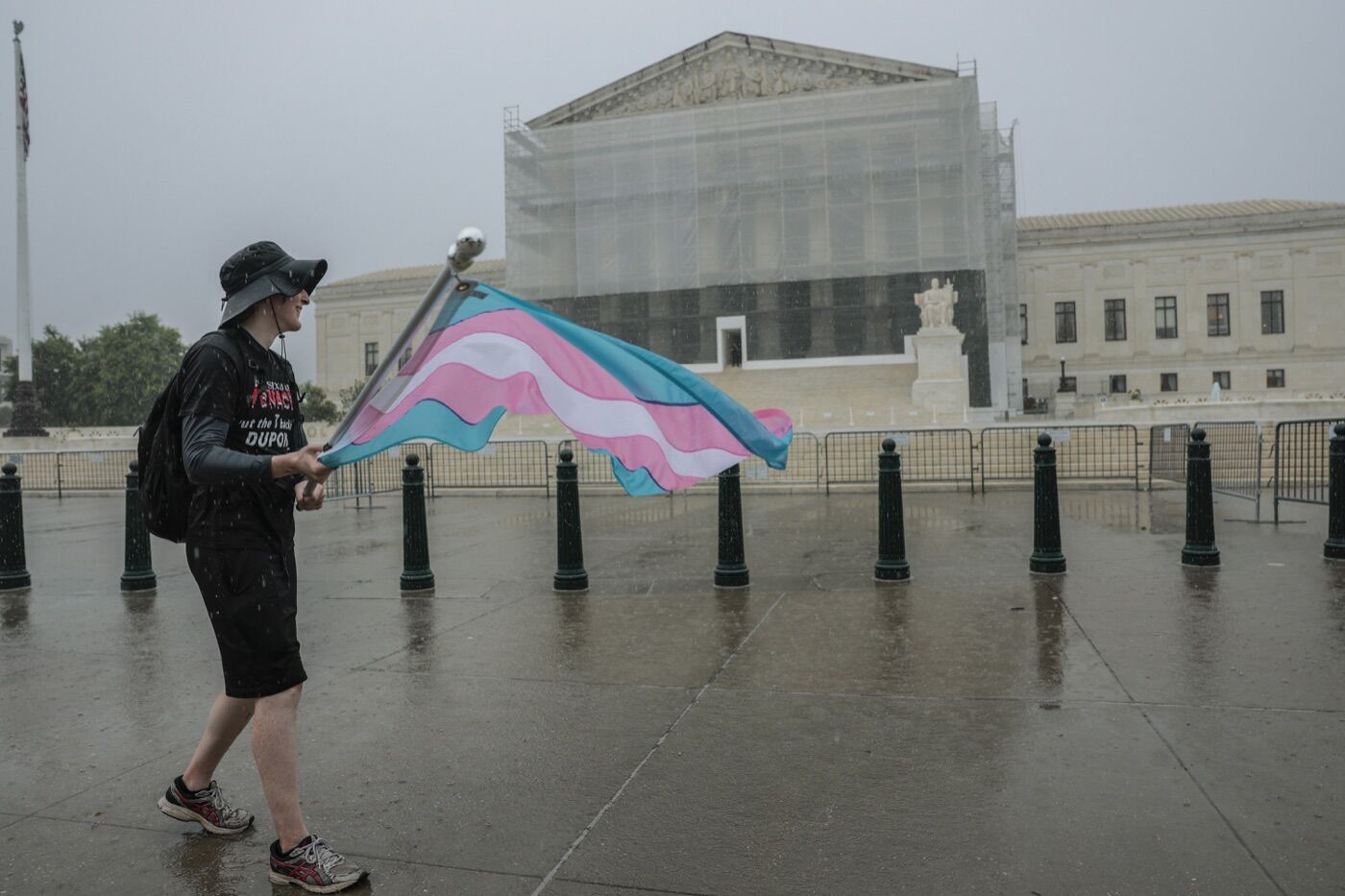
Lead photo: A transgender pride flag outside the U.S. Supreme Court at a June 18, 2025, rally. Archival photograph by Anna Moneymaker/Getty Images.


