


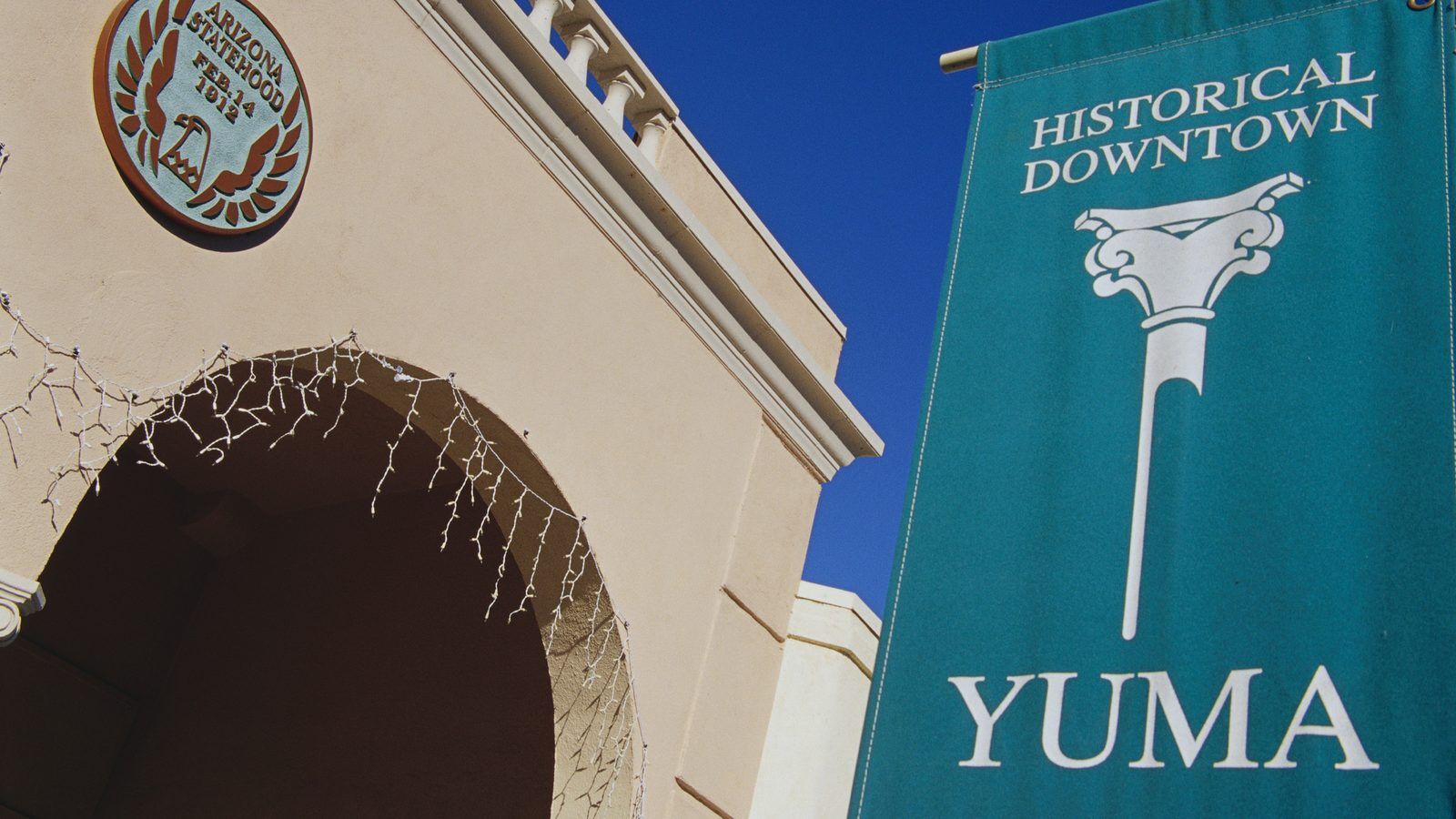
Yuma’s March for Visibility stepped off from the Main Street fountain on Saturday, Nov. 7, with marchers carrying Pride flags to the Yuma Center for Spiritual Living, KAWC’s Victor Calderón reported. They chanted “Love is Love!” and “We’re Here! We’re Queer! We Have No Fear!”
Peter Barranco of Yuma said the crowd was a few but mighty, with a lot of passion and heart, the station reported. Barranco explained the point of showing up.
“To make sure for that kid that’s hiding or afraid that we’re still present and there’s no need to hide,” Barranco told KAWC. “We’re all together in public.”
Citizens Curating Safe Spaces Yuma, or CCSS, organized what KAWC and organizer Peyton Ortiz both call the fifth annual march. Ortiz previewed it on KAWC’s Yuma Edition on Nov. 2.
“It’s more of a celebration,” Ortiz said. “It’s showing people in Yuma that we are here.”
Who Showed Up for the Yuma March on Nov. 7
Tonja Alvis of Yuma said she’s been out since she was 18, and she wants younger generations to see people of all ages there to support the community.
“I want to join our community and stand strong, be united and give people safe spaces,” Alvis said. “Everybody belongs and love is love.”
A Yuma mother identified only as Casey said her daughter is trans, and she’s come to the march every year in support. Yuma’s a small town, Casey said, so people need to show support.
“Whoever you are, you are loved and you are welcome,” she told KAWC. “It’s not something you see a lot here.”
KAWC also interviewed two members of the Gay Straight Alliance at San Luis High School.
How a 2021 Flyer Restarted Yuma’s Pride March
Yuma’s Pride march is older than CCSS. The Littlewood Fine Arts and Community Co-op held the city’s first ones in 2018 and 2019, Ortiz said on Yuma Edition. The pandemic wiped out 2020, and the co-op didn’t make it through COVID.
By 2021, Ortiz was planning an outfit and looking for the march. Nobody was going to do it.
“It felt too important to drop the ball,” Ortiz said.
So Ortiz put together a flyer: meet at the side of the road, walk downtown on the sidewalks, no permit and no road closures. Ortiz called it the March for Visibility.
“I turned back and I saw hundreds of people behind me,” Ortiz said. “It was so moving, so huge.”
Ortiz later counted more than 200 heads in video of that first march, footage Ortiz believes Calderón shot. That same night, the people who helped started calling themselves Citizens Curating Safe Spaces.
“And that’s exactly what we intend to do,” Ortiz said.
Why the Yuma March Moved From June to November
The early marches ran on the first Friday of June, for Pride Month. Ortiz believes the June dates lasted for the first three years.
The heat was the problem. “It is hot,” Ortiz said.
People still walked more than a mile, with CCSS handing out water bottles. Then “the community strongly felt that we deserved a cooler march,” Ortiz said.
A host pointed out that Nov. 20 is Trans Day of Remembrance. Ortiz said that was part of why the march landed in November and not “a different cooler month.”
Before this year, the march ended downtown on First Friday. “We chose a very visible route,” Ortiz said, down Fourth Avenue on a busy night so drivers heading home from work would “see our rainbows and smiles.”
This year, with help from the Yuma Center for Spiritual Living, CCSS reversed the route. Marchers left the Main Street fountain and finished at the center, KAWC reported. Ortiz had said they’d step off at 5 p.m. and close the night with an after party there.
What Walking in the Yuma Pride March Feels Like
Everyone gets nervous, Ortiz said, even the organizer who has to be first out with the signs.
“You don’t know what to expect. You don’t know what’s gonna happen when you get there,” Ortiz said.
Then it flips.
“There’s such a euphoria once you do it,” Ortiz said.
Chanting “love is love” in unison with everyone around you, Ortiz added, “could literally bring you to tears.”
Families come out for someone they love. Older marchers share stories of the hardship they’ve lived through.
“I like to describe it as seven to 70,” Ortiz said.
Why Peyton Ortiz Says Yuma Still Needs Safe Spaces
Ortiz said every place needs safe spaces, and Yuma’s no different. Its size plays a part.
“We’re not so small that you literally know everybody, but we’re also not so big that it’s easy to create distance between opposing forces,” Ortiz said.
Asked why something as simple as a haircut could feel intimidating, Ortiz compared it to being picked on or called the wrong name on purpose.
“The issue is that for the LGBT community, because they’re marginalized, for some reason, people might see it as more acceptable to pick on them,” Ortiz said.
Ortiz also wants more people in power “willing to say, ‘I see you, I support you, and you are valid.'” Some already show up. At the march, Ortiz said, “we’ll get the occasional figure that comes through and shakes hands.”
PFLAG Meetings and the Buy Nothing Bazaar in Yuma
CCSS also runs book clubs at the library, water days down by the river and “literal raves with lights and foam.”
Ortiz calls its Buy Nothing Bazaar “like a yard sale, but no money.”
“We don’t separate the clothing by gender, we just separate it by size,” Ortiz said.
One shopper told Ortiz about getting rid of all their boy clothes and leaving with girl clothes. That person couldn’t have afforded to dress that way before, Ortiz said.
PFLAG’s Yuma group meets on the first Saturday and third Wednesday of each month at the Yuma Center for Spiritual Living, according to Ortiz. Asked what would make Yuma more inclusive, Ortiz started with attendance.
“They say it takes a village, and that’s true, but that means you need to be a villager,” Ortiz said.


