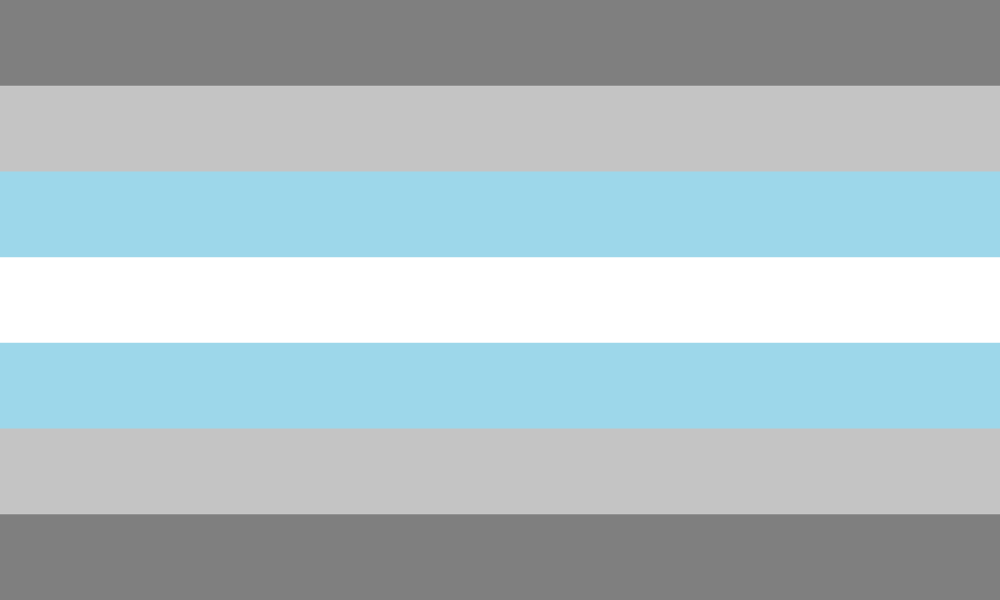

Look for two light blue bands against gray and white, and you’re looking at the demiboy flag. The demigirl design swaps in pink. Both seven-stripe flags are credited to Salem X in February 2014 by UC Santa Barbara’s flag glossary.
Demiboy describes someone who identifies partly, but not completely, as a boy or man. Demigirl describes a partial identification as a girl or woman. The definitions in Worcester Polytechnic Institute’s glossary do not depend on the sex someone was assigned at birth.
Reading the Demiboy and Demigirl Flags
| Stripe position | Demiboy flag | Demigirl flag |
|---|---|---|
| 1 and 7 (top and bottom) | Dark gray | Dark gray |
| 2 and 6 | Light gray | Light gray |
| 3 and 5 | Light blue | Pink |
| 4 (center) | White | White |
To reproduce the colors digitally, Flag Color Codes lists the two grays as #7F7F7F and #C4C4C4, blue as #9DD7EA and white as #FFFFFF. Its demigirl palette uses #FDADC8 for pink. These values come from that site; they are not a specification supplied by Salem.

Blue and pink have familiar associations with masculinity and femininity in these guides. Try to pin down the gray and white, though, and the explanations begin to disagree. Even the two university glossaries assign different meanings to the same bands:
| Color | UC Santa Barbara | Worcester Polytechnic Institute | Flag Color Codes (demiboy only) |
|---|---|---|---|
| Dark and light gray | Absence of gender | A partial connection to being a boy/man or girl/woman | Partial connection, “the grey areas” |
| White | Partial identification with a gender | Agender or nonbinary experiences | Agender or nonbinary identity |
In a December 2018 email interview with Majestic Mess, Salem explained the agender flag’s colors but supplied no separate key for the demi flags. The interpretations above should be read with that limitation in mind.
What Demiboy and Demigirl Can Mean to the People Using Them
Demigender is the umbrella term. Bergen Community College’s guide describes people who identify as nonbinary “but can sometimes relate to a gender.” Two first-person essays show how differently that connection can be experienced.
AZE founder Michael Paramo chose demiguy in a 2017 essay. “I feel mostly non-binary, along with a minimal connection to being a man,” Paramo wrote, also describing fairly minimal dysphoria.
Sofía Aguilar described a connection to womanhood that could come and go. In HipLatina in 2023, she described being a demigirl whose gender “fluctuates both in and out of the bounds” set by others. Some days she felt like a woman. Some days she did not. After reading Felix Ever After, she found a Trans Youth Equality definition that gave her a word for it.
Following the Flags Back to Tumblr
The creator’s Tumblr handle was transrants, according to Pride Flag Search. The Encycloflaggia archive documents reposts of Transrants’s demigirl and demiguy proposals from Feb. 18, 2014. Another user, druxydeity, added the yellow deminonbinary design to the thread on April 5, the archive says.
The Pride-Flags gallery uploaded the demigirl and deminonbinary flags to DeviantArt on July 4, 2015. Both say “Flag designed by transrants” and link to the original proposals, even though Encycloflaggia attributes the yellow addition to druxydeity. The upload date is also a year later than the reposts the archive found.
The Yellow Flag and Later Redesigns
You may also see the seven-stripe design with yellow in place of blue or pink. WPI calls that flag demigender: yellow for nonbinary and genderqueer identities, white for a lack of connection to gender, gray for a partial connection. Bergen presents it as the umbrella design, with blue and pink versions for demiboys and demigirls. Encycloflaggia uses deminonbinary for druxydeity’s April 2014 addition.
Willow is the credited designer of two later alternatives in the Pride-Flags gallery. Its demiboy and demigirl entries, both marked version 3, were uploaded on Aug. 24, 2015. UC Santa Barbara illustrates the original seven-stripe designs in its glossary.


