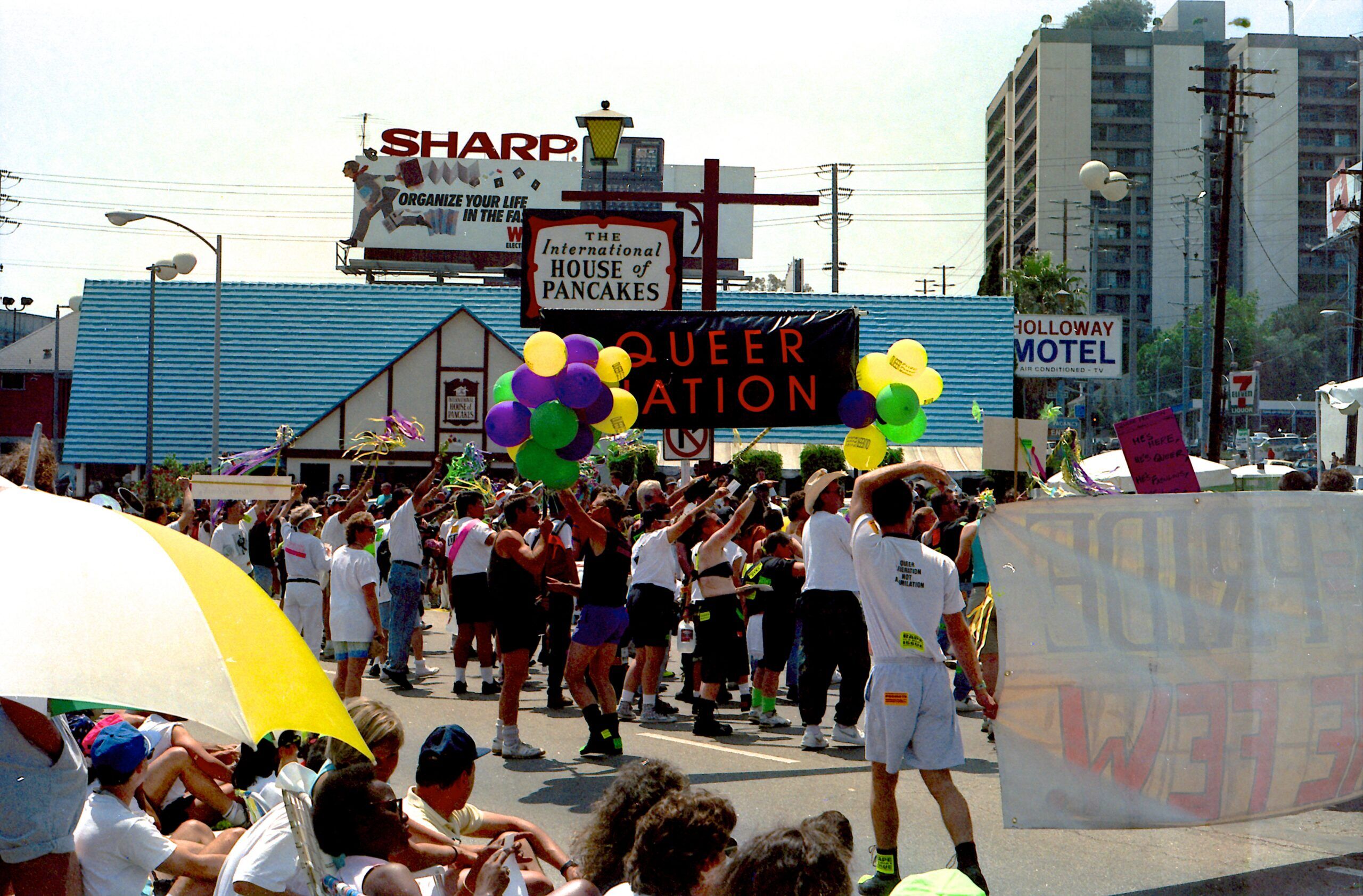

At New York’s Pride march in June 1990, activists handed out an anonymous leaflet called “Queers Read This,” according to an archived copy of the text. One line made the case for the word fast: “Queer, unlike GAY, doesn’t mean MALE.” So what does queer mean now? It depends on who’s saying it, and about whom.
Queer is an umbrella term for sexual orientations and gender identities that aren’t straight or cisgender. Planned Parenthood calls it “a word that describes sexual and gender identities other than straight and cisgender.” The word also has a long history as a slur. GLAAD cautions that it still isn’t universally accepted.
Queer Can Describe Orientation, Gender or Both
The GLAAD Media Reference Guide defines queer as an adjective used by some people, particularly younger people, whose sexual orientation isn’t exclusively heterosexual. GLAAD also says the Q in LGBTQ generally stands for queer when organizations, leaders and media use the acronym, while youth support groups may use it for questioning.
Planned Parenthood says lesbian, gay, bisexual and transgender people may all identify as queer. It also says the word is sometimes used to signal that sexuality and gender can be complicated, can change over time and might not fit either/or boxes. GenderPAC founder Riki Anne Wilchins defined “genderqueer” in a transgender newsletter in spring 1995, per Dictionary.com, and genderqueer and nonbinary can overlap, though people choose the terms that fit them.
Gay usually describes attraction to the same gender, and women as well as men use it. Queer can refer to orientation, gender or both. A straight transgender or nonbinary person may therefore identify as queer; being LGBTQ does not require anyone to choose that label.
From Odd to Insult
Queer first appeared in English around 1513, meaning odd or peculiar, Merrill Perlman wrote in the Columbia Journalism Review in 2019. Early uses covered counterfeit money and feeling unwell. Dictionary.com says it was first recorded in Scottish in the 16th century and may be related to the German quer.
The sexual meaning arrived with a scandal. The Oxford English Dictionary credits the Marquess of Queensberry with the first use of queer as a noun meaning homosexual, in 1894, CJR reports. Dictionary.com says he used “snob queer” in a letter to his son, Lord Alfred Douglas, and that Queensberry’s homophobia ultimately led to the prosecution and imprisonment of Oscar Wilde. By about 1914 the adjective meant homosexual too, mostly in the U.S., and Partridge’s slang dictionary calls that use “derogatory from the outside, not from within.”
Queer Nation and the 1990 Reclamation
The OED dates the word’s positive turn to the late 1980s, CJR says, and UC Irvine’s School of Humanities ties it to activists fighting the government’s refusal to address the AIDS crisis. Queer Nation was founded in New York on March 20, 1990, according to an EBSCO Research Starter by Jay Blotcher. Four longtime ACT UP members, Alan Klein, Karl Soehnlein, Michelangelo Signorile and Tom Blewitt, organized it, and 60 people came to an early meeting at the city’s Gay and Lesbian Community Services Center.
Its chant was “We’re here. We’re queer. Get used to it!” Members wore black T-shirts with a big yellow Q, and by summer 1990 there were chapters in Boston, Philadelphia, Los Angeles, San Francisco and Montreal, Blotcher writes. The New York group spun off the Lesbian Avengers and the Pink Panthers, lost steam after mid-1991 and eventually disbanded.

“Queers Read This” explained the choice. Its “Why Queer” section said many lesbians and gay men woke up feeling angry and disgusted, and that queer reminded people how the wider world saw them. UC Irvine says AIDS-era activists “reclaimed the homophobic insult as a term of power,” in a passage by Chancellor’s Professor of English Jonathan Alexander.
From the Streets to Classrooms and TV
A 1990 conference at the University of California, Santa Cruz, helped establish queer theory as an academic field. The university’s library credits professor Teresa de Lauretis and other members of its Faculty Lesbian and Gay Studies Group with organizing it. De Lauretis’s 1991 introduction to Queer Theory: Lesbian and Gay Sexualities identifies the conference as taking place in February 1990.
On TV, Dictionary.com notes, Queer as Folk premiered in the U.K. in 1999 and in the U.S. in 2000, Queer Eye for the Straight Guy was a hit in 2003, and Netflix rebooted it as Queer Eye in 2018.
Who Calls Themselves Queer?
On May 29, 2025, the Pew Research Center reported that 48% of LGBTQ adults think of themselves as queer, 44% don’t and 8% aren’t sure. Pew asked about queer separately from sexual orientation and trans identity: those labels can overlap. The Williams Institute at UCLA studied queer identity in its 2020 analysis of Generations research, but asked different questions of a different population. Its 6% figure and Pew’s 48% should not be read as a rise over time.
| Study | Who was asked | Key finding on queer |
|---|---|---|
| Pew Research Center, 2025 | LGBTQ adults, asked about queer separately | 48% identify as queer |
| Pew, by age | LGBTQ adults 18 to 29 | 59% identify as queer |
| Pew, trans adults | Transgender adults | 82% identify as queer |
| Williams Institute, 2020 | Non-transgender sexual minority adults in three age groups: 18–25, 34–41 and 52–59 | 6% identify as queer |
| Williams Institute, 2020 | Queer-identified respondents | 76% were 18 to 25; 83% assigned female at birth |
The Williams study also found that 85% of queer cisgender women and 47% of queer cisgender men reported attraction to both men and women. “Queer identity seems to represent greater openness to partners of all gender identities,” said Ilan H. Meyer, a distinguished senior scholar of public policy at the institute.
Why Some LGBTQ People Still Don’t Like the Word
Alexander’s UC Irvine page says not everyone in the LGBT community identifies with the term even now. Pew found fewer than half of LGBTQ adults 40 and older call themselves queer.
Dictionary.com points to the playground game “smear the queer.” It also describes a 2013 case in which a man in his 60s filed a complaint with the state after a Colorado College job application listed queer as a gender identity option, because it reminded him of past discrimination. In the U.K., “don’t be queer” can still just mean don’t act strange, Dictionary.com notes.
Using Queer for Someone Else
The AP and New York Times rows below come from CJR’s 2019 roundup, and the rest come from each group’s own current guidance.
| Guide | What it says about queer |
|---|---|
| GLAAD Media Reference Guide | Reclaimed by some, but “not a universally accepted term even within the LGBTQ community”; use caution outside self-identification or quotes |
| AP Stylebook (as quoted in 2019) | Acceptable for people and groups who use it for themselves; don’t use it as a slur |
| NLGJA Stylebook on LGBTQ+ Terminology | Reclaimed by some; “use with caution,” since it’s still offensive as an epithet; consider your audience and explain it if needed |
| The New York Times Manual of Style and Usage (as quoted in 2019) | Treat it as an offensive slur, with a narrow exception for ironic self-description and queer studies |
| Trans Journalists Association | Its general rule is to “honor the way someone speaks about themself whenever possible” |
| Planned Parenthood | Don’t use it for someone unless you know they accept it; ask what labels people prefer |
For a person’s own identity, follow the word they use. Queer appears throughout LGBTQ+ culture, but familiarity with the term isn’t permission to assign it to someone.


