


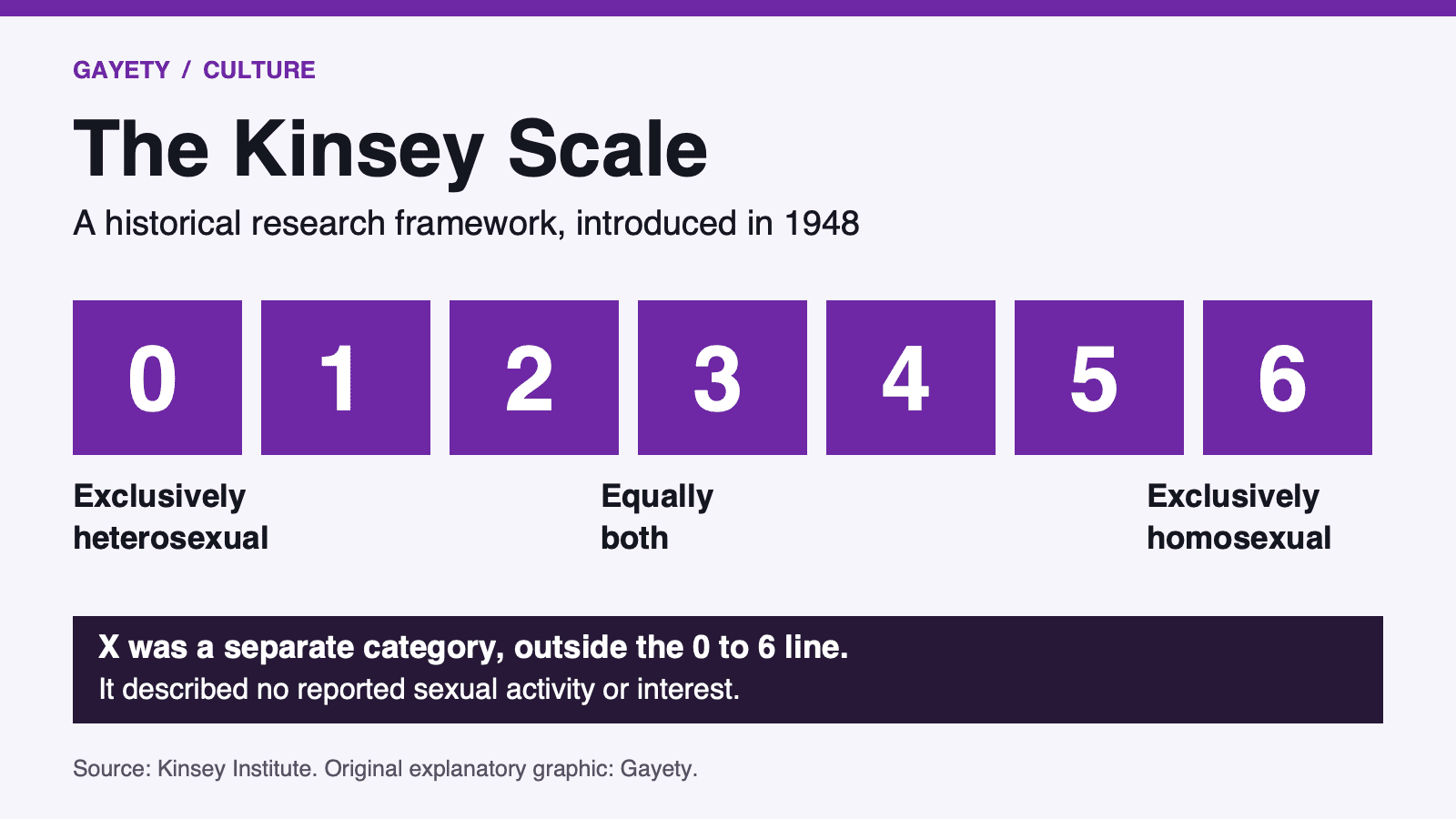
On the Kinsey scale, a 0 means “Exclusively heterosexual” and a 6 means “Exclusively homosexual,” according to the Kinsey Institute at Indiana University. Alfred Kinsey’s research team used the 0 to 6 rating of sexual behavior and attraction in its 1948 and 1953 reports on American sex lives, plus a separate X for people with “No socio-sexual contacts or reactions.”
“The living world is a continuum in each and every one of its aspects,” Kinsey wrote in Sexual Behavior in the Human Male in 1948, as the institute quotes him. He built the scale to show that most people don’t sort neatly into two boxes.
The Kinsey Scale Ratings From 0 to 6, Plus X
The institute still publishes the original wording for each number.
| Rating | Kinsey Institute description |
|---|---|
| 0 | Exclusively heterosexual |
| 1 | Predominantly heterosexual, only incidentally homosexual |
| 2 | Predominantly heterosexual, but more than incidentally homosexual |
| 3 | Equally heterosexual and homosexual |
| 4 | Predominantly homosexual, but more than incidentally heterosexual |
| 5 | Predominantly homosexual, only incidentally heterosexual |
| 6 | Exclusively homosexual |
| X | No socio-sexual contacts or reactions |
“People at ‘0’ report exclusively heterosexual / opposite sex behavior or attraction,” the institute says, and “Those at ‘6’ report exclusively homosexual / same-sex behavior or attraction.”
Everything from 1 to 5 is some mix. Dead center sits 3, “Equally heterosexual and homosexual,” in the institute’s words.

People tend to forget the X. In the original studies, the institute says, “the X category designated the group who reported no socio-sexual contacts or reactions in their interviews.”
About 1.5 percent of Kinsey’s adult male subjects landed there, the Canadian higher-education magazine University Affairs reported in 2013, describing the X as where asexual people ended up. “Instead, they were allotted their own category which Dr. Kinsey identified with an ‘X,'” it wrote.
Gayety’s guides to the asexual flag and demisexual meaning cover how ace people describe themselves now.
How Alfred Kinsey Assigned a Number in the 1948 and 1953 Reports
“The original Kinsey research team assigned a number based on a person’s sexual history,” the Kinsey Institute says. Nobody filled out a quiz.
“With support from the National Research Council, the original research team gathered more than 18,000 sex histories,” Indiana University said in 2022, when it unveiled a bronze sculpture of Kinsey for the institute’s 75th anniversary. IU added that “Kinsey was responsible for collecting more than 8,000 of these himself.”
“The institute was renamed for its founder in 1981,” the university says. It was incorporated at IU in 1947 as the Institute for Sex Research.
“Both books were national bestsellers and scientific landmarks,” IU says of the 1948 male volume and Sexual Behavior in the Human Female, which followed in 1953. The Kinsey Institute adds that “Together, they sold nearly a million copies and were translated in 13 languages.”
“Males do not represent two discrete populations, homosexual and heterosexual,” Kinsey and co-authors Wardell Pomeroy and Clyde Martin wrote on page 639 of the male volume. “The world is not to be divided into sheep and goats.” Historian Jonathan Ned Katz reproduces the passage in his OutHistory exhibit on the 1948 report.
“Many persons do not want to believe that there are gradations in these matters from one to the other extreme,” Kinsey wrote in the 1953 female volume, as the institute quotes him.
Kinsey’s 37 Percent and 10 Percent Findings on Men
“Kinsey reported that 37 percent of males had at least one homosexual experience to the point of orgasm,” according to PBS’s “The First Measured Century”. Numbers like that still circulate.
The same program says “10 percent of males in the sample were predominantly homosexual for at least three years.” It adds that “About 4 percent were said to be exclusively homosexual for life.”
PBS also reports that Kinsey over-sampled people in prison and counted incidents from the teen years. His colleague Paul Gebhard told PBS the first book tried to project its findings onto everyone.
“In the first book, Kinsey made an attempt to generalize, to extrapolate to the general population,” Gebhard said. “And he realized later that was a mistake.”
A later reanalysis by researchers John Gagnon and William Simon found some of the homosexuality percentages were overstated, according to PBS.
Why Researchers Say the Kinsey Scale Leaves People Out
“The Kinsey Scale does not address all possible sexual identities,” says the institute’s own scale page.
Its wording counts “behavior or attraction” at each end, which leaves one number doing a lot of work. A man who’s attracted to men but has only dated women gets squeezed into a single digit. Gayety’s explainer on bi erasure gets into what that kind of flattening does to bisexual people.
“He really jump-started international research into the field of asexuality with his 2004 paper,” sexuality clinician Lori Brotto of the University of British Columbia told University Affairs, speaking of researcher Anthony Bogaert. That paper, “Asexuality: Prevalence and Associated Factors in a National Probability Sample,” estimated that just over 1 percent of the population was asexual, the magazine reported. Asexual people had waited decades for dedicated research like it.
The Klein Grid and Other Kinsey Scale Alternatives
Psychiatrist Fritz Klein, who built the best-known successor, published The Bisexual Option in 1978 and introduced his grid in the Journal of Homosexuality in 1985, according to his 2006 obituary in the BMJ.
“It became obvious after a while that sexual orientation is more complicated than Kinsey’s scale,” Klein told BiMagazine, according to the BMJ. He said the grid grew out of talking with hundreds of bisexual people at the Bisexual Forum in New York.
The Klein Sexual Orientation Grid “features seven variables and three situations in time,” the Kinsey Institute says, asking about a person’s past and present and also about their ideal. The variables include sexual attraction, behavior, fantasies, emotional preference and sexual identity, according to the American Institute of Bisexuality, which hosts the grid. “The person then receives a rating from 1 to 7 for each of the 21 resulting combinations,” the group says.
“The Storms Scale, developed by Michael D. Storms, plots eroticism on an X and Y axis,” the Kinsey Institute says, and “This allows for a much greater range of descriptions.”
“Kinsey, Storm, and Klein are three of more than 200 scales to measure and describe sexual orientation,” the institute says. For one of the newer labels, Gayety’s guide to pansexual meaning explains how people use the word now.
Is There an Official Kinsey Scale Test?
“An official Kinsey ‘test’ does not exist, which is contrary to popular belief and many tests across the web,” the Kinsey Institute says. Kinsey’s team rated people from interviews, and the quizzes promising your number didn’t come from them.
The original interview data “has been digitized,” the institute says. It makes the material, including Kinsey’s original notes, available to qualified researchers who demonstrate a need to see it.
Kinsey Scale FAQ
What does a Kinsey 6 mean? The Kinsey Institute defines a 6, the top of the scale, as “Exclusively homosexual.”
What does X mean on the Kinsey scale? “No socio-sexual contacts or reactions” is the institute’s wording for the X, the rating Kinsey’s team gave people who reported no sexual contacts or reactions.
Can a Kinsey number change? “The concept of sexual orientation as an ongoing dynamic process is necessary,” the American Institute of Bisexuality says. Klein’s grid was built on that idea, which is why it rates past and present separately.


