


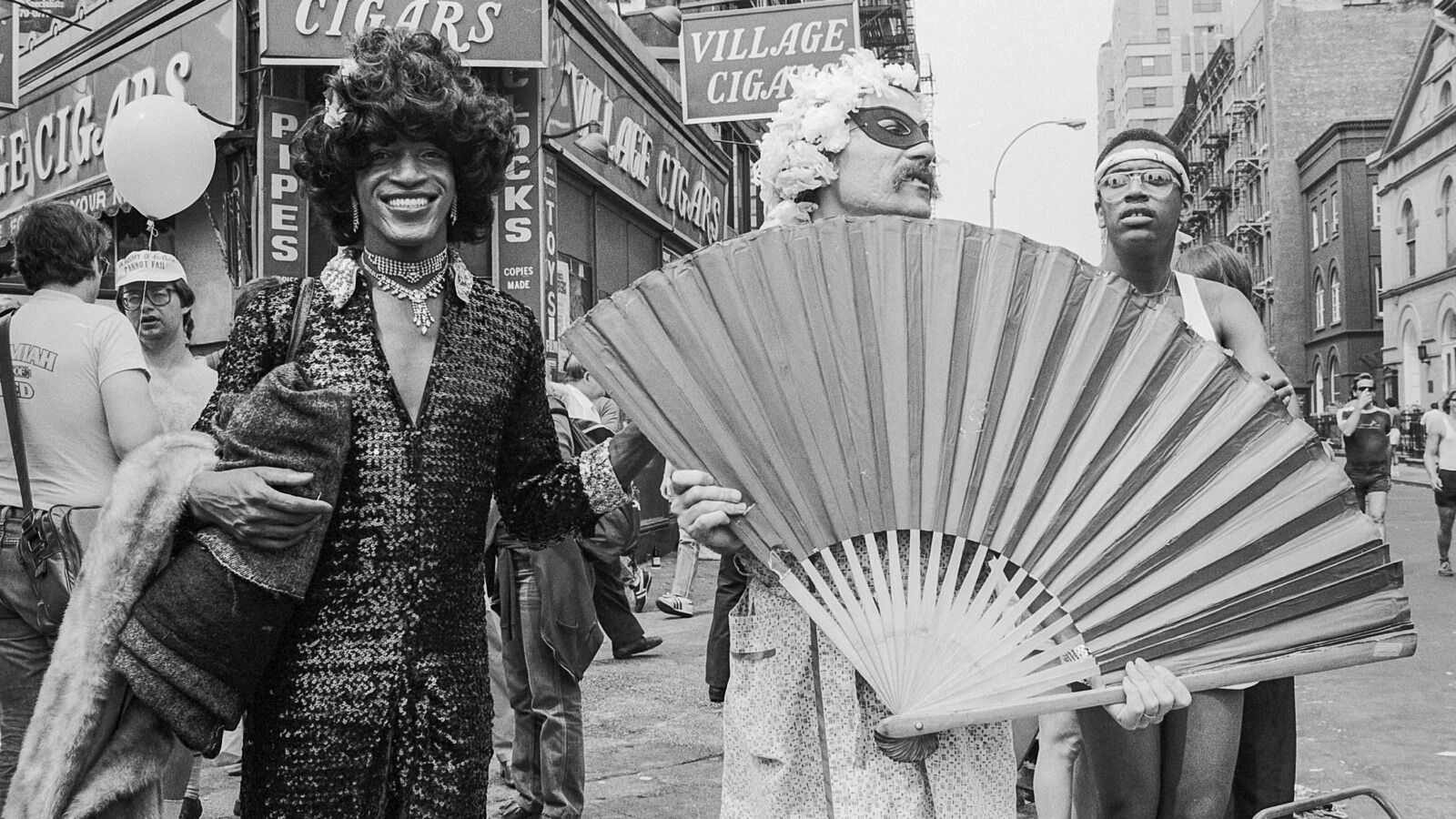
On January 24, 1989, Marsha P. Johnson sat in her friend Randy Wicker’s home in Hoboken, New Jersey, while writer Eric Marcus ran a tape recorder.
Marsha P. Johnson (1945 to 1992) was a Black drag queen, performer and gay liberation activist in New York City. She took part in the Stonewall uprising in June 1969. In 1970 she and Sylvia Rivera founded Street Transvestite Action Revolutionaries (STAR), and for two decades after that she fought for homeless queer youth, sex workers and people with AIDS.
Who Was Marsha P. Johnson? Her Name, Pronouns and Identity
Johnson was born on August 24, 1945, in Elizabeth, New Jersey, and moved to New York City in 1963. She had $15 and a bag of clothes, according to PBS NewsHour, and turned to sex work. Police sometimes arrested her just for wearing makeup in public.
She often told people the P stood for “pay it no mind.” A 2012 documentary took that as its title. In a 1979 interview with cultural historian Steven Watson, published in full by Interview in 2025, she said her Aunt Dorrie used to say it stood for “Piola.”
Today she is widely remembered as a pioneering Black trans activist. In her own time, she used words including drag queen, gay man, queen and “transvestite,” a term that is now dated. The NYC LGBT Historic Sites Project notes that she used both male and female pronouns. This article uses she/her.
Marsha P. Johnson at Stonewall: Her Own Account
Johnson told Marcus she was at a party uptown when the trouble started and didn’t get downtown until about 2 a.m., after the fighting began. On the same tape she calls herself one of the first drag queens to go to the Stonewall and mentions a police raid the night before. PBS NewsHour’s 2023 profile says she was wrongly credited with throwing the first brick.
Her account describes taking part once the uprising was underway. It doesn’t support the first-brick story, but it does place her among the people who confronted police. Her work afterward is much better documented than the identity of whoever threw the first object.
What the Record Shows About Marsha
| Question | What the sources show |
|---|---|
| Did she start Stonewall? | She said she arrived after the fighting began. |
| Did she take part? | Her recorded account describes joining the uprising. |
| Did she co-found STAR? | Yes, with Sylvia Rivera in 1970. |
| Did the P mean “pay it no mind”? | That was her familiar answer. She also told an interviewer about her aunt calling it “Piola.” |
| Was her death established as suicide? | No. The initial ruling was later changed to undetermined. |
STAR, Sylvia Rivera and the House on East Second Street
Johnson took part in the Gay Liberation Front and the Gay Activists Alliance. Those early liberation groups helped carry the energy of Stonewall into organizing beyond the bar. The uprising is also the reason Pride Month falls in June.
Johnson and Rivera founded Street Transvestite Action Revolutionaries, or STAR, in the fall of 1970. From November 1970 until July 1971, they ran STAR House at 213 East Second Street, providing a home for young street queens. The NYC LGBT Historic Sites Project documents the address and dates.
The New York Public Library’s Marsha P. Johnson and Sylvia Rivera Collection includes photographer Diana Davies’ pictures from a 1971 gay rights demonstration in Albany. In one, Johnson grins while holding a sign reading “STAR People are Beautiful People.” The records are viewable through the Digital Transgender Archive.
Hot Peaches, Andy Warhol and Saint Marsha
She sang and acted with Hot Peaches, a drag theater troupe founded in 1972 by Jimmy Camicia. NYU’s archive of the company includes photographs and other records of her performances. In 1975 she sat for Andy Warhol’s Ladies and Gentlemen series; the Whitney Museum identifies her portrait. PBS recalls another name people gave her: Saint Marsha.
HIV, ACT UP and the AIDS Crisis Years
During the AIDS crisis, Johnson raised money and awareness and cared for sick friends, PBS reports. She was herself living with HIV. The National Museum of African American History and Culture also records her involvement with ACT UP. Her activism included both public protest and the everyday work of looking after people.
Her Death in the Hudson in 1992
On July 6, 1992, Johnson’s body was pulled from the Hudson River near the Christopher Street pier. She was 46. Her death was initially ruled a suicide, and many of her friends never accepted that.
The ruling was changed to undetermined that December, according to the NYC LGBT Historic Sites Project. The case was reopened in 2012, and when PBS NewsHour revisited her story in 2023, it was still unsolved.
Marsha P. Johnson State Park and Her Legacy Today
On August 24, 2020, which would have been her 75th birthday, New York renamed Brooklyn’s East River State Park in Williamsburg as Marsha P. Johnson State Park. The seven-acre waterfront park was the first New York state park named for an LGBTQ person, according to the NYC LGBT Historic Sites Project.
The Marsha P. Johnson Institute advocates for Black transgender people. Johnson’s story has also reached audiences through documentaries including Pay It No Mind and The Death and Life of Marsha P. Johnson. Happy Birthday, Marsha! (2018), by Tourmaline and Sasha Wortzel, stars Mya Taylor in an imagined account of the hours before Stonewall. It is a dramatization, not documentary evidence of how the uprising began. Tourmaline’s biography Marsha: The Joy and Defiance of Marsha P. Johnson followed in 2025.
Marsha P. Johnson Quotes You Can Actually Source
- On Stonewall: “I didn’t get downtown until about two o’clock.” Making Gay History, 1989.
- On rights: “You never completely have your rights, one person, until you all have your rights.” PBS NewsHour archival audio, 2023.
Marsha FAQ: The First Brick, the P and Her Death
Did Marsha P. Johnson throw the first brick at Stonewall?
Her own account doesn’t support that claim. She told Eric Marcus in 1989 that she was at a party uptown and got downtown around 2 a.m., after the uprising had started.
What does the P in Marsha P. Johnson stand for?
She often said it stood for “pay it no mind.” In a 1979 interview, she said her aunt used to say it stood for “Piola.”
How did Marsha P. Johnson die?
Her body was found in the Hudson River on July 6, 1992. The initial suicide ruling was changed to undetermined that December. PBS NewsHour reported the case still unsolved in 2023.
Was Marsha P. Johnson transgender?
She is widely remembered as a pioneering Black trans activist. She used several terms for herself, including drag queen and gay man, and both male and female pronouns. Those historical terms are part of her story, alongside her place in the movement for transgender rights.
What is Marsha P. Johnson known for?
She’s best known for the 1969 Stonewall uprising and for founding STAR with Sylvia Rivera in 1970. Later she cared for sick friends during the AIDS crisis.


