


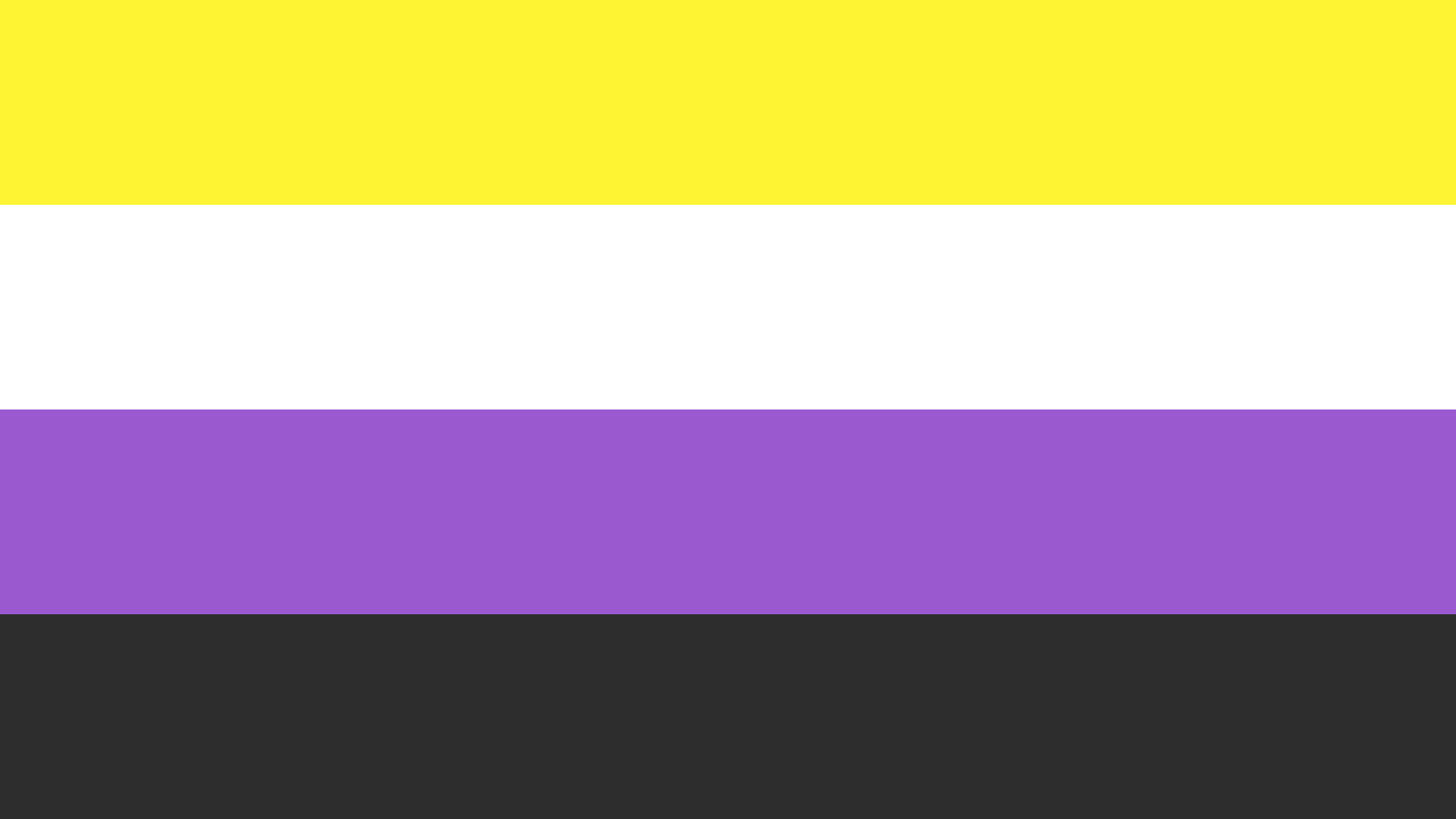
The nonbinary Pride flag has four equal horizontal stripes: yellow, white, purple and black, from top to bottom. The colors represent different experiences of gender, including identities outside the man-woman binary and having no gender at all.
Outright International credits Kye Rowan with creating the flag in 2014. You may also see it called the enby flag. Here is how to read its colors, distinguish it from the genderqueer flag and use it yourself.
Nonbinary Flag Colors and What Each Stripe Means
Start with the yellow stripe and work down. Yellow represents gender outside the man-woman binary. White makes room for people with many or all genders. Purple represents a combination of man and woman, while black represents having no gender.

| Stripe | Color | Who it represents | Hex code |
|---|---|---|---|
| 1 (top) | Yellow | People whose gender exists outside the binary | #FFF433 |
| 2 | White | People with many or all genders | #FFFFFF |
| 3 | Purple (lavender) | People whose gender is a mix of man and woman | #9B59D0 |
| 4 (bottom) | Black | People without a gender, including agender people | #2D2D2D |
Nonbinary is an umbrella term. It does not mean everyone shares one gender or sits halfway between man and woman. The stripes recognize several experiences within that umbrella.
Nor do you have to choose a personal stripe before flying the flag. Someone who is agender might use this flag, an agender flag, both or neither. Ask about their preference rather than trying to assign one.
Picking Colors for a Print or Digital Graphic
The hex codes in our graphic provide one commonly used digital palette. They are useful when making a poster, a social graphic or a background. They do not guarantee that a printer will reproduce the colors exactly.
Color references also differ slightly. Flag Color Codes lists #FCF434 for yellow, #FFFFFF for white, #9C59D1 for purple and #2C2C2C for black. Those small differences are easy to miss on a screen.
For a design project, pick one palette and use it throughout. Order a printed proof before committing to a large batch. Check the stripe order, too: yellow belongs at the top when the flag is displayed horizontally.
Kye Rowan Created the Nonbinary Flag in 2014
Rowan’s four-stripe design dates to 2014. The lavender, white and green genderqueer flag already existed by then. The newer flag gave nonbinary people another symbol to use; both designs are still around.
The nickname “enby” comes from saying the letters N and B aloud. It is informal shorthand for nonbinary. Seeing “enby flag” on a shop listing does not mean you have found a different design.
For more on the identity behind the flag, read our nonbinary meaning guide. A flag can tell you which community someone wants to recognize. It cannot tell you all the words they use for themselves.
How the Nonbinary Flag Differs From the Genderqueer Flag
The quickest visual clue is the stripe count. The nonbinary flag has four. Marilyn Roxie’s genderqueer flag has three: lavender, white and dark chartreuse green.
Outright’s flag guide explains the genderqueer design’s symbolism. Lavender combines blue and pink to represent androgyny and queerness. White represents agender identity. Green, opposite lavender on the color wheel, represents identities outside the binary.
In a 2019 interview about the design, Roxie dates the first version to September 2010. The design was finalized in 2011. Roxie describes trying several arrangements, including one with black instead of white, before settling on the familiar palette.
| Flag | Designer | Year | Stripes, top to bottom |
|---|---|---|---|
| Genderqueer | Marilyn Roxie | 2011 (first draft 2010) | Lavender, white, dark chartreuse green |
| Nonbinary | Kye Rowan | 2014 | Yellow, white, purple, black |
The names need some care as well. The Trans Journalists Association describes genderqueer as similar to nonbinary, but not a synonym. Use the word someone gives you. A shared color or a similar definition is no reason to swap their label.
How to Display the Nonbinary Flag or Use It in a Message
An ally can display the nonbinary flag to show support. Buying one for somebody else calls for a little more thought. Ask which flag they like before choosing the gift. Our Pride flag guide also covers agender, genderfluid and other designs.
For a text message, colored hearts offer a simple workaround: 💛🤍💜🖤. Unicode’s current emoji list has no dedicated nonbinary flag. In March 2022, Unicode emoji chair Jennifer Daniel explained the flag-emoji policy and suggested colored hearts as an alternative.
Unicode’s current submission guidelines still exclude flag proposals. New flags tied to officially assigned ISO region codes follow a separate automatic process. A custom image or sticker may work in a particular app, but it is not a standard emoji that travels between platforms.
Nonbinary Flag Meaning FAQ
What do the nonbinary flag colors mean?
Yellow stands for gender outside the binary; white, for many or all genders. Purple represents a mix of man and woman. Black represents having no gender, including agender identity.
Who designed the nonbinary flag?
Kye Rowan created it in 2014. The four equal stripes run yellow, white, purple and black from top to bottom.
Is the nonbinary flag the same as the genderqueer flag?
No. The nonbinary design has four stripes, including yellow and black. Marilyn Roxie’s genderqueer flag has three: lavender, white and green. The familiar genderqueer design dates to 2011.
Is there a nonbinary flag emoji?
There is no dedicated nonbinary flag emoji. Four hearts in the flag’s color order, 💛🤍💜🖤, can stand in for it.
When is International Non-Binary People’s Day?
International Non-Binary People’s Day falls on July 14. The day recognizes nonbinary people and the diversity of their experiences.


