


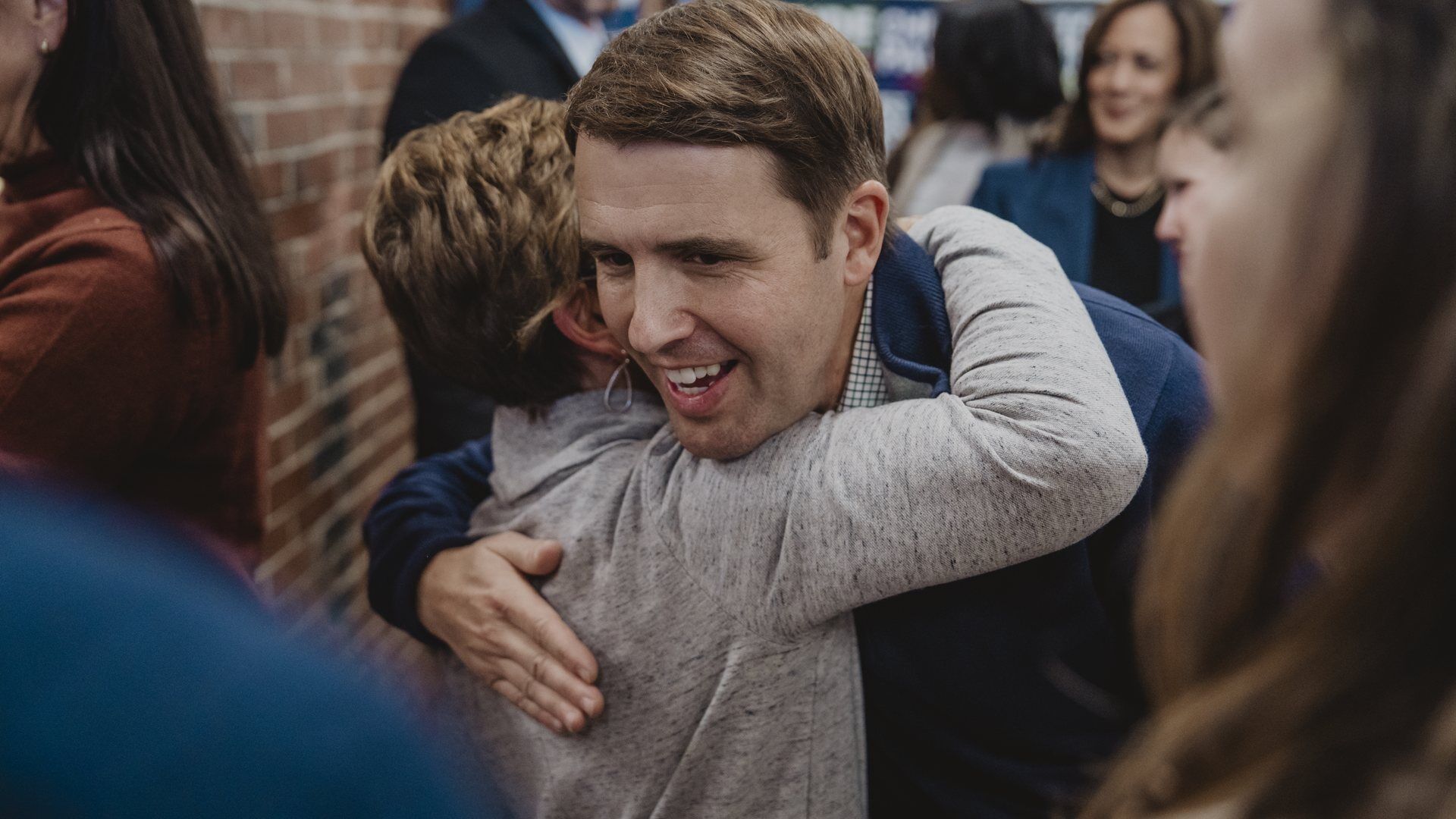
Rep. Chris Pappas could become the first openly gay man elected to the U.S. Senate on Election Day 2026, Tuesday, Nov. 3. Virginians will also decide Question 2, which would take the state’s 2006 same-sex marriage ban out of its constitution. (Polling places and rules are at vote.gov.)
Voters in Missouri, Colorado, Washington, Arizona and Nebraska will weigh measures aimed at transgender minors and student athletes. Trans athlete bans have never gone to a statewide vote before this year, the Associated Press reported. “What is happening in 2026 is a testing ground for the future,” said Chris Melody Fields Figueredo, executive director of the Ballot Initiative Strategy Center.
New Hampshire Senate: Chris Pappas vs. John E. Sununu
“We expect this thing will go down to the wire,” Pappas said last month, NBC Boston reported.
Sen. Jeanne Shaheen, who’s retiring, took the seat from Republican John E. Sununu in 2008. Now Sununu wants it back. “He’s had Kamala Harris campaign for him, Gavin Newsom, and these are the left wing of the left wing,” Sununu said, according to the station.
A Saint Anselm College poll taken Oct. 19 and 20 had Pappas up 50% to 43% among likely voters. The online survey included 1,672 likely voters and had a margin of error of plus or minus 2.4 percentage points.
“In more than two centuries, not one openly gay man has been elected to the United States Senate,” Evan Low, president and CEO of the LGBTQ+ Victory Fund, said Oct. 28.
Wisconsin Sen. Tammy Baldwin is the chamber’s only out LGBTQ+ member now. “Chris Pappas can double that,” Victory Fund board chair Joe Falk said. Pappas became New Hampshire’s first openly gay member of Congress in 2018.
Virginia Question 2 and Vermont’s Proposal 4 Head to Voters
“It means a lot to me because I have many friends who are married under the shadow of that ban,” Gov. Abigail Spanberger said Saturday at Babes of Carytown, a Richmond lesbian bar. She joined the Human Rights Campaign and Equality Virginia to launch a turnout drive, WTVR reported.
View this post on Instagram
Virginians approved the ban in 2006. Obergefell v. Hodges left it unenforceable in 2015, but it would spring back if the Supreme Court reversed that ruling, the state’s official explanation says. Question 2 would replace it with a right to marry for two adults, regardless of “sex, gender, or race.”
“It would speak to the fact that when given the opportunity to right a past wrong of our Commonwealth, that the people of Virginia take it,” Spanberger said.
Opponents say Question 2 reaches past marriage by naming sex and gender separately, WTVR reported. Former Lt. Gov. Winsome Earle-Sears has urged a no vote. “There are no protections for those who have deeply held religious beliefs,” she said, Cardinal News reported in August.
Ben Purves, a pastor at Occoquan Bible Church in Prince William County, has sued to stop the question, backed by the Founding Freedoms Law Center. “It doesn’t belong to us to reshape it in whatever way we would like,” he said of marriage, FOX 5 DC reported. The suit won’t reach a judge before Tuesday, the station said.
Vermont’s Proposal 4 would add an equal protection clause to the state constitution covering sexual orientation, gender identity and gender expression, among other traits. “It’s taken 10 years to get this thing onto the ballot,” state Sen. Ginny Lyons, a Democrat, said, according to Seven Days.
Missouri Amendment 3 and Anti-Trans Ballot Measures in Five States
“I think it is critically important that Missourians very much understand that when you’re under 18 years old, you don’t have the ability to make those types of body-changing decisions,” Missouri Gov. Mike Kehoe told the Washington Examiner.
Amendment 3 would repeal the abortion rights amendment voters passed in 2024. Its ballot language ends with this: “Prohibit gender transition procedures for minors?”
A 2023 state law already bans those procedures, though its limits on puberty blockers and hormones expire in August 2027. A yes vote would make Missouri the first state with a ban on gender-affirming care in its constitution, the Missouri Independent reported. The existing ban on gender-affirming surgeries for minors has no expiration date.
Colorado’s Proposition 134 would sort school and college teams by sex. Nadine Bridges, executive director of One Colorado, opposes it. “They will say that they want to protect kids and in particular, young girls,” she said, according to the AP, “but I don’t understand how you can protect kids and discriminate against kids at the same time.” Proposition 135 would ban surgeries on minors when intended to change sex characteristics in response to the patient’s perception of sex or gender, with limited medical exceptions. It would not ban puberty blockers or hormones.

Washington’s Initiative 638 would bar transgender girls from girls’ school sports. Students seeking to play on girls’ teams would need a health care provider’s signed statement verifying their sex. Opponents warn that could mean genital exams or costly testing. “We see that as being as simple as a checkbox,” Let’s Go Washington spokesperson Hallie Herzberg said, according to the AP.
Arizona lawmakers sent voters Proposition 318, which would tie school teams, restrooms, locker rooms and shower rooms to the sex recorded on a person’s original birth certificate. “It’s really an effort to push trans people out of public life,” Darrell Hill of the ACLU of Arizona said, KOLD reported. Nebraska’s Measure 442 would put sex-designated school teams into the state constitution.
Texas has no trans measure on its ballot, but no race in the country has drawn more Republican TV ads on transgender issues than its U.S. Senate contest. AdImpact puts the tab at about $58 million in the race between Republican Ken Paxton and Democrat James Talarico, the Associated Press reported. Who sent the fake “Texas Transgender Student Union” mailers that hit Texas mailboxes in October is still an open question.
Election Day 2026’s LGBTQ+ Candidates, From Kotek to JD Ford
“This race is close, and the choice is clear,” Oregon Gov. Tina Kotek said in an Oct. 26 Victory Fund release. Oregon elected her in 2022 as one of “the first two lesbian governors in the country” (the other, for the record, is Massachusetts Gov. Maura Healey). She faces Republican state Sen. Christine Drazan.
Rhode Island attorney general nominee Kim Ahern would be the state’s first LGBTQ+ statewide officeholder, the group says. “Rhode Islanders want an attorney general with the experience to protect their rights, and I’m proud to make history doing it,” said Ahern, who faces Republican Alan Gordon.
Arizona Attorney General Kris Mayes wants a second term. “Kris Mayes won by 280 votes four years ago,” Victory Fund board member Rebecca Prozan said. The group is backing more than 450 LGBTQ+ incumbents this year.
JD Ford became the first openly gay member of the Indiana General Assembly in 2018. Now he’s challenging Republican Rep. Victoria Spartz in Indiana’s 5th District, and a win would make him the state’s first openly LGBTQ+ member of Congress, Victory Fund says. In Arizona’s 6th District, Navy and Marine Corps veteran JoAnna Mendoza is challenging Republican Rep. Juan Ciscomani. A win there would add “an out LGBTQ+ woman veteran to Congress,” the group says.
Michigan Senate: Abdul El-Sayed vs. Mike Rogers After Haley Stevens’ Endorsement
“Our Democratic nominee for Senate said I was no longer welcome in his campaign and that I should stay away,” Rep. Haley Stevens said Sunday in a video on X. “And he’s right. And that’s why I am endorsing Mike Rogers for the United States Senate today.”
Stevens lost the August Democratic primary to El-Sayed. “At the end of the day I actually don’t think about Haley Stevens,” El-Sayed said Sunday, the AP reported.
The Human Rights Campaign PAC backed El-Sayed in September. “LGBTQ+ Michiganders deserve leaders who will have their backs when it matters most, not just when it’s politically convenient,” he said in HRC’s announcement, which says Rogers scored 0 on every HRC scorecard while in the House. A WDIV/Detroit News poll taken Oct. 19 to 22 had El-Sayed ahead 51.4% to 45.1%. The Glengariff Group surveyed 600 likely voters by phone; the poll had a margin of error of plus or minus 4 percentage points.
Supreme Court Hears St. Mary Catholic Parish v. Roy Tuesday
“Colorado promised free preschool for all, then slammed the door on families who chose a religious education for their children,” Nicholas Reaves, senior counsel at Becket, which represents the parishes and families, said in April.
Colorado’s free preschool program requires schools to give kids an equal shot at a seat regardless of a family’s sexual orientation or gender identity. “Petitioners’ witnesses testified that their schools would refuse to enroll the children of same-sex parents,” the state told the justices in an August brief.
“A four-year-old shouldn’t lose their spot in preschool because of who their parents are,” says GLAD Law, which filed a brief backing Colorado with Lambda Legal.
St. Mary Catholic Parish v. Roy is the only case on the court’s Election Day calendar, and the justices take the bench at 10 a.m. Eastern. “A ruling in the case is expected next year,” the Human Rights Campaign said Oct. 26.


