


Vermont Proposal 4 passed Tuesday, Nov. 3, adding explicit LGBTQ+ equality protections to the state constitution. The Associated Press called the result just after 11 p.m. Eastern, Vermont Public reported.
The amendment bars the state from denying equal treatment based on sexual orientation, gender identity or gender expression. It builds on constitutional protections Vermont courts have already recognized.
The effective-date clause makes the amendment part of the constitution “on the first Tuesday after the first Monday of November 2026 when ratified and adopted by the people of this State.” That date is Nov. 3, 2026.
“It’s taken 10 years to get this thing onto the ballot,” Democratic state Sen. Ginny Lyons told Seven Days in October.
Proposal 4 made Gayety’s list of LGBTQ+ ballot measures to watch, and the live results hub is tracking the rest of the election results.
What Vermont Proposal 4 Protects
The new article opens with one promise: “That the people are guaranteed equal protection under the law.”
“The State shall not deny equal treatment under the law on account of a person’s race, ethnicity, sex, religion, disability, sexual orientation, gender identity, gender expression, or national origin,” it says.
Courts cannot use this article to block measures supporting equality for groups that have faced discrimination. Big Hartman, executive director and general counsel of the Vermont Human Rights Commission, explained its purpose to Seven Days. Hartman said it would keep courts from using the new clause to strike down diversity, equity and inclusion programs.
“Proposal 4 is about constitutional clarity,” the Rev. Mark Hughes, executive director of the Vermont Racial Justice Alliance, said in May, according to Vermont Public. “It’s about ensuring that equal protection under the law is explicit and also that it’s enforceable.”
Dana Kaplan, executive director of the LGBTQ+ youth group Outright Vermont, made the case for queer and trans kids in an Oct. 28 commentary for VTDigger. “Nobody should have to wonder whether their rights will be protected,” Kaplan wrote.
Lawmakers’ purpose statement says the change would make sure “that the government does not create or perpetuate the legal, social, or economic inferiority of any class of people.” Former Gov. Madeleine Kunin, Vermont’s first woman governor, spelled out who that covers.
“By extending constitutional protections to people of all races, religions, sexual orientations, gender identities, disabilities, and national origins, Vermont is affirming a simple principle: that every person deserves dignity, fairness, and equal protection under the law,” Kunin said in March, according to Vermont Business Magazine.
Vermont’s Civil Unions and Marriage Equality History
The purpose statement leans on Chapter I, Article 7, which says government is “instituted for the common benefit, protection, and security of the people.” The Vermont Supreme Court relied on that same clause in Baker v. State on Dec. 20, 1999.
“We hold that the State is constitutionally required to extend to same-sex couples the common benefits and protections that flow from marriage under Vermont law,” the justices wrote.
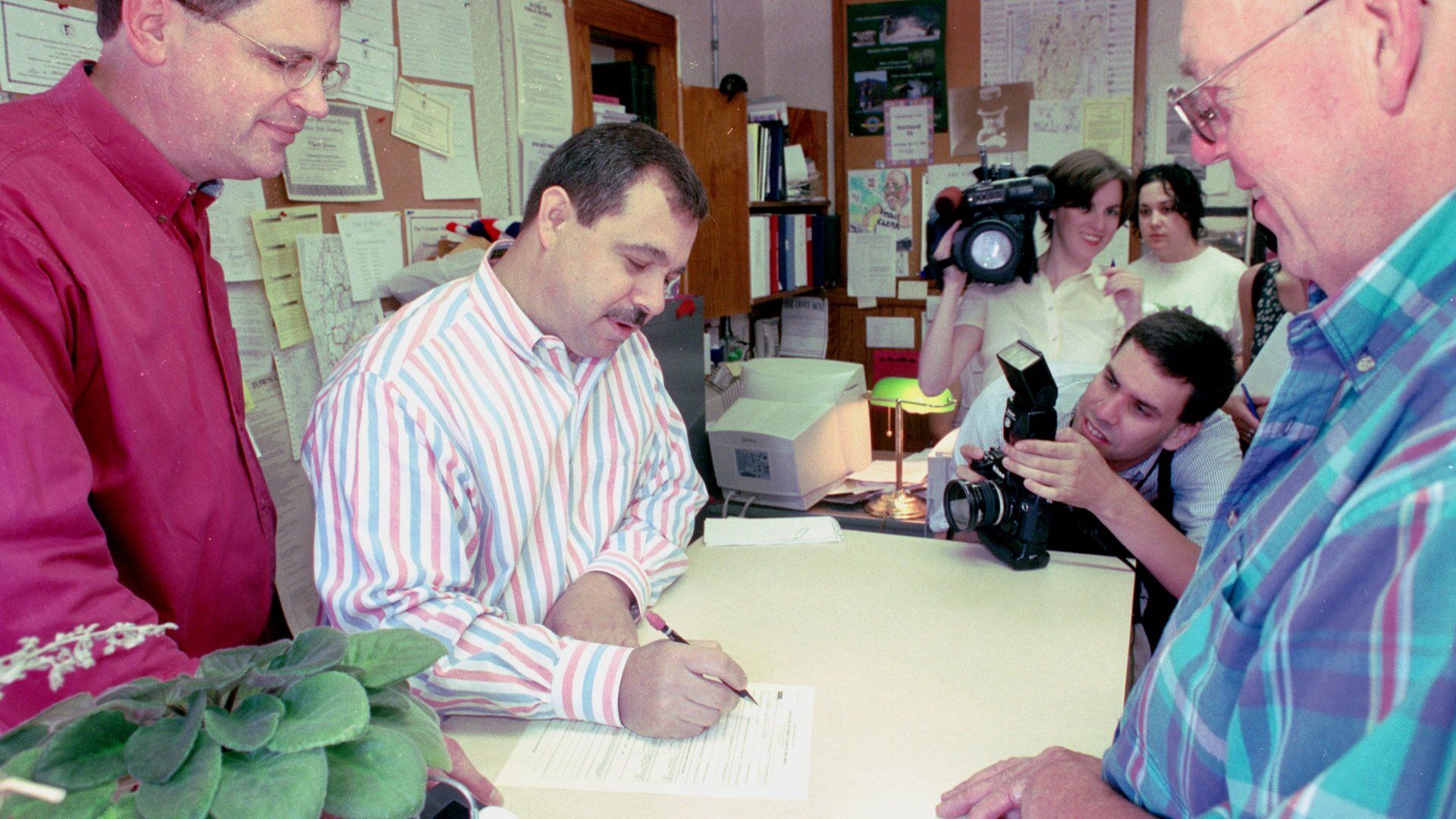
Lawmakers answered by voting for civil unions on April 26, 2000. The law gave same-sex couples all the rights and responsibilities of marriage under Vermont law. A Statehouse marker unveiled in 2017 commemorates that step. Couples from 48 states and dozens of countries traveled to Vermont for civil unions, the marker says.
“On April 7, 2009, Vermont became the first state to enact same-sex marriage through a vote of the legislature rather than through a court ruling,” the marker reads.
Stan Baker, the named plaintiff in the 1999 case, spoke at the unveiling. “If you’ve been denied a fundamental right, you know the value of that thing, and will stand up and fight for it,” Baker said, according to Vermont Public.

How Proposal 4 Reached the Ballot
Lyons traces the push to 2016, the year Donald Trump ran for president, according to Seven Days. “For decades, advocates, legislators, and Vermonters across our state worked to bring the Equal Rights Amendment to this moment,” she said in March, according to Vermont Business Magazine. A group she was part of turned first to a reproductive rights amendment, and voters approved that one in 2022, Seven Days reported.
“It’s a very heavy lift,” Rep. Conor Casey, a Montpelier Democrat, told Seven Days of amending the constitution. Vermont makes lawmakers pass a constitutional change twice, in back-to-back two-year sessions with an election in between, before voters ever see it. “It’s a heavier lift than the statutory processes of passing laws in the halls of the Statehouse, and rightfully so,” Casey said.
Lyons, Sen. Nader Hashim and Sen. Kesha Ram Hinsdale led the sponsor list in the first round. That round wrapped up in May 2024, legislative records show. The Senate approved the measure again, 29-0 on March 11, 2026.
“Today the Legislature finished an important piece of work, but the final decision belongs to the people of Vermont,” Hashim said. Vermont Business Magazine published his statement after the Senate vote. Hashim chairs the Senate Judiciary Committee.
The House followed, 128-14, on May 13, according to the secretary of state’s legislative history.
“Vermont’s constitution is its overriding and founding document. What is in it and what isn’t says a great deal about Vermont and our value,” Burlington Rep. Barbara Rachelson, a Democrat, said, according to Vermont Public. “The lack of an equal protection clause speaks volumes.”
Vermont voters had turned down a narrower Equal Rights Amendment, focused on sex discrimination, in 1986, when Kunin backed it as governor, Vermont Business Magazine noted. “I gave my first speech on the floor of the House in 1973 in support of the Equal Rights Amendment,” Kunin said.
Why Some Vermonters Opposed Proposal 4
Renee McGuinness, a policy analyst for the Vermont Family Alliance, argued the amendment’s last sentence works as reverse discrimination, Seven Days reported. “If you’re white, you’re now lower on the hierarchy of who gets preferential treatment,” she told the paper. In a September commentary for VTDigger, she wrote, “Proposal 4 creates a hierarchy of rights rather than protecting equal rights.”
Lyons disputed that reading. “It doesn’t mean that,” she told Seven Days. “It means we have to have a level playing field and equality across the board.”
Other opponents said Vermont didn’t need the amendment at all and raised the prospect of groups seeking reparations from the state, WCAX reported in October.
In the House, where 14 members voted no, Castleton Rep. Zachary Harvey called the proposal a symptom of “woke-ism,” according to Vermont Public. “This is very much part of a cultural zeitgeist that is currently falling out of vogue, and that not many people are really subscribing to,” he said.
What Happens Next Under Vermont’s Equal Protection Amendment
Legal experts and advocates alike didn’t expect a big change right away, Vermont Public reported in May. Hartman said the Vermont Supreme Court is where the language would be “tested out and interpreted,” according to the station.
Some constitutional experts questioned the amendment’s list approach, which names some traits and leaves out others, such as age, VTDigger reported Tuesday night.
The amendment changes Vermont’s constitution; it does not change federal law. “We are living at a time when we cannot take for granted that the legal and social gains made for equality based on sex or any other class will stand,” Cary Brown, executive director of the Vermont Commission on Women, told lawmakers, according to Vermont Public.
Hughes pitched the amendment as a more “durable civil rights policy,” with Vermont facing what he called “one of the most hostile federal civil rights environments since the 19th century,” the station reported.
“Equal protection must mean something in the places where people live,” Hughes said at a Burlington event in September, WCAX reported. “Where they work, where they learn, where they build businesses, seek housing, acquire property and capital, raise their families and attempt to build something to leave behind for their children.”


