


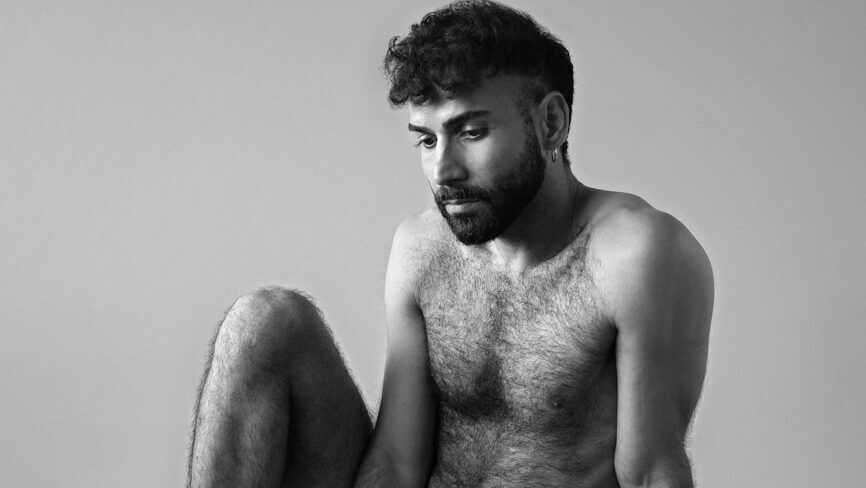
Yves Torfs doesn’t photograph the male body to idealize it. He photographs it to study it, patiently, deliberately, and without interference. His images don’t rely on shock value or excess. Instead, they linger in the quiet space between exposure and restraint, where the smallest details do the heaviest lifting.
The Belgian visual artist has carved out a signature approach that strips away artifice and replaces it with intimacy. His portraits feel less like performances and more like moments you weren’t supposed to interrupt. Every crease of skin, every tension held in a shoulder or jawline, is allowed to exist as it is. There’s nothing flashy about the work, and that’s exactly why it lands.
What draws me in most is how unforced his images feel. Torfs doesn’t chase perfection or exaggeration. He lets the body sit in its own truth, then meets it there.


Rooted in Art, Drawn to Reflection
Torfs grew up in a small rural town near Antwerp, surrounded by creativity that leaned toward tradition rather than trend. A painter grandfather. A father who sketched for pleasure. A mother trained in graphic design and photography. Art wasn’t presented as a spectacle, it was part of daily life.
Cameras entered his world early, both in front of and behind the lens. His mother photographed constantly. His father loved cinema. For a time, Torfs imagined himself directing films, but photography offered something more immediate: a direct line to self-examination.
By 18, he committed to formal studies in photography and visual arts in Antwerp. What followed wasn’t just technical refinement, but a deeper engagement with identity, perception, and control, themes that remain central to his practice.

Structure as Freedom
Torfs’ work is deeply shaped by his experience living with Autism Spectrum Disorder. Rather than treating that as a limitation, he builds his creative process around it. Fixed camera positions. Repeated actions. Controlled sequences.
This repetition isn’t rigid, it’s grounding.
By returning to the same setup again and again, Torfs creates a visual language that prioritizes focus. The consistency allows subtle differences to emerge: posture, presence, tension, vulnerability. When everything else stays the same, the human element becomes impossible to ignore.
His self-portraits, especially, read as ongoing conversations with himself. They aren’t declarations. They’re questions.

‘Projekt Y’ and the Power of Ritual
That sense of ritual is clearest in Projekt Y, Torfs’ ongoing series centered on the male body through figure studies and portraiture. Each session begins the same way: the model seated on a specific church chair, positioned in identical light, performing the same action, looking left.
From there, Torfs captures a second image focused solely on the face, eyes forward. Only after those anchors are set does the session expand into body details, full-frame compositions, and references to classical art.
The chair isn’t decorative. It introduces an unavoidable tension between religion and queerness, tradition and presence. What fascinates me is how quietly that tension exists, it’s never explained, only felt.

Bodies, Without Casting Calls
Diversity in Torfs’ work doesn’t arrive through rigid planning. It happens because he keeps the door open.
Models of different ages, sizes, and shapes enter the series organically, often reaching out themselves. That willingness matters. It means the people in front of the lens aren’t being “used” to fill a concept — they’re choosing to be there.
There’s something refreshing about that exchange. It keeps the work human, not transactional.
Art, Censorship, and Context Loss
Like many artists working with nudity, Torfs constantly navigates social media restrictions. While he understands the need for moderation, the limitations often flatten his work, stripping images of their context and intention.
Short-form platforms demand speed. His work demands time.
An image meant to live within a series loses its weight when isolated in a scroll. That disconnect frustrates him, and honestly, it should frustrate viewers too. These photos aren’t meant to be consumed in seconds.
Between Nude and Erotic
Torfs doesn’t draw hard lines between artistic nude photography and pornography, and I appreciate that refusal. Both, he argues, can be composed with care and intention. The difference lies in what’s being emphasized.
His focus remains on form, light, and quiet sensuality. Daylight softens the body, making it feel lived-in rather than staged. Even when his work brushes against eroticism, it never tips into excess.
It stays observational. Poetic. Grounded.

What Remains
Photography has pushed Torfs out of isolation and into conversation. Each shoot becomes a dialogue, sometimes verbal, sometimes silent, between artist and subject.
The first nude photograph he ever took was a self-portrait in 2016. He sat on a chair. The setting stayed the same. The project, in many ways, started there.
What he hopes viewers take away is simple: reflection. An expanded understanding of beauty that includes variation rather than erasing it. In a media landscape obsessed with narrow ideals, especially within queer spaces, Torfs’ work quietly pushes back.
And that quiet resistance is where its power lives.
To see the full gallery and explore more stories like this, Gayety’s Substack has you covered.


