




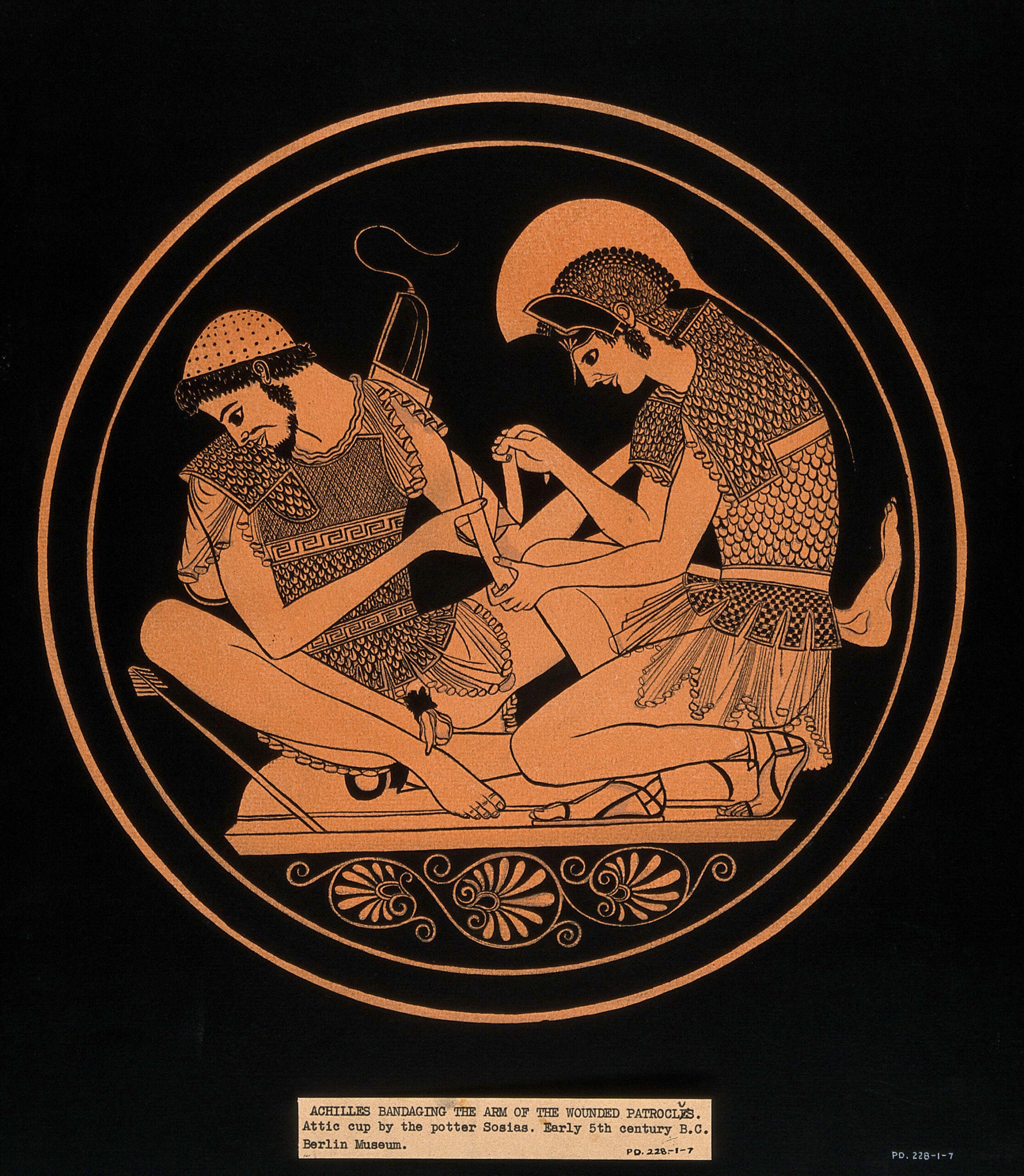
Homer’s Iliad never says whether Achilles and Patroclus were lovers. It calls Patroclus Achilles’ dearest companion. Achilles grieves him harder than he’d grieve his own father or son, and the two ask to share one burial urn. The poem does not explicitly describe them as sexual or romantic partners.
The Greeks who came after Homer argued about it for centuries. The playwright Aeschylus and the philosopher Plato both wrote the pair as lovers. The orator Aeschines said Homer hid their love on purpose. Xenophon insisted they were comrades and nothing more. Modern classicists still split, and Madeline Miller built the love story in her novel “The Song of Achilles” on the ancient romantic reading.
Achilles and Patroclus at a Glance
| Question | Short answer | Where it comes from |
|---|---|---|
| Who was older? | Patroclus | Iliad 11.786 to 787 |
| How did they meet? | Patroclus was sent to Achilles’ father, Peleus, as a boy after killing another child | Iliad 23.84 to 90 |
| What does Homer call Patroclus? | Hetairos, a companion or comrade | Iliad 18.80, 19.315 |
| Who kills Patroclus? | Apollo, Euphorbus and Hector together | Iliad 16.784 to 857 |
| Are they buried together? | Yes, bones mixed in one golden urn | Odyssey 24.76 to 77 |
| Early text that makes them lovers | Aeschylus’ lost play “Myrmidons,” fifth century BCE | Fragments quoted by later writers |
What the ‘Iliad’ Actually Says About Achilles and Patroclus
Iliad line numbers here follow the standard Oxford Greek text, edited by David B. Monro and Thomas W. Allen. It’s the edition the Perseus Digital Library uses. The English quotes are Samuel Butler’s, from his public-domain prose translations on Project Gutenberg of the Iliad and the Odyssey.
Book 11, lines 785 to 789. “Achilles is of nobler birth than you are, but you are older than he,” Menoetius told his son Patroclus when he left for Troy. The old counselor Nestor repeats it to Patroclus as a reminder. The father had also told him to guide Achilles with good advice.
Book 16, lines 784 to 857. Patroclus goes into battle wearing Achilles’ armor. The god Apollo strikes him and knocks the armor loose. The Trojan Euphorbus spears him in the back, and Hector finishes him. Dying, Patroclus tells Hector he was only the third to kill him.
Book 18, lines 80 to 82. When the news reaches Achilles, he tells his mother, the goddess Thetis, that Patroclus was the man “whom I valued more than all others, and loved as dearly as my own life.” In Greek it’s “ἶσον ἐμῇ κεφαλῇ,” literally “equal to my own head.”
Book 19, lines 315 to 327. Achilles won’t eat. No worse grief could reach him, he tells the dead Patroclus, “not even though I were to hear of the death of my father,” or of his son Neoptolemus.
Book 23, lines 83 to 92. Patroclus’ ghost comes to Achilles in a dream and asks for one thing: “let not my bones be laid apart from yours, Achilles, but with them; even as we were brought up together in your own home.” He recalls killing the son of Amphidamas as a child in a fight over a game. (Butler says dice. The Greek word means knucklebones.) He asks to share the golden two-handled jar Thetis gave her son.
Book 24, lines 3 to 13. Days later, Achilles still can’t sleep. He “yearned after the might and manfulness of Patroclus,” in Butler’s version, and wandered the shore at dawn.
Odyssey Book 24, lines 72 to 79. In the underworld, Agamemnon’s ghost tells Achilles how the Greeks buried him. They “mingled your bleached bones with those of Patroclus,” he says. Antilochus’ bones were kept separately.

What Homer Leaves Out, or Points Elsewhere
Both men get women in the poem. In Book 9, lines 663 to 668, Achilles “slept in an inner room, and beside him the daughter of Phorbas lovely Diomede.” Across the room, Patroclus lay with Iphis, a woman Achilles had given him. And the quarrel that drives the whole epic starts when Agamemnon takes Briseis, a captive woman, from Achilles.
Thetis, in Book 24, lines 128 to 131, scolds her grieving son for thinking “neither of food nor of woman’s embraces,” in Butler’s translation.
| The Iliad says | The Iliad doesn’t say |
|---|---|
| Patroclus is Achilles’ dearest companion (19.315) | That they were lovers |
| Patroclus is older (11.787) | Which one was the lover and which the beloved |
| Achilles’ grief outranks grief for his father or son (19.321 to 327) | Any kiss or sex between them |
| Their bones should share one urn (23.91 to 92) | That they were cousins |
| Both men sleep beside captive women (9.663 to 668) | That those relationships rule out love between the men |
Aeschylus’ Lost ‘Myrmidons’ and the ‘Many Kisses’ Fragment
Aeschylus wrote one of the oldest surviving texts to make them lovers, a fifth-century BCE tragedy called “Myrmidons” after Achilles’ soldiers. The play is lost. Later authors quoted a few lines, including the scene where Achilles stands over Patroclus’ body.
“No reverence hadst thou for the unsullied holiness of thy limbs, oh thou most ungrateful for my many kisses!” Achilles says, in Herbert Weir Smyth’s 1926 translation of the fragments. Athenaeus kept the line alive by quoting it in his “Deipnosophists” (13.602e), and Plutarch echoes it. Smyth’s “limbs” is polite. The Loeb translation of the same Athenaeus passage is blunter: “For the pure honour of the thighs thou hadst no reverence.” Fordham’s Internet History Sourcebooks posts it.
Plato’s ‘Symposium’: Phaedrus Flips Achilles’ Role
Plato’s “Symposium” (179e to 180a), from the fourth century BCE, takes the pair as lovers and fights only over who played which part. The speaker Phaedrus says Aeschylus got it wrong. Making Patroclus the beloved is “a foolish error into which Aeschylus has fallen, for Achilles was surely the fairer of the two,” he says in Benjamin Jowett’s translation. Citing Homer, Phaedrus argues Achilles was beardless and much younger.
Those roles came from Athenian pederasty, a relationship between an adult man and a younger male, with set expectations about age and status. It doesn’t map neatly onto a modern gay couple.
Aeschines and Xenophon Read Homer in Opposite Ways
Aeschines, the Athenian orator, took the romantic side in his prosecution speech “Against Timarchus” (1.142). Homer “hides their love and avoids giving a name to their friendship,” he told the court, and trusts educated listeners to understand. That’s Charles Darwin Adams’ 1919 translation, posted by ToposText.
Xenophon’s Socrates disagreed, in Xenophon’s own “Symposium” (8.31). Homer made Achilles avenge Patroclus “not as his favourite, but as his comrade,” in H.G. Dakyns’ translation.
| Ancient source | Date | Reading of the pair |
|---|---|---|
| Homer, “Iliad” | Before the fifth century BCE | Devoted companions, no stated romance |
| Aeschylus, “Myrmidons” | Fifth century BCE | Lovers, with Achilles as the lover |
| Plato, “Symposium” | Fourth century BCE | Lovers, with Achilles as the younger beloved |
| Aeschines, “Against Timarchus” | Fourth century BCE | Lovers, with Homer hiding it on purpose |
| Xenophon, “Symposium” | Fourth century BCE | Comrades only |
Later men took the pair as a model. At Troy, Alexander the Great laid a garland on Achilles’ tomb, “and it is said that Hephaestion decorated that of Patroclus in the same way,” the historian Arrian wrote in his “Anabasis” (1.12.1), in E.J. Chinnock’s translation. Gayety’s piece on Alexander and Hephaestion goes further.
How Classicists Read Achilles and Patroclus Today
Scholars today still divide, and their readings are interpretation, not settled fact. In “Achilles in Love” (Oxford University Press, 2012), classicist Marco Fantuzzi argues the Iliad shows “a friendship of constancy and great depth of feeling, not however an explicitly erotic relationship,” as reviewer Benjamin Acosta-Hughes summed it up for Bryn Mawr Classical Review. The erotic reading “could be read back into Homer in later periods,” the review says.
Ancient historian Cezary Kucewicz, writing for the myth-checking site Bad Ancient, says the reason for the bond “is not made explicit by Homer.” Even so, “its passion and emotional intensity led subsequent authors to suspect that there was a homoerotic element to it.”
Miller, who studied and taught classics, reads the text more warmly. “There is a lot of support for their relationship in the text of the Iliad itself, though Homer never makes it explicit,” she says on her author website. She points to Achilles keeping Patroclus’ body in his tent and embracing it.
Were Achilles and Patroclus Cousins? What ‘Troy’ Changed
In Wolfgang Petersen’s 2004 film “Troy,” Garrett Hedlund’s Patroclus is the younger cousin of Brad Pitt’s Achilles. Kucewicz says that choice likely removed hints of romance.
Homer never calls them relatives. Ancient family trees do connect them through the nymph Aegina, which would make them first cousins once removed. One tradition attributed to the poet Hesiod makes Menoetius the brother of Peleus, Kucewicz writes. He rates the cousin claim “misleading” and calls those traditions “extremely marginal and insignificant.”
‘The Song of Achilles’ and Its BookTok Revival
“Homer would be proud of her,” judging chair Joanna Trollope said when Madeline Miller’s debut novel won the 2012 Orange Prize for Fiction (now the Women’s Prize), according to the Women’s Prize. “The Song of Achilles” came out in 2011. Patroclus narrates it, telling his love story with Achilles from boyhood to Troy.
Miller took the romance from the ancient sources. “I stole it from Plato!” she says on her website. In 2012 she told the Washington Independent Review of Books what drew her in: “Homer doesn’t tell us why he means so much to Achilles, only that he does.”
Nearly a decade later, TikTok sent it back up the charts. Barnes & Noble started seeing sales spikes in summer 2020. Its Shannon DeVito called the novel one of BookTok’s “juggernauts,” NBC News reported in 2021. The book sold 650,000 copies in the U.S. in 2021, the No. 4 adult fiction title of the year, according to NPD BookScan figures reported by Tubefilter. Achilles also lends his name to “Achillean,” a modern community word for men who love men. Gayety’s guide to WLW and MLM explains it.
In that 2012 interview, Miller described Patroclus’ outlook as “closer to Sappho than Homer,” a nod to the poet in Gayety’s guide to Sappho.
Achilles and Patroclus FAQ
Were Achilles and Patroclus lovers in the ‘Iliad’?
Homer never says so. The Iliad shows deep devotion and a shared burial, but no kiss, sex or stated romance. Aeschylus, Plato and Aeschines later read them as lovers. Xenophon saw comrades.
Who was older, Achilles or Patroclus?
Patroclus, according to Iliad 11.786 to 787. Plato’s Phaedrus agreed that Homer made Achilles “younger far,” in Jowett’s translation.
How did Patroclus die?
Wearing Achilles’ armor, in Iliad Book 16. Apollo stunned him, Euphorbus wounded him and Hector killed him.
What does Achilles say when Patroclus dies?
He tells Thetis he loved Patroclus “as dearly as my own life” (18.82). Then he refuses to eat (19.319 to 321) and swears to kill Hector.
Were Achilles and Patroclus buried together?
Yes. Patroclus’ ghost asks for one urn in Iliad 23.91 to 92. The Odyssey (24.76 to 77) says their bones were mixed in a golden urn.
Were Achilles and Patroclus cousins?
Not in Homer. Later genealogies make them distant relatives, and one fragment attributed to Hesiod makes them first cousins. The 2004 film “Troy” made them cousins.
Is ‘The Song of Achilles’ accurate to the ‘Iliad’?
It follows the Iliad’s main events but invents much of the backstory. And it makes the romance explicit, which Homer never does.


