




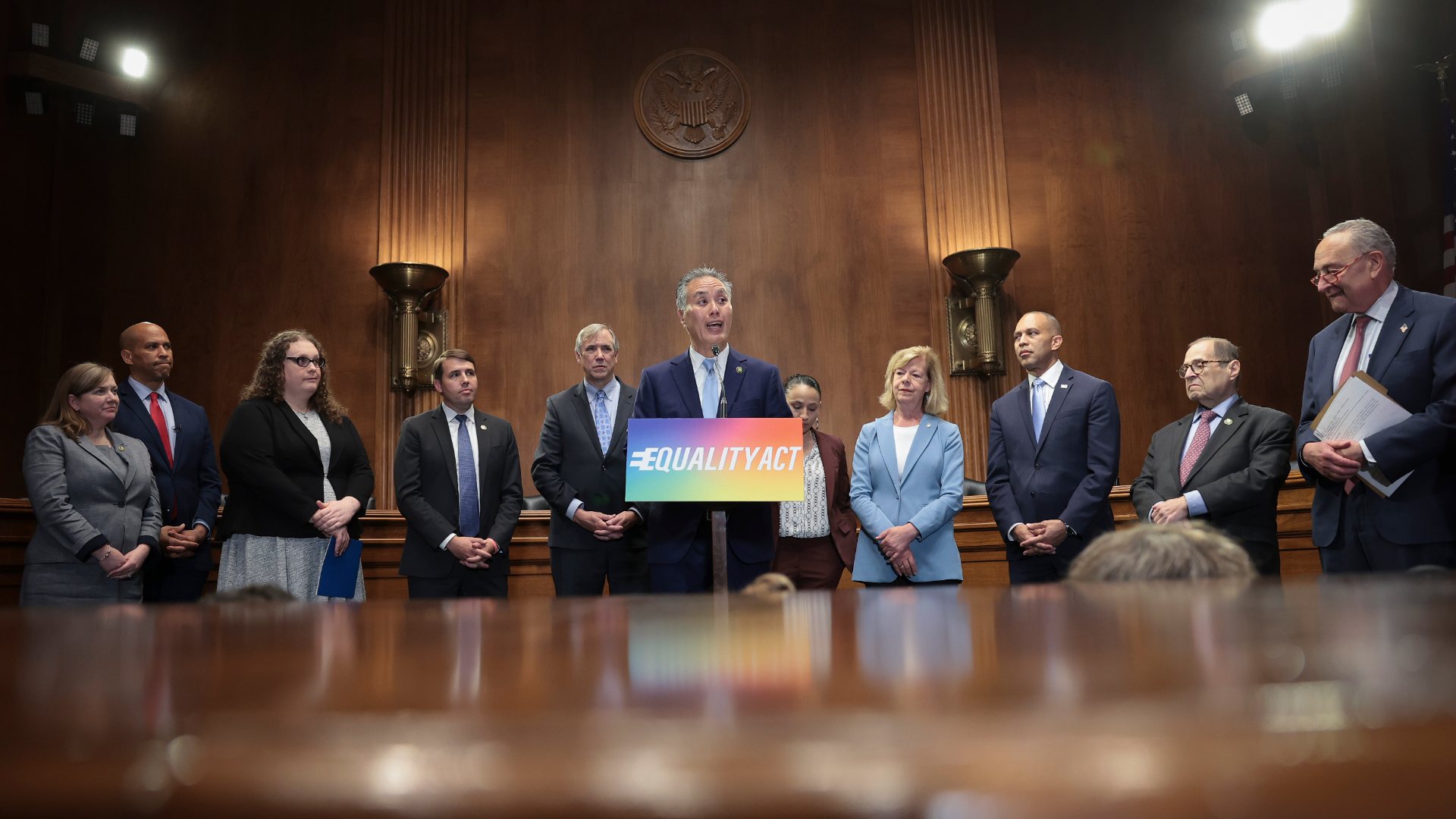
The Equality Act has passed the House twice. With Democrats winning both chambers of Congress, its supporters get another chance in January. The Associated Press called the Senate for them Tuesday night and the House by early Wednesday. “We hear you,” House Democratic Leader Hakeem Jeffries of New York said, AP reported.
The new congressional terms begin Jan. 3, 2027. Democrats can decide which bills get a hearing and a vote. Getting those bills signed into law is another matter. The Equality Act has never passed the Senate, where most legislation needs 60 votes to end debate. And Trump still has his veto.
“I have the power of the veto,” President Donald Trump said Wednesday at the White House ballroom construction site, Cronkite News reported.
Congress can override him, but that takes two-thirds of the votes in each chamber. If every member votes, Democrats would need 290 House votes and 67 senators, as Cronkite News explained. The Congressional Research Service warned in a 2021 report that for executive orders, “legislative repeals may be relatively rare due to the threat of a presidential veto.”
How Many Seats Did Democrats Win?
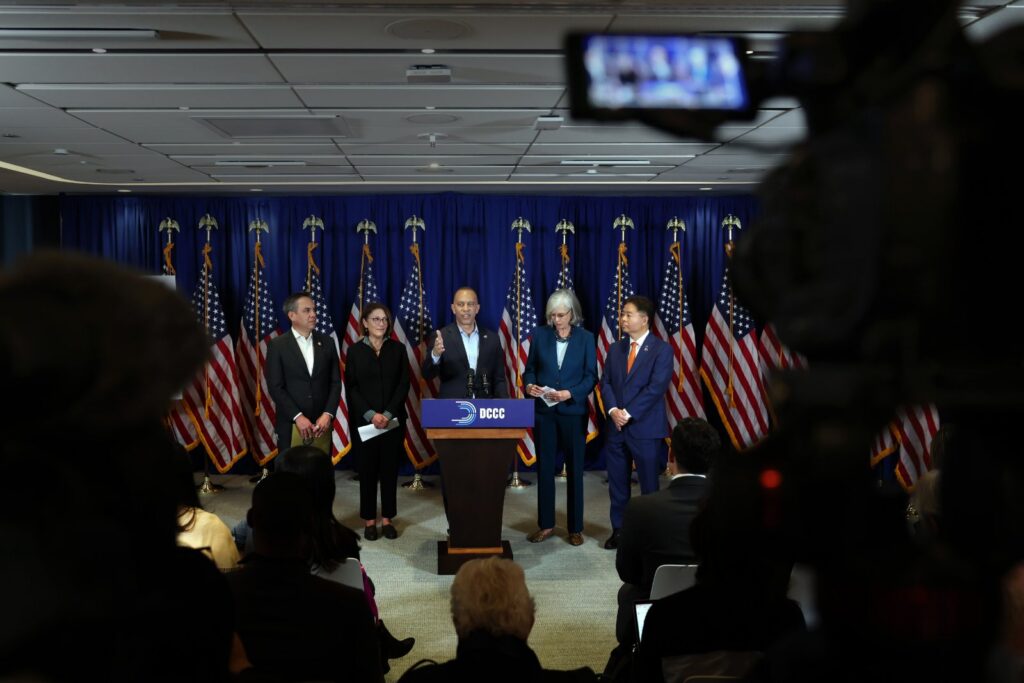
Senate Democrats will hold “at least 54 of 100 seats,” AP’s Lisa Mascaro reported Wednesday, and the House majority is “well past the 218 needed.” “Five words for the American people: Relief is on the way,” Senate Democratic Leader Chuck Schumer said, according to AP.
“We’re going to work hard to deliver on the dramatic change that you deserve,” said Jeffries, who would be the first Black House speaker if his colleagues elect him.
Pappas and McBride Will Be Part of the New Congress
“Tonight voters delivered a resounding message: equality wins,” Human Rights Campaign President Kelley Robinson said in a statement Tuesday night. She said voters “have elected a historic number of LGBTQ+ elected officials,” and she called Rep. Chris Pappas of New Hampshire “the first-ever out gay man elected to the U.S. Senate.”
The AP called New Hampshire’s Senate race for Pappas at 8:20 p.m. EST Tuesday, Gayety reported, six years after he told WBUR, “I was blessed to become the first LGBT member of Congress from New Hampshire.”
Equality PAC, co-founded by Rep. Mark Takano of California, chair of the Congressional Equality Caucus, said on Aug. 27 that Everton Blair’s special-election win in Georgia would give the current Congress “a record 14 openly LGBTQ Members of Congress.”
The AP called Rep. Sarah McBride’s Delaware race at 8:50 p.m. Tuesday, WHYY reported, and she said Democrats will need to work hard to keep the House for more than one term, according to WDEL. “To build a government that sees and respects all of us, and to build a tomorrow that is different, and better, than today,” McBride said.
What Would the Equality Act Do?
The House first passed the bill 236-173 on May 17, 2019, with eight Republicans voting yes, House Clerk records show. When it passed again on Feb. 25, 2021, 224-206 with three Republicans aboard, AP’s Kevin Freking wrote that the legislation “faces an uphill battle in the Senate.”
Sen. Jeff Merkley of Oregon and Rep. Mark Takano of California reintroduced the bill on April 29, 2025. The proposal would write protections for sexual orientation and gender identity into federal civil rights laws. It covers jobs, housing, public accommodations, jury service, credit and federally funded programs.
“Generations of Americans have marched, voted, organized, and raised their voices to fully realize the vision of America as a land of freedom and equality for all,” Merkley said.
An unfinished bill does not carry over into January. Its sponsors would have to introduce it again. Then comes the Senate problem. A simple majority can pass a bill, but ending a filibuster generally takes 60 votes. Democrats could try to change that rule. Winning the election leaves it in place.
“The Equality Act is necessary, urgent, and long overdue,” Schumer said at the time.
When the bill came back in April 2025, Takano said in his office’s announcement, “We will not rest until full equality is the law of the land.”
What Happens to Trump’s Anti-Trans Policies?
Trump signed his “gender ideology” order on his first day back, Jan. 20, 2025. “It is the policy of the United States to recognize two sexes, male and female,” the order says.
For anyone applying for a passport, the State Department still has the same instructions. It issues new passports based on its determination of a person’s sex at birth. Passports already issued remain valid until they expire, are replaced or are individually invalidated.
On Nov. 6, 2025, the Supreme Court allowed that policy to operate during litigation, with three justices dissenting. The justices were deciding whether the policy could operate while the case continued. They did not settle the case itself. Justice Ketanji Brown Jackson, dissenting, wrote that “by preventing transgender Americans from obtaining gender-congruent passports, the Government is doing more than just making a statement about its belief that transgender identity is ‘false.'”
The Jan. 27, 2025, military order says a gender identity that doesn’t match a service member’s sex “cannot satisfy the rigorous standards necessary for military service,” according to the White House text. The Marine Corps announced Oct. 30 that it was ending extension waivers for transgender Marines facing involuntary separation, Stars and Stripes reported. Marines can still have separation hearings. The waivers had given them more time before separation. Gayety has more on the waiver decision.
Takano, McBride and five other House Democrats pressed Defense Secretary Pete Hegseth in September over separation pay owed to ousted trans troops. “This is unacceptable and appears to be another broken promise by this Administration to those who have served,” they wrote in a Sept. 23 letter.
Can Congress Block Spending or Investigate?
Congress “may inhibit the implementation of an executive order by preventing funds from being used to put the order into practice,” the CRS report says. To do that, Congress must get a spending restriction into law. Trump can veto that legislation, too.
The Congressional Review Act won’t touch the orders themselves. “The CRA does not apply to presidential actions or to non-rule agency actions such as orders,” the CRS says in an overview updated Oct. 1.
Agency rules are a different matter, though the CRA has strict deadlines for reviewing them. Take the Health and Human Services rule on gender dysphoria. The published final rule takes effect Jan. 4, 2027. Whether the next Congress can use the CRA against it depends on those deadlines.
For a rule that qualifies, the CRA gives senators a vote without a filibuster. A simple majority can approve the resolution. But it still goes to the president, CRS explains. If Trump vetoes it, Congress faces the same two-thirds requirement.
Rep. Robert Garcia of California, the top Democrat on the House Oversight Committee, issued a one-sentence warning, AP reported: “Lawyer up.”
“Whenever Trump defies the will of the American people or the law, we will launch investigations, take him to court, and entangle him in legislative razor wire,” Schumer told reporters Wednesday, according to Cronkite News.
“I don’t want to be just sitting there for two years vetoing everything,” Trump told Politico, according to AP.


