
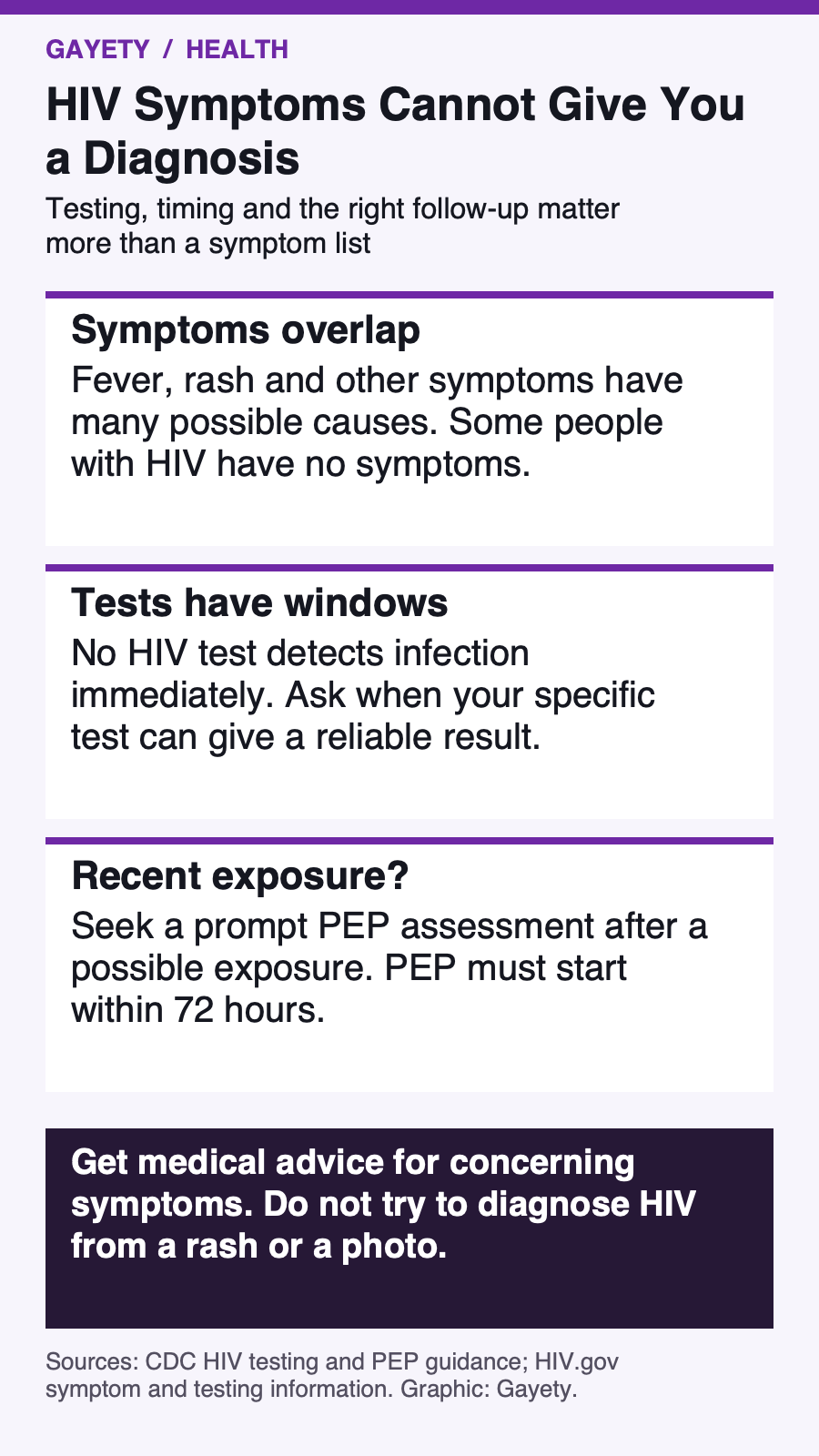
A new rash can be alarming, especially after an encounter you are worried about. It cannot tell you whether you have HIV. Early HIV sometimes causes a rash, but so do many other infections, medicines and everyday skin conditions. The next step is an appropriate test and an assessment of the rash, not a search for a matching photograph.
The short answer: A rash during early HIV may include small, flat or slightly raised spots, often alongside fever or other flu-like symptoms. There is no single appearance, location or duration that confirms HIV. Some people never develop a rash or any other early symptoms.
Jump to: Appearance · Other possible causes · Medication reactions · Testing · FAQs
What an Acute HIV Rash Looks Like on the Skin
The NIH’s HIV and rash guide describes early HIV rash as small, flat areas with tiny bumps. DermNet describes a symmetrical rash that can involve the trunk, limbs, face, palms or soles. These are possible patterns, not a checklist for self-diagnosis.
| Question | What the pattern can tell you |
|---|---|
| When does it appear? | Early HIV illness often begins two to four weeks after infection, but timing varies. |
| What might it look like? | Small flat or slightly raised spots. Appearance alone cannot establish the cause. |
| Where can it appear? | The trunk and other areas, including limbs, face, palms or soles. |
| Does it have to itch? | No single itch or pain pattern confirms or excludes HIV. |
| How long does it last? | Duration varies. A rash fading does not establish HIV status. |
Redness is not equally visible on every skin tone, and lighting can change how a rash looks in a photo. Pay attention to new changes in texture, discomfort and spread as well as color. A rash that does not resemble an online example still deserves assessment if it is new, persistent or accompanied by other symptoms.
How Common a Rash Is in Early HIV
Not everyone with early HIV gets a rash. HIV.gov says about two-thirds of people have flu-like symptoms within two to four weeks of infection, but that figure covers the overall illness, not rash alone. Some people feel well. Absence of a rash does not rule out HIV.
Fever, sore throat, swollen glands and fatigue overlap with many other illnesses. A rash plus fever may be a reason to ask about recent HIV testing, but the combination is not a diagnosis.
Rashes and Sores That Can Look Like HIV
A clinician may consider allergies, eczema, a medication reaction or another infection. Some STIs also cause visible skin changes. The conditions below can overlap in appearance, so a rash should not be identified from its location alone.
| Condition | What CDC says |
|---|---|
| Syphilis | Usually painless sores around the mouth, genitals or anus; a later rash can involve the palms or soles. Some people have no symptoms. |
| Herpes | One or more blisters on or around the genitals, rectum or mouth. Most people have no or very mild symptoms. |
| Mpox | Often painful, firm or deep-seated lesions that may develop a central indentation. Some people have only a few lesions, including near the genitals, anus or mouth. |
A new rash on the palms or soles is one reason to discuss syphilis testing. Explain any recent sexual exposures so your clinician can decide which other tests, including HIV, are appropriate.
Rashes From HIV Medication
A rash in someone living with HIV does not necessarily mean the virus is causing it. It may be related to another infection or a medicine, including a recently started treatment. Tell the prescriber when it began and what medicines or supplements you have started.
Some drug reactions need immediate attention. NIH highlights hypersensitivity reactions involving abacavir and severe skin reactions such as Stevens-Johnson syndrome. A rash with breathing difficulty, facial swelling, faintness, painful blisters, peeling skin or sores involving the mouth or eyes warrants urgent medical care. Tell the treating clinician about every medicine you take.
Do not wait for a routine appointment if those severe symptoms are present. For a mild new rash, contact the prescribing team promptly for advice rather than changing HIV treatment on your own. Treatment depends on what caused the rash.
When to Test for HIV After a Rash
Ask for HIV testing after a possible exposure whether or not you have a rash. Tell the clinic when the exposure occurred, when symptoms started and whether you have used PrEP or PEP. A test chosen for a very recent exposure may differ from a routine screening test.
According to the CDC’s testing guidance, a nucleic acid test can usually detect HIV 10 to 33 days after exposure, a laboratory antigen/antibody test using blood from a vein 18 to 45 days, and an antibody test 23 to 90 days. A negative test taken too early needs follow-up. PrEP and other antiretroviral medicines can affect detection, so follow the clinic’s testing schedule.
If a possible substantial HIV exposure occurred within the past 72 hours, seek an immediate assessment for PEP. Do not wait for a rash or an HIV test to become positive. A rash appearing weeks after an earlier encounter does not reopen that encounter’s PEP window, but testing and care are still useful. For ongoing prevention, ask a clinician whether PrEP is appropriate.
HIV Skin Rash FAQ
What does an HIV rash look like?
Early HIV can cause small, flat or slightly raised spots, sometimes with fever or other flu-like symptoms. Many other conditions look similar, and only testing can determine HIV status.
Is an HIV rash itchy?
Itchiness does not identify the cause. HIV-related skin conditions and medicine reactions can vary, so neither itching nor its absence can diagnose HIV.
How long does an HIV rash last?
There is no dependable duration that identifies HIV. Early symptoms may last days to weeks, and a rash fading does not mean an infection is gone.
Can you have HIV without a rash?
Yes. Some people have no rash and some have no early symptoms at all. Testing after a possible exposure matters even when you feel well.
Where does an HIV rash usually appear?
The trunk is a common site, but the face, limbs, palms and soles may also be involved. Location cannot distinguish HIV from other causes.