
A queasy first week on PrEP is different from a side effect that keeps you from taking it. Mild nausea or a headache may settle as your body adjusts. Persistent symptoms deserve a call to your prescriber, and severe symptoms need prompt care.
Pills and injections also have different risks, so it helps to know which medicine you are taking. Our PrEP guide explains the prevention options.
Jump to: Compare medicines · The first month · Kidney monitoring · Weight changes · Injection reactions · Serious symptoms · FAQs
Truvada, Descovy, Apretude and Yeztugo Side Effects Compared
The four options below are approved for HIV prevention in the United States. Their labels draw on different studies and populations, so these percentages are not a head-to-head ranking. The Truvada label, for example, reports selected events from a placebo-controlled trial. HIV testing is required for every option, in addition to the monitoring listed here.
| PrEP option | How it’s given | Selected side effects in PrEP studies | What gets monitored |
|---|---|---|---|
| Truvada (emtricitabine/tenofovir disoproxil fumarate) | Daily pill | Headache 7%, abdominal pain 4%, weight loss 3% in iPrEx (placebo: 6%, 2%, 2%) | Kidney function, hepatitis B status |
| Descovy (emtricitabine/tenofovir alafenamide) | Daily pill | Diarrhea 5%, nausea 4%, and headache, fatigue and abdominal pain at 2% each in DISCOVER | Kidney function, hepatitis B status, cholesterol, weight |
| Apretude (cabotegravir) | Shot in the buttock muscle, two starter doses a month apart, then every 2 months | Injection site reactions 82% in HPTN 083; headache, fever and fatigue at 4% each | Injection schedule, allergic reactions, liver and mood symptoms |
| Yeztugo (lenacapavir) | Two shots under the skin of the belly (or thigh) every 6 months, plus starter tablets on days 1 and 2 | Injection site reactions 83% and nodules 63% in PURPOSE 2; headache, nausea and diarrhea at 2% each | Injection site reactions, medication interactions and the injection schedule |
All four options warn about drug resistance if PrEP is used during an unrecognized HIV infection. Their warnings are not identical: Truvada and Descovy also carry a boxed warning about hepatitis B flares after stopping. HIV testing before starting and at the required follow-up visits is essential. Descovy is not approved for people whose HIV risk comes from receptive vaginal sex; a different option is needed for that exposure.
Start-Up Syndrome in the First Month on PrEP Pills
Fewer than 10% of people prescribed Truvada or Descovy get “start-up syndrome,” per CDC’s 2021 PrEP clinical guideline: headache, nausea or abdominal discomfort that usually resolves within the first month. Ireland’s Health Service Executive (HSE) lists bloating and diarrhea too. Diarrhea hit 5% on Descovy and 6% on Truvada in DISCOVER, a trial of 5,387 men and transgender women who have sex with men, the Descovy label says. HIV.gov’s advice is to tell your provider about any side effect that bothers you or doesn’t go away.
Kidney Function on Truvada and Descovy
Tenofovir, the drug in both PrEP pills, can lower kidney function. CDC’s clinical guidance calls those decreases “generally small” and usually within the normal range, though occasional cases of acute kidney failure, including Fanconi syndrome, have occurred. Providers check creatinine clearance, a measure of kidney filtering, at the start.
The Truvada label does not recommend it for PrEP when estimated creatinine clearance is below 60 mL/min. Descovy can be used at 30 mL/min or above. CDC recommends checking kidney function at least annually for everyone taking oral PrEP, and at least every six months for people 50 or older or those who started below 90 mL/min. Diabetes, high blood pressure or other kidney concerns may call for closer follow-up.
Tell your prescriber about painkillers, supplements and other medicines, including high-dose or multiple NSAIDs such as ibuprofen or naproxen. They can affect kidney safety or the interpretation of test results. Do not assume an over-the-counter product is irrelevant to the prescription.
Bone Density on PrEP, Especially for Younger Men
Truvada’s label reports an iPrEx substudy that scanned the bones of 503 participants. Compared with placebo, Truvada users lost an average of 0.4% to 1.0% of bone mineral density at the hip and spine. About 13% lost at least 5% of spine density, against 6% on placebo. Values moved back toward baseline once people stopped. Fractures: 1.7% on Truvada, 1.4% on placebo.
CDC cites studies of young gay and bisexual men on Truvada: drops were bigger at ages 15 to 19 than at 20 to 22. After stopping, participants ages 18 to 22 recovered within 48 weeks, while declines persisted in younger participants. CDC suggests providers consider Descovy for adolescent males. Spine density in DISCOVER rose 0.5% on Descovy and fell 1.1% on Truvada at 48 weeks, the Descovy label says. Routine bone scans for PrEP users aren’t recommended, per CDC.
Does PrEP Cause Weight Gain? The Descovy Numbers
In iPrEx, 3% of Truvada users lost weight, against 2% on placebo, the label says. Descovy went the other way. Median weight gain after 96 weeks of DISCOVER was 1.7 kilograms (about 3.7 pounds) on Descovy and 0.5 kilograms (about 1.1 pounds) on Truvada, per results published in The Lancet HIV in July 2021. Triglycerides rose 9 mg/dL on Descovy at 48 weeks, and total cholesterol fell 12 mg/dL on Truvada, the Descovy label says. Before starting Descovy and every 12 months after, CDC recommends checking cholesterol, triglycerides and weight.
Apretude and Yeztugo Injection Site Reactions
In HPTN 083, which tested Apretude in men and transgender women who have sex with men, 82% had at least one injection site reaction, according to the Apretude label. Pain or tenderness was the most common type. The median reaction lasted 4 days. Three percent quit the shots over reactions, the label says, and fever ran 4%, versus less than 1% on Truvada.
Yeztugo’s label reports nodules, firm lumps under the skin, in 63% of PURPOSE 2 participants. Median duration after the first injections: 297 days, longer than the six-month gap between doses. Only 1.2% stopped over injection reactions, and the label calls none of them serious. Injecting into the skin rather than under it has been linked to tissue death and ulcers, it warns. Gayety’s Yeztugo PrEP shot guide has the full schedule.
Hepatitis B Flares, Allergic Reactions and Other Rare PrEP Risks
Truvada and Descovy both carry a boxed warning that people with hepatitis B can have severe flares after they stop. CDC says everyone considered for oral PrEP should be screened, and for people with hepatitis B it advises involving a hepatitis B expert and watching the liver if PrEP stops.
The Apretude label warns about severe allergic reactions, including serious skin reactions, and reports liver problems and depressive disorders. Trouble breathing, facial swelling or a severe blistering rash calls for emergency care. New depression or other substantial mood changes deserve prompt medical attention. Report yellowing skin or eyes, dark urine or persistent abdominal pain to your clinician as well.
Cabotegravir and lenacapavir can remain in the body for a year or longer after the last injection. That does not mean a missed appointment leaves you protected for a year. Drug levels eventually fall below those needed for prevention, creating a period when HIV infection could lead to resistance. Plan any switch or stop with your prescriber, including alternative prevention and follow-up HIV tests.
PrEP and Gender-Affirming Hormones
Gender-affirming hormone therapy does not rule out PrEP. The CDC guidance supports offering PrEP to transgender and nonbinary people. Bring your complete medication list, including hormones and supplements, so your clinician can choose an appropriate option and check interactions. Advice about daily tenofovir-based pills should not be assumed to cover every injectable drug or every dosing schedule.
When to Call Your Provider or Switch PrEP Options
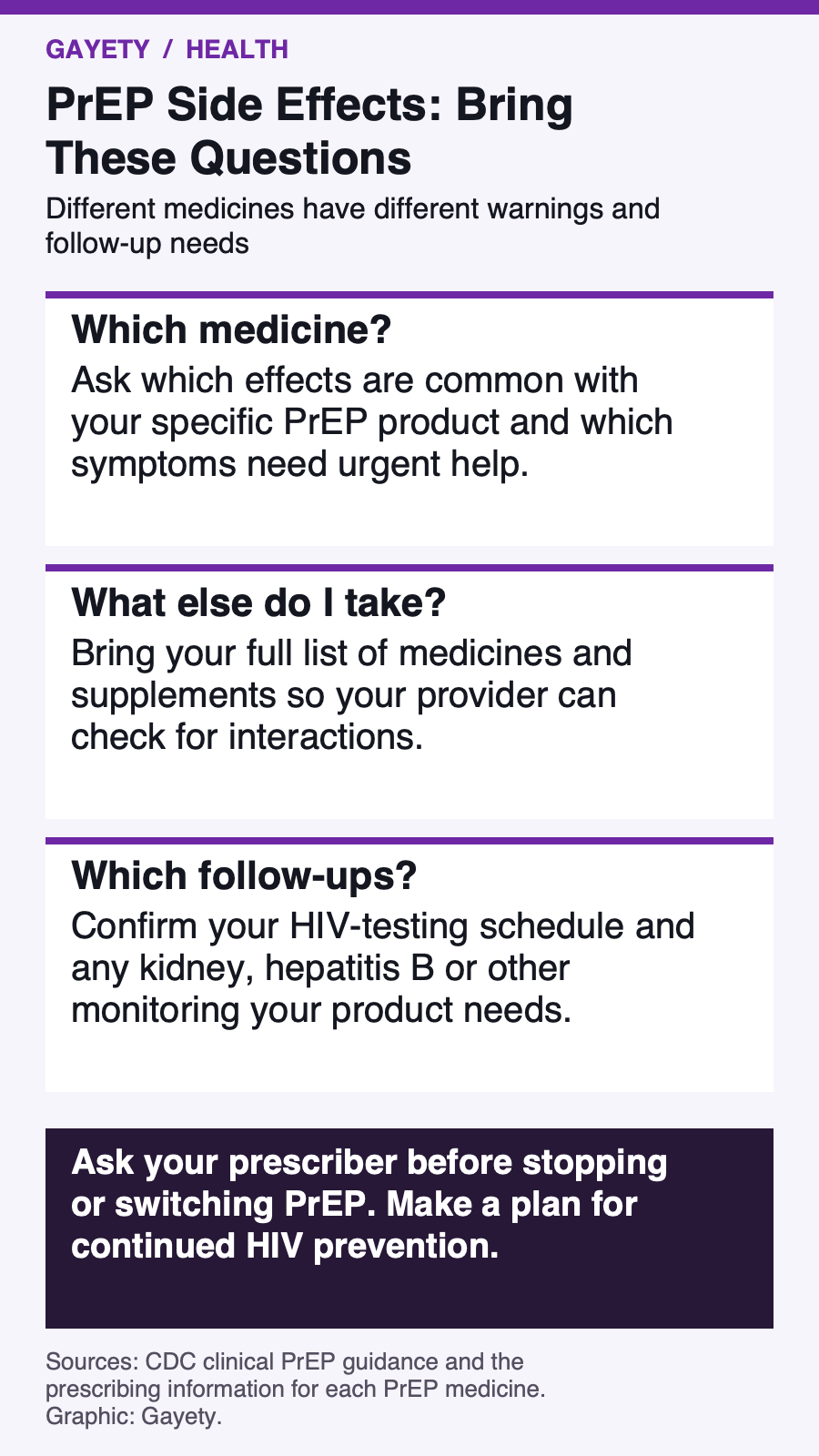
A troublesome side effect does not necessarily mean giving up HIV prevention. Ask your prescriber what can be managed, what needs testing and whether another option would suit you better. Two useful questions:
- Given my kidney numbers, age and bone health, is Truvada or Descovy the better fit?
- If a side effect makes me skip doses, can I switch to a different pill or a shot?
Fever, fatigue, muscle aches or a new rash can have many causes, including a new HIV infection. Tell your prescriber promptly, especially after missed doses or a possible exposure. If that exposure was within 72 hours, seek an immediate assessment for PEP. PrEP does not prevent other STIs, so keep up with regular STI testing.
PrEP Side Effects FAQ
How long do PrEP side effects last?
Mild stomach upset or headaches after starting pills often settle within the first month. Injection reactions vary: soreness can last days, while lenacapavir nodules can persist for months. Tell your clinician about symptoms that persist or interfere with daily life.
Does PrEP damage your kidneys?
Tenofovir-based pills can affect kidney function. Most changes are small, but serious problems can occur, which is why kidney tests are part of oral PrEP care. Your results help determine which medicine is appropriate.
Does PrEP make you gain weight?
Weight changes differ between people and medicines. In the DISCOVER study, median gain at 96 weeks was 1.7 kilograms with Descovy and 0.5 kilograms with Truvada. Those study results do not predict what an individual will experience.
Do PrEP shots hurt?
Pain, tenderness and other injection site reactions are common. Apretude soreness often resolves within days; Yeztugo can leave lumps that last much longer. Ask the clinic what to expect and which changes should prompt a call.
Can you take PrEP with gender-affirming hormones?
Yes, hormone therapy does not rule out PrEP. A clinician should review your medicines, exposure routes and preferred dosing schedule to choose an appropriate option.