

A painless sore is easy to dismiss, especially if it disappears. With syphilis, that can be a costly assumption: the sore may heal while the infection remains. The CDC describes a sore that is often firm, round and painless, but it can be atypical, painful or one of several. Testing matters even when a symptom does not match the usual description.
Syphilis can affect anyone who is sexually active. In men, a sore may be on the penis, around or inside the anus, or in the mouth. Later symptoms can include a rash, sometimes on the palms or soles. Some people never notice either stage. The infection is treatable, and getting assessed early helps prevent complications and transmission.
Jump to: Stages and timing · Urgent symptoms · Testing · Treatment · FAQs
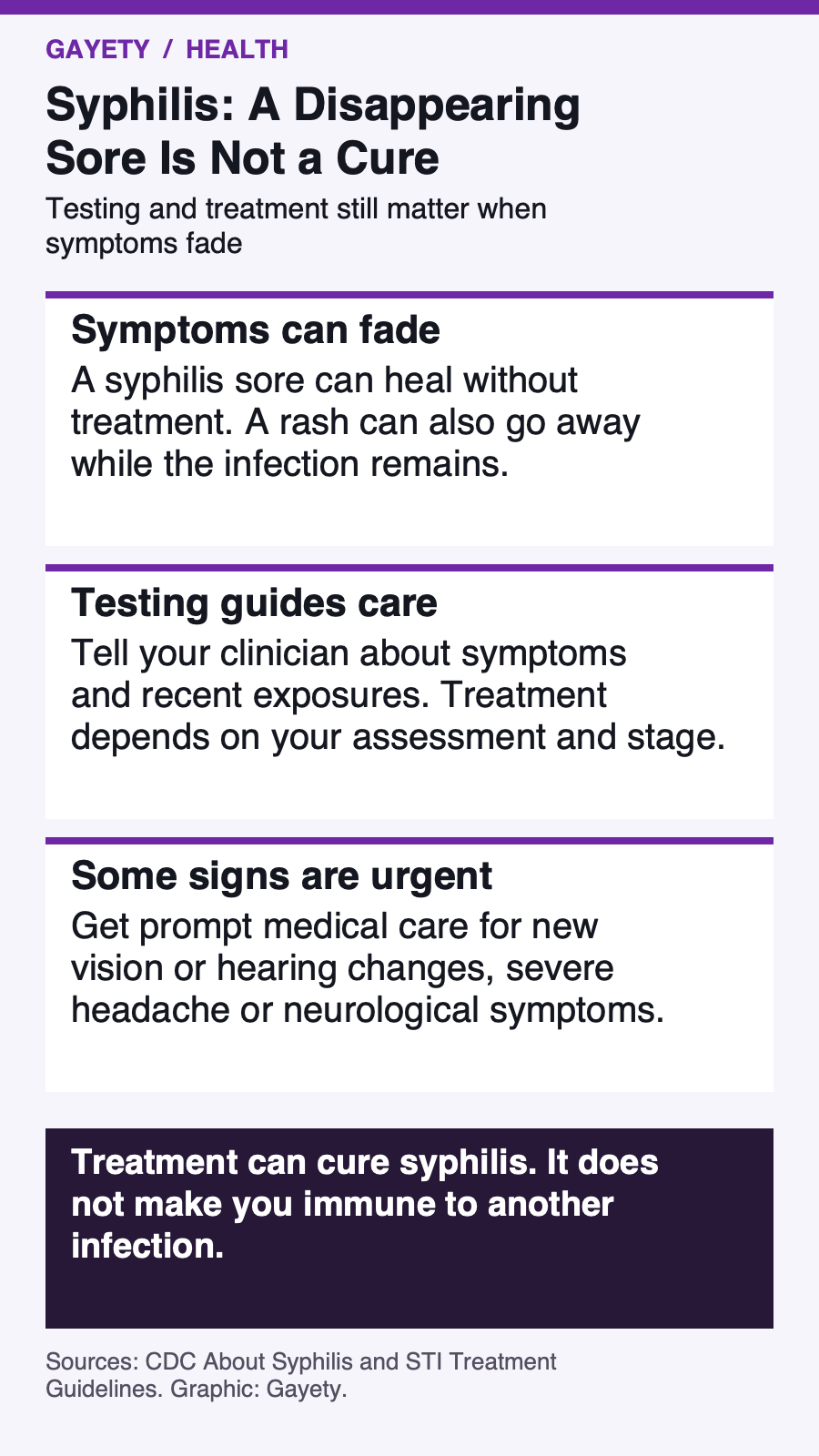
Syphilis Stages in Men at a Glance
| Stage | Timing, per CDC | What you might notice |
|---|---|---|
| Primary | Sore appears 10 to 90 days after exposure, about three weeks on average; lasts 3 to 6 weeks | One or more firm, round sores, usually painless |
| Secondary | Rash starts as the sore heals or several weeks later | Rash that usually does not itch, sometimes on palms and soles; fever, swollen glands, sore throat, patchy hair loss, headaches, weight loss, muscle aches, fatigue |
| Early latent | Evidence of infection acquired within the preceding year | No symptoms |
| Late latent or unknown duration | Infection more than a year old, or of unknown duration | No symptoms; can last for years |
| Tertiary | 10 to 30 years after infection | Damage to the heart, blood vessels, brain and nerves; can be fatal |
The stages guide treatment, but they are not a clock you can use to diagnose yourself. CDC defines early latent syphilis using evidence that infection was acquired within the preceding year. When timing cannot be established, a clinician may classify it as infection of unknown duration and choose treatment accordingly.
Primary Syphilis Sore: Painless and Easy to Miss
Clinicians call the sore a chancre, and some men get more than one. It shows up at the point of entry. CDC’s fact sheet names the places it hides: inside the anus, under the foreskin, in the mouth. If you bottom, you may never see it, and the same goes if you were the one giving oral sex.
The chancre lasts three to six weeks and heals “regardless of whether you receive treatment,” per CDC’s About Syphilis page. That healing fools people. Without treatment, the infection can progress even after the sore heals.
Secondary Syphilis Rash and Flu-Like Symptoms
The rash is the headline of stage two. CDC describes rough, red or reddish-brown spots, often on the palms of the hands or the soles of the feet, and it usually doesn’t itch. Some men also run a fever or get swollen lymph glands, a sore throat, patchy hair loss, headaches, weight loss, muscle aches or fatigue.
Some symptoms overlap with early HIV and other infections. A clinician may recommend HIV and other STI tests alongside syphilis testing. If the rash fades without treatment, that does not mean the syphilis has cleared. Infection can continue without visible signs.
Neurosyphilis and Ocular Syphilis Warning Signs
People tend to file brain and eye damage under late syphilis. CDC says it can happen at any stage. Neurosyphilis may bring a severe headache, muscle weakness, trouble with movement, changes in mental state or dementia; ocular syphilis, eye pain or redness, vision changes and even blindness. Otosyphilis can cause hearing loss, ringing in the ears and dizziness.
New vision changes, eye pain, sudden hearing loss, severe headache, weakness or confusion need urgent assessment. Tell the clinician if syphilis is possible or has been diagnosed. Sudden major vision loss or stroke-like symptoms warrant emergency care; do not wait for a routine sexual health appointment.
Syphilis Testing for Gay and Bi Men: How Often
Testing is usually a blood draw, and some providers also test fluid from a sore, CDC says.
The schedule is in CDC’s STI screening recommendations. Sexually active men who have sex with men should be tested at least once a year, and every 3 to 6 months if they’re at increased risk. Sexually active people living with HIV get screened at their first HIV visit and at least yearly after that, and CDC’s consumer page adds people taking PrEP to the regular-testing group.
Why push for more often? A model cited in CDC’s guidance on men who have sex with men found “quarterly syphilis screening averted more than twice the number of syphilis cases” compared with screening every six months.
Syphilis Treatment: Penicillin and the 2026 Shortage
Syphilis can be cured. CDC’s treatment guidelines call injected penicillin G “the preferred drug for treating patients in all stages of syphilis,” and the standard product for primary, secondary and latent infection is benzathine penicillin G, sold as Bicillin L-A. Late latent syphilis takes a longer course than early infection. CDC also notes that treatment might not undo damage already done, one more reason to test early.
Within 24 hours of starting treatment, some people get a fever, headache and muscle aches. This can be the Jarisch-Herxheimer reaction, CDC says, a reaction to treatment rather than a penicillin allergy.
Bicillin L-A remains affected by supply constraints. The CDC’s product-availability page reports an anticipated recovery in the fourth quarter of 2027, temporary imports of Lentocilin and a September 2026 shelf-life extension for specified Bicillin stock. These are supply-management measures for clinicians. If treatment is needed, the clinic should arrange an appropriate available regimen rather than ask you to wait for the shortage to end. Penicillin remains essential during pregnancy; alternatives for other patients depend on the stage and clinical circumstances.
Partner care is part of treatment. Under CDC guidance, partners exposed within 90 days before a diagnosis of primary, secondary or early latent syphilis generally need presumptive treatment even if their test is negative. Earlier partners may also need evaluation or treatment. The clinic or health department can help with notification, follow-up blood tests and advice about when sex can safely resume.
Syphilis Reinfection and Doxy-PEP Prevention
Treatment does not provide immunity. You can acquire syphilis again after successful treatment, including from a partner whose infection has not been treated. Condoms reduce risk but cannot cover every potentially infectious sore. Follow-up testing tracks the response to treatment and helps identify a new infection.
Doxy-PEP can reduce some bacterial STI risks for selected patients. CDC recommends discussing it with gay, bisexual and other men who have sex with men, and transgender women, who have had syphilis, chlamydia or gonorrhea in the previous year. When prescribed, the dose is 200 mg as soon as possible within 72 hours after sex, with no more than 200 mg in 24 hours. It is prevention, not a substitute for treating a current infection, and requires follow-up STI testing.
If a new sore, rash or other symptom worries you, book an assessment rather than waiting for the next routine screen. Mention any past syphilis treatment, because some blood tests can remain positive afterward and need interpretation alongside previous results.
Syphilis Symptoms in Men FAQ
What does a syphilis sore look like on a man?
It is often firm, round and painless, but sores can be multiple, painful or atypical. They may be on the penis, anus, rectum, lips or mouth and can be difficult to see. Appearance alone is not a diagnosis.
How long does it take for syphilis symptoms to show?
The first sore typically appears about three weeks after exposure, with a reported range of 10 to 90 days. Some people never notice a sore, so do not wait for one before testing after a known exposure.
Can syphilis go away on its own?
Symptoms can disappear without treatment while the infection remains. A healed sore or fading rash does not mean syphilis has been cured.
Is syphilis curable?
Yes. Appropriate antibiotics cure the infection, although treatment may not reverse damage already caused. The regimen depends on the stage and whether the nervous system, eyes or ears are involved.
Can you get syphilis from oral sex?
Yes. Direct contact with an infectious sore during oral sex can transmit syphilis. A sore in the mouth or around the genitals may be easy to miss.
Can you get syphilis more than once?
Yes. A previous infection does not provide immunity. Partner care and regular screening help prevent and detect reinfection.