
If a possible HIV exposure happened within 72 hours, seek care now. PEP is emergency HIV prevention. Start as soon as possible, ideally within 24 hours. An emergency department, urgent care clinic or your health care provider can assess whether you need it.
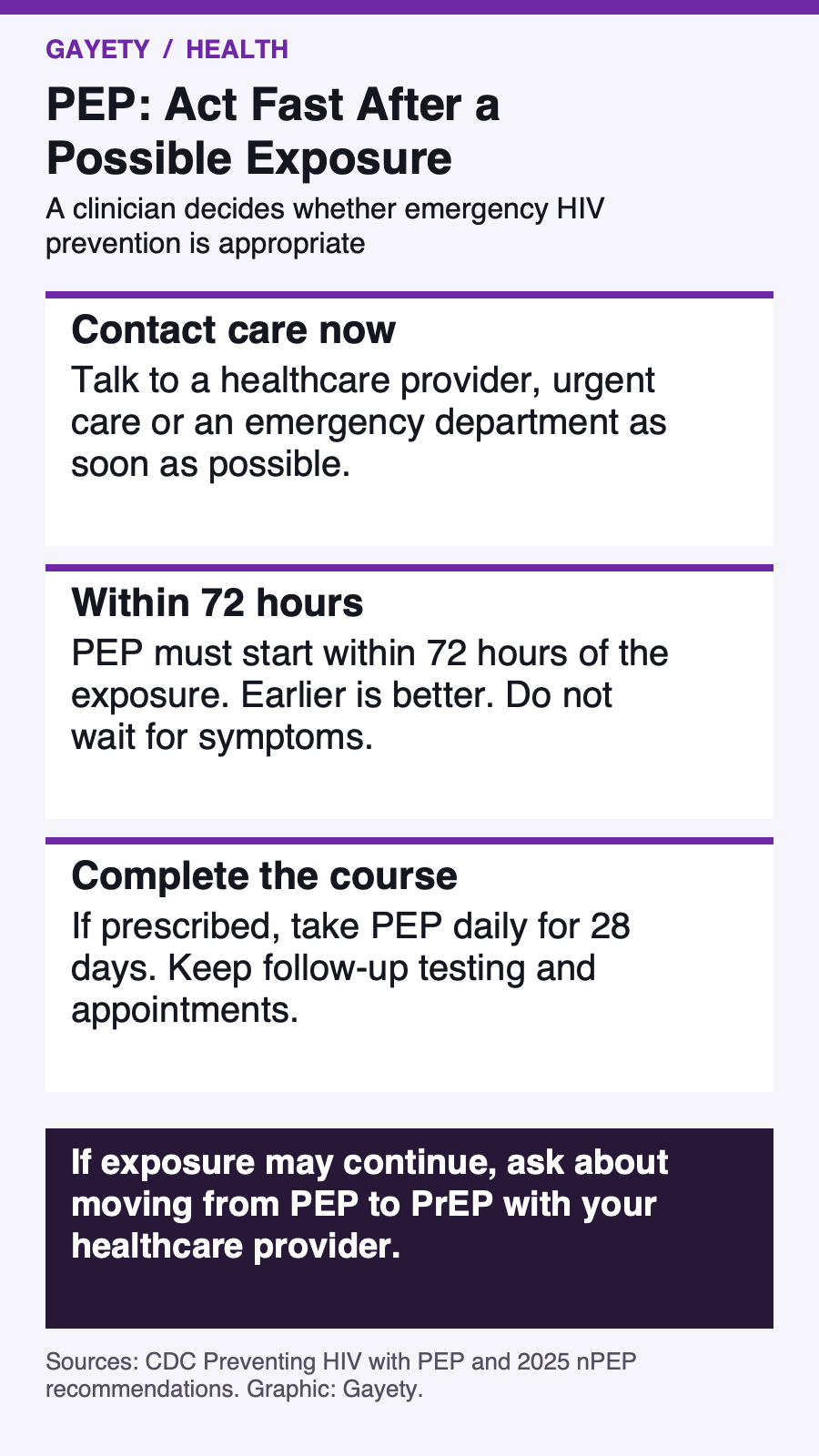
PEP stands for post-exposure prophylaxis. It is a 28-day course of HIV medicines taken after a possible exposure, such as a broken condom or shared needles. The CDC’s current recommendations say treatment should begin no later than 72 hours after exposure. A clinician decides whether the exposure warrants PEP. Do not wait for symptoms.
Jump to: The 72-hour window · Who needs PEP · Where to get it · Costs and insurance · Side effects · FAQs
How PEP Works Within the 72-Hour Window
The guideline, led by CDC’s Mary R. Tanner and published in MMWR Recommendations and Reports, says not to hold the first dose for lab results. The course runs 28 days, every day. HIV.gov says PEP is effective when taken correctly but not 100% effective, so condoms and other prevention still count that month. Already past 72 hours? Seek care anyway. A clinician can arrange HIV testing, discuss prevention and plan follow-up, even though CDC finds insufficient evidence to recommend starting PEP after that window.
Who Should Take PEP After a Possible HIV Exposure
HIV.gov’s list covers people who are HIV-negative or don’t know their status and may have been exposed in the last 72 hours, from condomless sex to workplace needlesticks. CDC’s PEP page calls it an emergency option, not a replacement for regular prevention.
The exposure matters, as does the other person’s HIV status. CDC recommends PEP for a substantial-risk exposure to someone with HIV whose virus is not durably suppressed or whose viral load is unknown. When the other person’s HIV status itself is unknown, the decision is made case by case. Don’t wait to find them or obtain their records before seeking care.
If a partner has HIV and maintains an undetectable viral load, they do not transmit HIV through sex. That is U=U, or Undetectable = Untransmittable. This statement concerns sexual transmission; other exposure routes need their own assessment.
Doxy-PEP is an antibiotic for bacterial STIs, not HIV medicine. CDC’s PEP page points gay and bisexual men and transgender women who’ve had syphilis, chlamydia or gonorrhea in the past year toward it.
CDC’s 2025 PEP Guidelines: Regimens and Testing
The updated CDC guideline names newer preferred regimens for most adults and adolescents. None is FDA-approved specifically for PEP, so this is an off-label use. The prescriber chooses the drugs based on factors including kidney function, other medicines and the circumstances of the exposure.
| Step | What CDC’s 2025 guideline says |
|---|---|
| When to start | As soon as possible, ideally within 24 hours, no later than 72 hours |
| First dose | Don’t delay it while waiting for lab results |
| How long | 28 days |
| Preferred regimens | Bictegravir/emtricitabine/tenofovir alafenamide as a single tablet, or dolutegravir plus tenofovir (alafenamide or disoproxil fumarate) plus emtricitabine or lamivudine |
| Baseline HIV test | Lab antigen/antibody test, with a rapid blood test when available; add a nucleic acid test (NAT) if you received long-acting injectable PrEP in the past 6 months |
| Follow-up HIV tests | Lab antigen/antibody plus NAT at 4 to 6 weeks and at 12 weeks after starting PEP, with dates set by the clinician |
| Other labs | Kidney and liver tests at baseline; repeat if indicated. Hepatitis B testing, pregnancy testing when relevant, and other STI or hepatitis tests based on the exposure |
The baseline HIV test cannot rule out infection from an exposure in the past 72 hours. Keep the follow-up appointments even if you feel well. CDC’s detailed guidance allows a clinician to defer the 4-to-6-week HIV test only if PEP started within 24 hours, the full course was taken without missed doses, and the person is not considering PrEP. The final test is still needed.
The care team should check in within 24 hours of the first visit to confirm that you obtained the medicine and can take it. Ask which other STI tests you need and when. CDC’s STI testing guidance explains why the site of exposure matters.
Where to Get PEP Tonight
Call a health care provider right away, or go to an emergency room or urgent care, CDC and HIV.gov say. HIV.gov’s locator lists nearby services. At the desk, say you had a possible HIV exposure, how many hours ago, and that you need PEP.
Some states allow qualified pharmacists to provide PEP without a separate prescription. California’s Board of Pharmacy maintains a registry of pharmacies reporting that they offer it. Call ahead to confirm availability, and go to urgent care or an emergency department if you cannot get prompt help. Permission under state law does not mean every pharmacy provides the service.
Clinicians can consult the National Clinician Consultation Center at 844-275-6222. Its PEP service operates weekdays from 7 a.m. to 5 p.m. Pacific and weekends from 10 a.m. to 2 p.m., excluding holidays. Seeking expert advice should not delay an indicated first dose.
How to Pay for PEP With or Without Insurance
HIV.gov says PEP is covered by health insurance in many states, including Medicaid. Uninsured? Your provider can apply to drugmakers’ patient assistance programs, and CDC says those requests can often be handled urgently. Copay assistance programs can cut a big copay or deductible.
Ask the prescribing team to check current assistance-program eligibility and help with the application. Ask separately what the visit and lab work will cost. Resolving payment should not mean putting off the urgent assessment.
Sexual assault survivors may get partial or total reimbursement for medicine and clinical care from the Justice Department’s Office for Victims of Crime, HIV.gov notes. On-the-job exposures usually go through workplace health insurance or workers’ compensation.
PEP Side Effects and the Switch From PEP to PrEP
HIV.gov calls PEP safe but says the medicines can cause side effects like nausea in some people, and nearly all can be treated. Other meds? PEP can interact with them, so tell your provider everything you take, over-the-counter products, alcohol and non-prescribed drugs included. Don’t stop early without talking to them.
If you expect possible exposures to continue, ask about a plan to move directly from PEP to PrEP. A clinician can arrange testing and the transition without a medication gap. PEP or PrEP can delay detection of HIV, so starting PrEP does not cancel the remaining follow-up tests. Ongoing risk is also no reason to put off an urgent PEP assessment for an exposure that has already happened.
PEP for HIV FAQ
How long after exposure can you take PEP?
CDC says to start PEP as soon as possible and no later than 72 hours after a possible exposure, ideally within 24 hours. After 72 hours, CDC says the evidence is too thin to recommend starting PEP, but you should still seek testing, prevention advice and a follow-up plan.
How effective is PEP?
HIV.gov says PEP is effective at preventing HIV when it’s taken correctly, but it isn’t 100% effective. Take every dose for 28 days and keep using condoms or other prevention.
Can a pharmacist prescribe PEP?
In some states, qualified pharmacists can provide PEP without a separate prescription. California maintains a registry of pharmacies that report offering it. Call ahead, because services vary. If a pharmacy cannot help promptly, seek an emergency department or urgent care clinic.
How do I pay for PEP?
Many insurance plans, including Medicaid in many states, cover PEP, per HIV.gov. Uninsured people can apply through drugmakers’ assistance programs, and sexual assault survivors may qualify for reimbursement through the Office for Victims of Crime.
Do I need PEP if my partner is undetectable?
A partner with HIV who maintains an undetectable viral load does not transmit HIV through sex. If you do not know whether their virus is durably suppressed, or the exposure involved shared injection equipment, seek an individual assessment promptly. An unknown HIV status also calls for a case-by-case decision.
What’s the difference between PEP and PrEP?
PEP comes after a possible exposure: 28 days, started within 72 hours. PrEP comes before, as pills or shots, for people with ongoing HIV risk, and CDC recommends moving from PEP to PrEP if exposures continue.