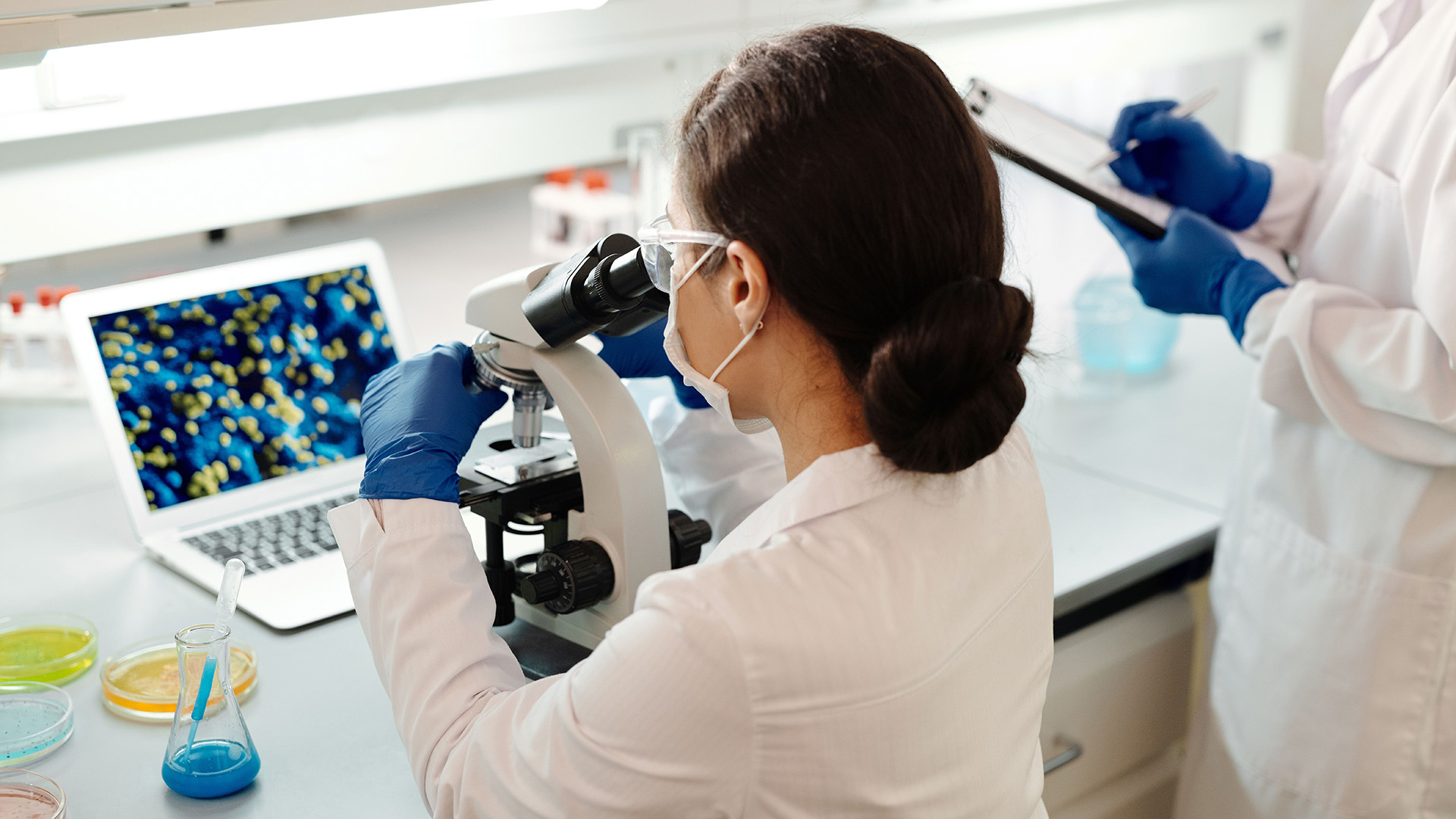

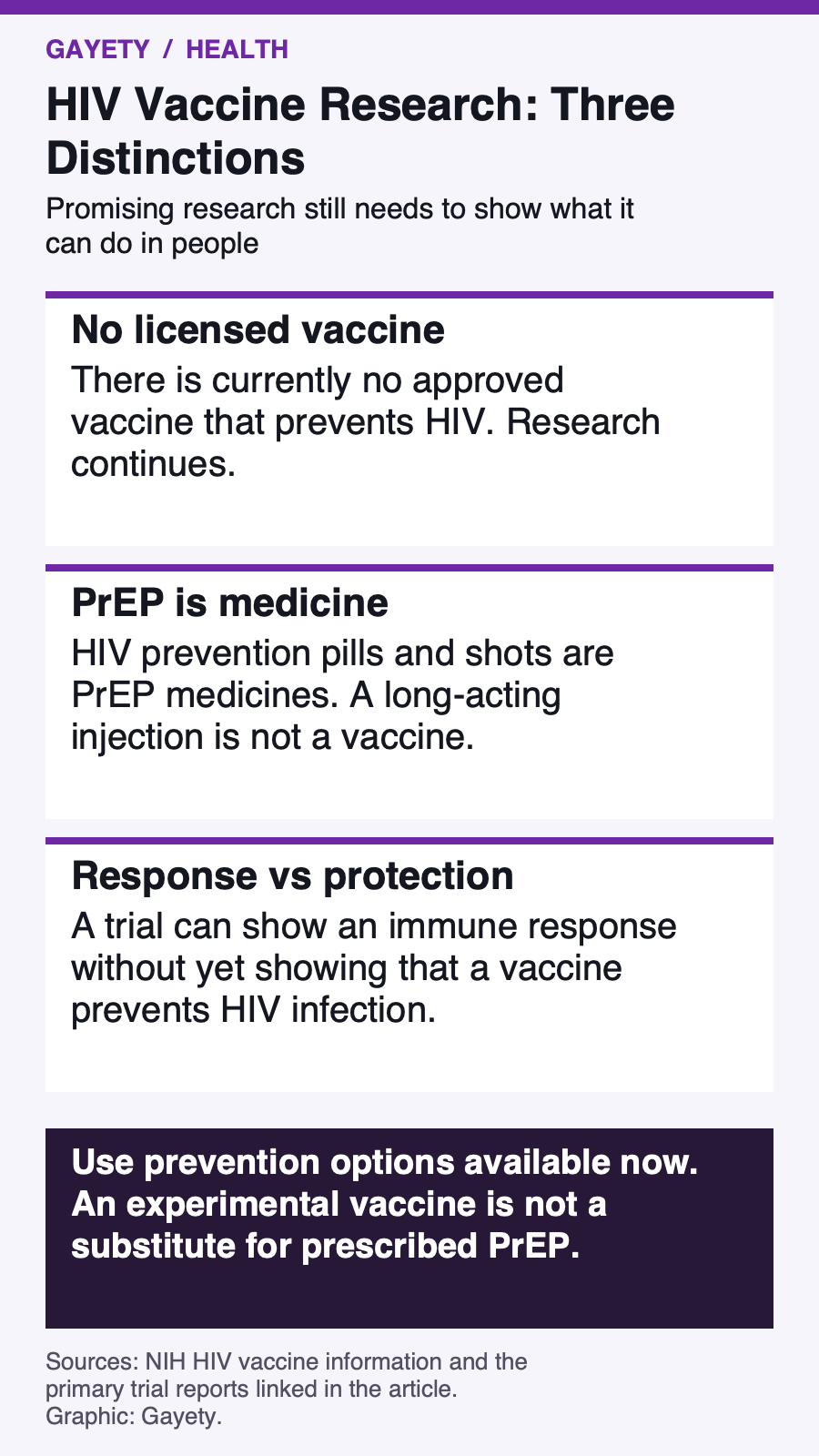
There is still no approved HIV vaccine. That can be confusing when headlines describe promising vaccine trials alongside twice-yearly prevention shots.
The shots available in clinics are PrEP medicines. Experimental vaccines are testing a different idea: teaching the immune system to prevent infection. HIV.gov’s current guidance makes that distinction clear.
Jump to: Trial results · Why it is difficult · mRNA research · 2026 trials · PrEP vs. vaccines · Joining a trial · FAQs
What HIV.gov Says About an HIV Vaccine in 2026
Preventive vaccines are intended for people without HIV. Therapeutic vaccines aim to help people already living with HIV control the virus; they are a separate research area. Neither kind is an approved replacement for established prevention or treatment.
What Major HIV Vaccine Trials Found
| Trial | When | Who and where | Result |
|---|---|---|---|
| RV144 | Results in 2009 | More than 16,000 volunteers in Thailand | 31% efficacy, a modest effect |
| HVTN 505 | 2009 to 2013 | 2,504 men and transgender women who have sex with men in the U.S. | Did not prevent HIV infection; vaccinations stopped in 2013 |
| HVTN 702 (Uhambo) | 2016 to 2020 | 5,407 adults ages 18 to 35 at 14 sites in South Africa | Stopped in February 2020: 129 infections in the vaccine group, 123 on placebo |
| HVTN 705 (Imbokodo) | Results in August 2021 | More than 2,600 cisgender women in five sub-Saharan African countries | Didn’t significantly reduce HIV acquisition |
| HVTN 706 (Mosaico) | 2019 to 2023 | About 3,900 cisgender men and transgender people who have sex with men, in eight countries | No protective benefit; stopped in January 2023 |
| PrEPVacc | Results in July 2024 | 1,512 adults in Uganda, Tanzania and South Africa | Neither vaccine regimen reduced HIV infections |
Fred Hutch News Service described RV144’s 31% as mild efficacy when it reported HVTN 702’s end. “There was no evidence of efficacy, no matter how you cut it,” Larry Corey, the principal investigator of the HIV Vaccine Trials Network, said of HVTN 702. University College London’s July 2024 report on PrEPVacc was just as blunt: “neither vaccine combination offered any protective effect.”
Mosaico enrolled roughly 3,900 cisgender men and transgender people across Europe and the Americas. In January 2023, the study’s sponsor announced that an independent review found no protective benefit over placebo. No vaccine-related safety issue was identified in that review. The distinction matters: a candidate can stimulate an immune response and still fail to prevent infection.
Why an Effective HIV Vaccine Is So Hard to Build
HIV changes rapidly and shields parts of its surface from the immune system. IAVI’s research program is pursuing broadly neutralizing antibodies, which can recognize multiple variants, alongside approaches that stimulate T cells. Producing the right response reliably through vaccination remains a major challenge.
The immune cells that could grow into bNAb makers are rare, so researchers designed a strategy called germline targeting, according to Scripps Research: a first shot wakes up those rare B cells, and slightly different boosters guide them step by step toward antibodies that can block HIV.
IAVI G002 and G003: The mRNA HIV Vaccine Results
Two trials, with results published in the journal Science on May 15, 2025, tested that first step with mRNA vaccines made by Moderna. IAVI G002 enrolled 60 people in North America, and IAVI G003 enrolled 18 in South Africa and Rwanda, Scripps Research reported.
All 17 G002 participants who received the priming vaccine followed by the distinct booster developed the targeted VRC01-class response, according to Scripps Research. That was evidence that the approach could guide early antibody development. It was not evidence that 17 people had become protected against HIV: the trials did not test that outcome.
Safety also needs attention. The research team’s report described skin reactions in 18% of G002 participants. A promising immune response does not remove the need to study side effects, dosing and durability before moving toward wider use.
New HIV Vaccine Trials in 2026: G004, C114 and BRILLIANT 011
IAVI’s May 2026 update highlighted G004, C114 and BRILLIANT 011. G004 began vaccinations in South Africa in December 2025 and is examining safety, immune responses and dose. C114, which began in August 2025, studies a T-cell approach. BRILLIANT 011 began in January 2026 in South Africa. These early-phase studies address different parts of the vaccine problem; none is an approved prevention option.
There is no dependable launch date. Before a vaccine can be offered routinely, researchers need evidence that it is acceptably safe and actually prevents HIV, not simply that a blood test detects an encouraging immune response. Early results can justify another study without settling those questions.
Yeztugo and Other PrEP Options Aren’t HIV Vaccines
Yeztugo is lenacapavir, a medicine that interferes with the virus rather than training the immune system. Its starting regimen includes injections and tablets on day one, followed by tablets on day two. Continuing injections are given every six months. Calling it a vaccine obscures the need to keep appointments and undergo HIV testing.
The CDC’s lenacapavir recommendation reports strong prevention results from the PURPOSE trials. That is a reason to discuss PrEP now, rather than wait for a vaccine. If a substantial exposure may already have occurred, seek prompt assessment for PEP, which must start within 72 hours when indicated.
How to Join an HIV Vaccine Trial
HIV.gov directs interested volunteers to ClinicalTrials.gov, the NIH Vaccine Research Center and the HIV Vaccine Trials Network. Ask the study team about eligibility, side effects, visit requirements and access to established prevention. Experimental HIV vaccines cannot give you HIV, but enrolling in a trial does not protect you from acquiring it through an outside exposure. A vaccine response may also affect some HIV antibody tests, so follow the study team’s testing advice.
HIV Vaccine FAQ: Trials, PrEP Shots and Timelines
Is there a vaccine for HIV?
No approved HIV vaccine is available. PrEP medicines, condoms and HIV treatment that maintains an undetectable viral load are established prevention tools. PEP may be used after an exposure when indicated.
Why is there no HIV vaccine yet?
HIV’s diversity and its ability to evade immune defenses make vaccine development difficult. Several large trials have failed to prevent infection, while newer approaches are still being tested.
Is the Yeztugo PrEP shot a vaccine?
No. It is long-acting lenacapavir, an HIV prevention medicine. It requires a starting regimen, repeat injections and HIV testing.
When will an HIV vaccine be available?
There is no reliable date. Encouraging immune responses in early trials do not establish that a vaccine prevents HIV. Larger studies must answer that question.
Can an experimental HIV vaccine give you HIV?
The vaccines being studied cannot cause HIV infection. Participants can still acquire HIV through exposures outside the study, and some vaccine-induced antibodies can affect HIV tests. The study team should explain prevention and testing.