
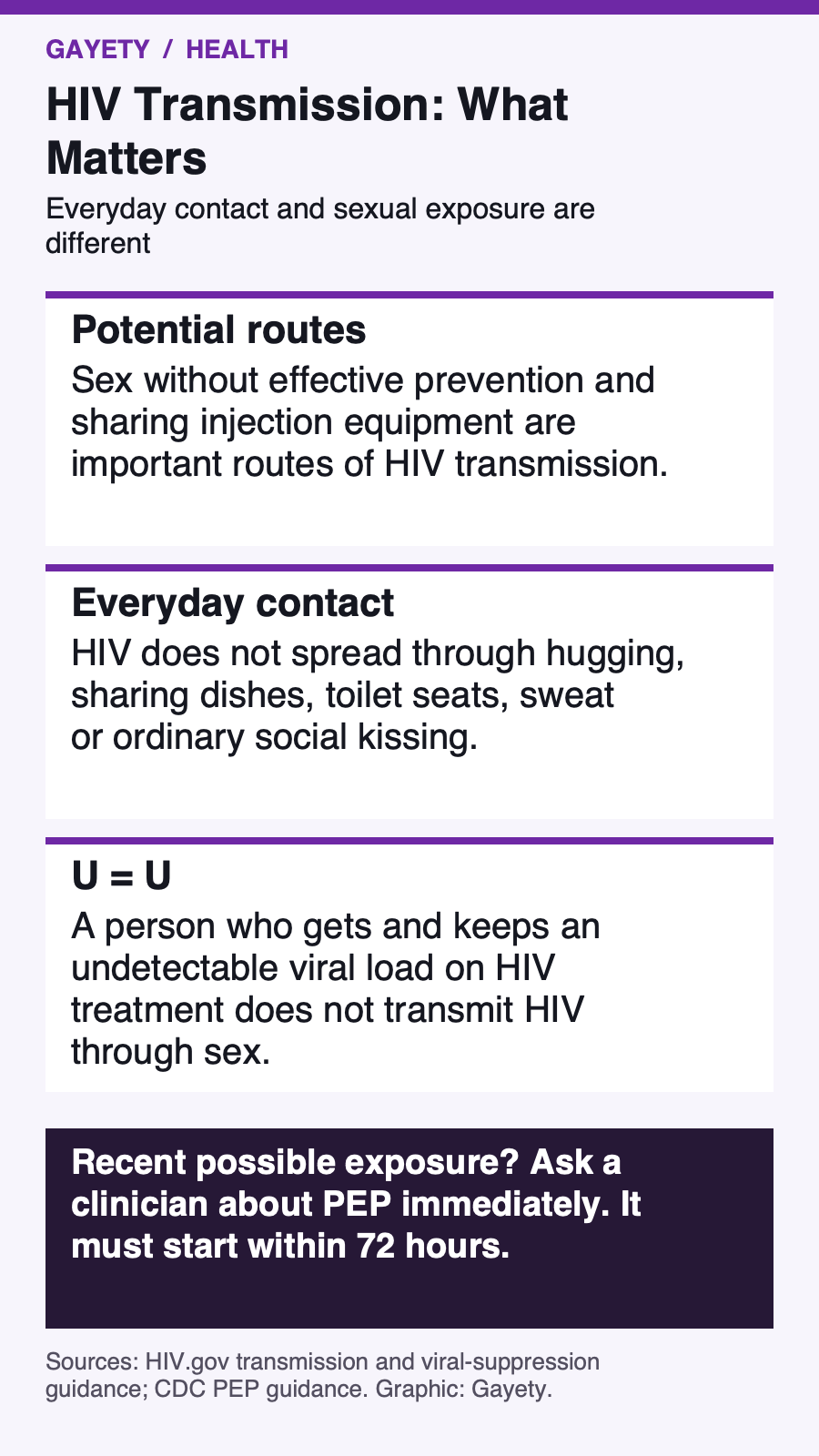
HIV does not spread through ordinary kissing, a shared glass or a hug. The main routes are anal or vaginal sex without effective HIV prevention and sharing injection equipment that contains blood. The details matter: a person with HIV who maintains an undetectable viral load on treatment does not transmit HIV through sex.
CDC’s transmission guide identifies the fluids that can carry HIV: blood, semen, pre-seminal fluid, rectal fluid, vaginal fluid and breast milk. Saliva alone does not transmit it. Having contact with someone who has HIV is not, by itself, an exposure.
Jump to: Body fluids · Risk by exposure · Kissing · Other routes · Myths · Prevention · FAQs
The Body Fluids That Can Transmit HIV
For transmission to occur, a fluid that can carry HIV must reach a mucous membrane, damaged tissue or the bloodstream. Mucous membranes include the lining of the rectum and vagina and the opening of the penis. HIV cannot pass through intact skin. The zero-risk finding for an undetectable viral load applies to sexual transmission; it should not be extended to every other route.
HIV Risk by Exposure: CDC’s Per-Act Numbers
The CDC estimates below describe exposure to a source who has HIV, without accounting for effective prevention such as PrEP or sustained viral suppression. They are population estimates, not a calculation of your personal risk. They do not describe sex with a partner who has maintained an undetectable viral load.
| Exposure to a source with HIV | Estimated infections per 10,000 exposures |
|---|---|
| Blood transfusion (blood that has HIV) | 9,250 |
| Receptive anal sex (bottoming) | 138 |
| Sharing needles to inject drugs | 63 |
| Needlestick injury | 23 |
| Insertive anal sex (topping) | 11 |
| Receptive vaginal sex | 8 |
| Insertive vaginal sex | 4 |
| Receptive or insertive oral sex | Low |
Among the sexual exposures in this table, receptive anal sex has the highest baseline estimate. Prevention changes that picture substantially. The transfusion figure also needs context: it refers to receiving blood that contains HIV, not the risk of receiving screened blood in the United States. Donating blood does not give you HIV.
Can You Get HIV From Kissing?
Kissing is not a usual route of HIV transmission, and saliva does not transmit HIV. The rare concern described by HIV.gov involves blood during deep kissing when both people have sores or bleeding gums. That is a possible blood exposure, not evidence that saliva spreads HIV.
A 1997 CDC investigation is sometimes cited as proof that kissing transmits HIV. Investigators could not establish the route. Blood contacting a mucous membrane was one possibility; other exposures could not be excluded. The report does not justify treating ordinary kissing as an HIV risk.
Oral Sex, Bites and Other Low-Risk HIV Routes
Giving or receiving oral sex carries little to no HIV risk. CDC does not assign it a precise per-act number. Blood, mouth sores and other STIs are factors a clinician may consider when assessing an unusual exposure. Oral sex can transmit other infections, including gonorrhea and syphilis.
Ordinary biting that leaves the skin intact does not transmit HIV. The very rare reported transmissions involving bites have involved severe injury and blood. Spitting does not transmit HIV.
Needles, Hormones and Pregnancy: HIV Spread Outside of Sex
Used needles, syringes and other injection equipment can retain blood. Use sterile equipment for every injection and do not share it, whether the injection involves recreational drugs, prescribed hormones or another substance. The issue is blood on shared equipment, not the reason a person injects.
HIV can also pass during pregnancy, childbirth and breastfeeding. Treatment and coordinated care greatly reduce those risks. For someone taking treatment who maintains an undetectable viral load, CDC puts breastfeeding transmission below 1%, but not at zero. Properly prepared formula or pasteurized donor milk eliminates transmission through breast milk. Infant-feeding decisions deserve individualized care and support.
HIV Transmission Myths: Mosquitoes, Toilet Seats and Spit
| Myth | What HIV.gov says |
|---|---|
| Mosquitoes or ticks can carry HIV | Insects don’t spread HIV |
| You can catch HIV from a toilet seat | Sharing toilets doesn’t spread it |
| Sharing a glass, fork or plate is risky | Dishes, silverware and drinking glasses don’t spread it |
| Hugs and handshakes can pass HIV | They can’t |
| Spit can give you HIV | There are no documented cases |
| Sweat, tears, urine or feces carry HIV | These fluids alone do not transmit HIV. Blood exposure is assessed separately. |
| You can catch AIDS | AIDS is the late stage of HIV infection, not something you catch |
Air, water and drinking fountains are on HIV.gov’s no-risk list too, along with sex that involves no fluid exchange, like touching.
How U=U, PrEP and PEP Stop HIV Transmission
HIV treatment lowers the amount of virus in the blood. When a person gets and keeps an undetectable viral load, they do not transmit HIV through sex. This is undetectable equals untransmittable, or U=U. Regular treatment and viral-load testing establish whether someone has reached and maintained suppression; appearance and symptoms cannot tell you.
PrEP is medicine for people without HIV that greatly reduces the chance of acquiring it. Options include daily pills and longer-acting injections, including twice-yearly Yeztugo. Condoms provide another layer of prevention and help reduce several other STI risks. Choosing prevention can be a conversation about what fits your life, not a judgment about your sex life.
If a possible exposure has already happened, PEP may be appropriate. The CDC’s 2025 guidance calls for starting it as soon as possible, ideally within 24 hours and no later than 72 hours after an exposure that warrants treatment. The course lasts 28 days. A clinician considers the fluid, the route and what is known about the source’s HIV status and viral suppression.
If you think you had a meaningful exposure within the past 72 hours, contact an urgent care service, emergency department or sexual health clinic now for assessment. Do not wait for symptoms or an at-home test. Kissing, hugging and saliva contact alone are not reasons for PEP. If blood was involved, explain exactly what happened so a clinician can assess it.
How HIV Is Spread FAQ: Saliva, Toilet Seats and PEP
Can you get HIV from saliva?
No. Saliva alone does not transmit HIV, and ordinary kissing is not an HIV exposure. Rare reports involving deep kissing concern possible blood exposure, not saliva itself.
Can you get HIV from a toilet seat?
No. Sharing toilets, drinking glasses or utensils does not transmit HIV. Neither do hugs and handshakes.
Which sex act has the highest HIV risk?
Without effective prevention, receptive anal sex has the highest baseline risk among the sexual exposures CDC lists. Those estimates do not apply to sex with someone who maintains an undetectable viral load.
Can you get HIV from someone who is undetectable?
Not through sex if that person gets and keeps an undetectable viral load on HIV treatment. This finding should not be generalized to breastfeeding or sharing injection equipment.
How soon do you need PEP after a possible HIV exposure?
Seek an assessment immediately. When PEP is indicated, it should start as soon as possible and no later than 72 hours after exposure. Treatment lasts 28 days.