
Top surgery is gender-affirming surgery that changes the chest. It may involve removing tissue, reducing it, reshaping the nipples or adding volume with implants.
The right plan depends on your anatomy and the result you want. A flat chest, a smaller chest and a fuller chest are different goals, and none is required to validate your gender.
Jump to: Techniques · Chest augmentation · Recovery · Risks · Cost and insurance · Age and access · FAQs
Top Surgery Types: Double Incision, Keyhole and Periareolar
For chest flattening, Johns Hopkins Medicine describes several techniques. Double incision is commonly used when more tissue or skin needs to be removed. It often includes free nipple grafts, although nipple placement and whether to retain nipples are decisions to discuss with the surgeon.
Keyhole and periareolar approaches use smaller incisions around the areola and generally suit smaller chests with less excess skin. Smaller scars do not make a technique suitable for every body. Tissue volume, skin elasticity and your priorities about contour and sensation all affect the choice.
| Technique | Usually suited to | Nipples | Typical scar |
|---|---|---|---|
| Double incision with free nipple grafts | Moderate to large chests, extra skin | Removed, resized and grafted back | Two horizontal lines across the lower chest |
| Periareolar (circumareolar) | Smaller chests with suitable skin elasticity | Stay attached | A ring around the areola |
| Keyhole | Very small chests, no extra skin | Stay attached | A short line along the lower areola |
| Inverted T (anchor) | People seeking a reduction while retaining some chest volume | Stay attached | Anchor shape |
| Buttonhole | Selected patients; suitability depends on anatomy and goals | Kept on a stalk of tissue | Horizontal line, no vertical cut |
Some techniques keep the nipple attached to a stalk of tissue, which may preserve sensation better than a free graft. No technique guarantees sensation. Ask to see results on people with anatomy and goals similar to yours, including examples of healed scars and revisions.
Feminizing Top Surgery With Breast Implants
For transfeminine people, augmentation usually adds volume with implants, sometimes with fat transfer. Discuss chest width, existing breast development, implant position and desired size. Hormone history may affect planning, but do not assume every surgeon or insurer has the same requirement.
Breast implants need long-term follow-up. The FDA explains that they are not lifetime devices and may require another operation. Ask about rupture, scar tissue tightening around an implant, imaging recommendations and the uncommon cancers associated with implants, including BIA-ALCL. Implant-related risks differ from those of tissue-removal surgery.
Top Surgery Recovery Timeline, From Drains to Scars
Many people need several weeks before returning to their usual activities. UCSF’s chest surgery program schedules follow-up visits at one, two and six weeks and describes a return to normal activities at six weeks. That is one program’s timeline, not automatic clearance for every patient.
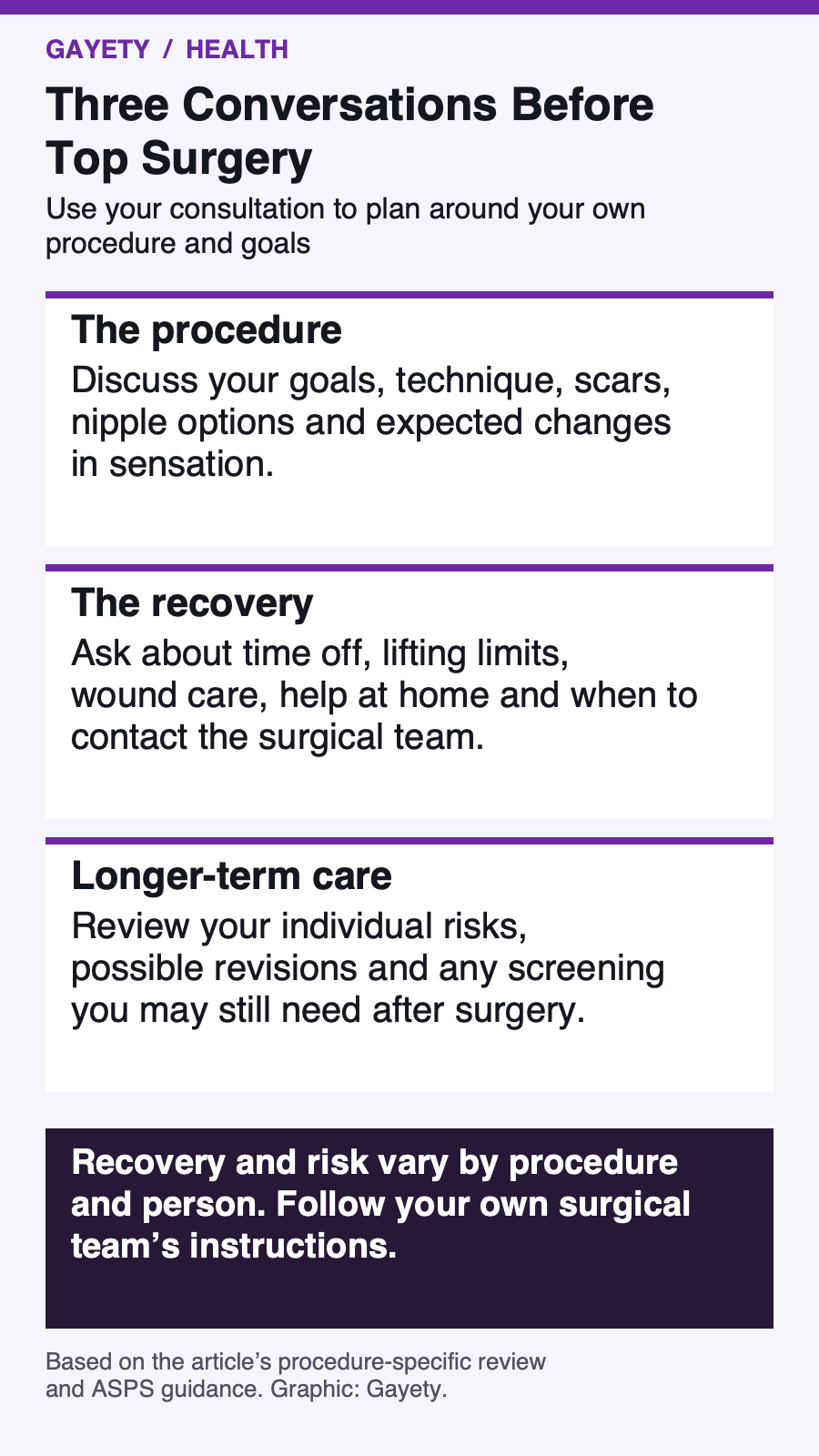
Recovery instructions vary by procedure and surgical team. Arrange a ride home, help with meals and household tasks, time away from work and a way to reach the team after hours. Ask whether you will go home the same day and whether you will have drains.
| Stage | Plan for |
|---|---|
| First days | Rest, help at home, prescribed wound care and short walks as directed. |
| Early follow-up | A wound check and a decision about drains, dressings and bathing. |
| Following weeks | Restrictions on lifting, reaching, exercise and sex until cleared by your team. |
| Following months | Changes in swelling, contour, sensation and scars; discuss any persistent concerns. |
Follow your own team’s restrictions on lifting, arm movement, bathing and compression garments. Do not start scar massage or silicone products on an incision that has not healed or without clearance. UCSF’s patient instructions also emphasize help at home, gentle walking and protecting healing scars from the sun.
Top Surgery Risks and Questions to Ask
The ASPS safety page lists bleeding, infection, poor incision healing, hematoma, loss of nipple sensation, loss of the nipple and areola, anesthesia risks and uneven results that may need another operation.
Published complication figures often combine different techniques, patient groups and definitions. They are not a personalized forecast. Ask your surgeon for results from the procedure you are considering and how often patients need further treatment.
Small folds of tissue at the ends of an incision, often called “dog ears,” can sometimes be revised later. A cosmetic revision is different from an urgent return to surgery for bleeding. Ask the surgeon to separate those outcomes when discussing their complication and revision rates. Also discuss nicotine use, medical conditions and medicines that could affect healing.
Chest masculinization does not remove all breast-cancer risk. UCSF’s screening guidance distinguishes mastectomy from breast reduction: screening needs depend on the tissue that remains, age, personal and family history, and the operation performed. A baseline mammogram is not a universal requirement for every person having top surgery. Report a new lump, discharge or other change even after surgery.
Choosing a Top Surgery Surgeon and Checking Eligibility
Ask the clinic for its assessment, consent and referral requirements, and ask your insurer separately about coverage paperwork. Discuss physical and mental health concerns so the team can plan appropriate support. A clinic’s checklist should not be presented as a universal rule for every trans or nonbinary person.
ASPS publishes a list of questions to bring to a consultation. Paraphrased, the most useful ones are:
- Where will I go right after surgery, and will I have drains? For how long?
- When can I bathe or shower, and how should I sleep?
- When can I get back to normal activity and exercise?
- How should I care for my scars, and when are follow-ups?
Also ask how many chest surgeries the surgeon does each year and what a touch-up revision costs.
Top Surgery Cost and Insurance Coverage
For a concrete U.S. example, the Gender Confirmation Center quotes $14,000 to $17,000 for chest reconstruction paid entirely out of pocket. That is a clinic-specific estimate, not a national average, and it excludes travel. Its lower procedure-only prices exclude facility and anesthesia fees, which is why comparing headline prices can mislead.
Prices depend on the surgeon, technique, region and whether the facility and anesthesia are billed separately. Ask for an itemized written quote covering the surgeon’s fee, anesthesia, facility, compression garments and revision charges. If you have insurance, request your plan’s written policy on gender-affirming chest surgery and its documentation rules before you book.
Top Surgery Under 19: ASPS Statement and State Laws
In a February 2026 position statement, the American Society of Plastic Surgeons recommended delaying gender-related surgery until age 19. The society distinguished that statement from a clinical practice guideline. It is a professional position, not a nationwide law.
WPATH and USPATH responded the following day by reaffirming individualized assessment for adolescents under their Standards of Care rather than a single age cutoff. The organizations therefore differ on this question.
Access also depends on current state law, court orders, the institution and insurance. Young people and families should confirm the rules that apply with the treating clinic and, where needed, a qualified legal adviser before arranging care or travel. A professional society’s recommendation alone cannot tell you whether a particular procedure is available.
Top Surgery FAQ: Recovery, Scars and Sensation
How long does top surgery recovery take?
Expect restrictions for several weeks, with the details set by your surgical team. Scars and sensation can continue changing for many months. Return to desk work, lifting and exercise may happen at different times.
Will I lose nipple sensation after top surgery?
You may. Sensation can change or be lost, particularly with free nipple grafts. A technique that keeps the nipple attached does not guarantee normal sensation.
Do you need testosterone before top surgery?
Testosterone is not a universal prerequisite for chest masculinization. Confirm the specific clinic and insurance requirements.
Does top surgery remove breast cancer risk?
No. Residual tissue may remain, and a breast reduction differs from a mastectomy. Discuss screening based on your surgery, age and individual risk.
Can you get top surgery under 18?
Availability depends on current law, clinical assessment, the institution and coverage. Professional organizations differ on age guidance. Confirm the requirements directly with a qualified care team.