
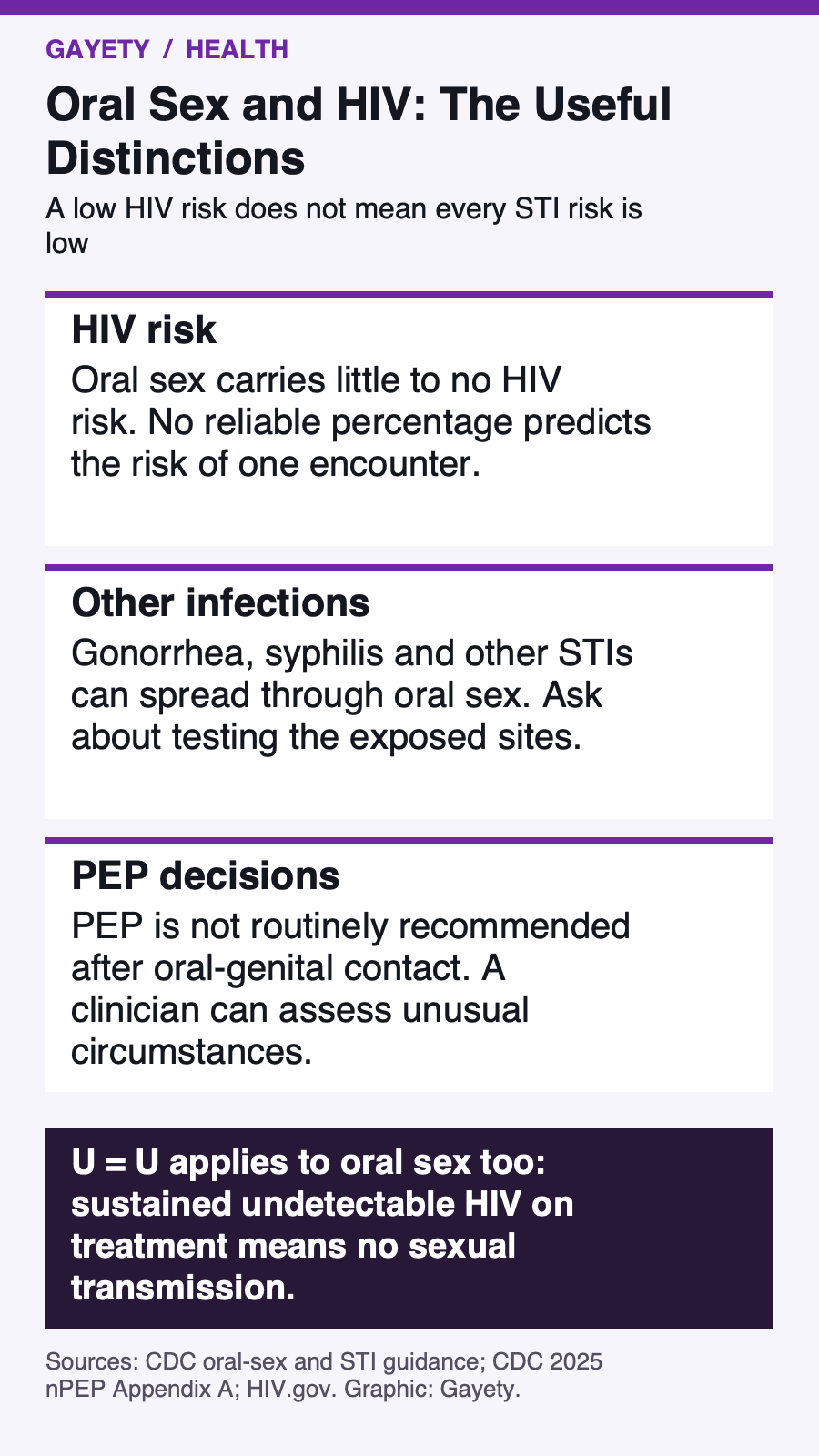
Oral sex carries little to no risk of HIV transmission. That is the useful starting point if you are worried about a recent encounter. Other infections, including gonorrhea and syphilis, spread through oral sex much more readily, so a conversation about testing can still be worthwhile.
The short answer: HIV transmission through oral sex is possible but very uncommon. There is no reliable per-act percentage to apply to an individual encounter. A partner who gets and keeps an undetectable viral load on HIV treatment does not transmit HIV through sex, including oral sex.
Jump to: How low is the risk? · Giving vs. receiving · Risk factors · Prevention and PEP · Other STIs · FAQs
HIV Risk From Oral Sex: Why There Is No Reliable Percentage
The CDC’s risk table uses a low-risk label for oral sex instead of a number. The numerical estimates below describe exposures to a partner with HIV without effective prevention. They do not describe sex with a partner who maintains an undetectable viral load.
| Exposure (partner has HIV) | Estimated risk per 10,000 exposures |
|---|---|
| Receptive anal sex | 138 |
| Insertive anal sex | 11 |
| Receptive vaginal sex | 8 |
| Insertive vaginal sex | 4 |
| Receptive oral sex | Low |
| Insertive oral sex | Low |
CDC lists factors that change those odds. Up: an ulcerative STI, acute or late-stage HIV, a high viral load. Down: condoms, antiretroviral treatment, PrEP.
A 2008 systematic review found too little consistent evidence to calculate a precise oral-sex risk. One historical estimate of 0.04% is often repeated online, but treating it as the chance for any particular encounter would give a false sense of precision. The studies differed in their methods and in how they excluded other exposures.
Giving vs Receiving Oral Sex and HIV
Giving oral sex can bring semen or pre-seminal fluid into contact with the mouth. That creates a biologically possible route, particularly if blood or damaged tissue is involved, but the overall HIV risk remains very low. Saliva itself does not transmit HIV, so receiving oral sex is not an exposure to HIV merely because saliva touches the penis.
In a 2002 UCSF study, researchers found no HIV infections among 239 men who reported oral sex as their only recent sexual exposure. A study with no infections cannot prove the risk is absolutely zero, but it helps explain why researchers describe oral transmission as uncommon.
Oral sex includes mouth contact with a penis, vulva or anus. The same broad reassurance about HIV does not mean every STI has the same risk. Oral-anal contact can also transmit intestinal infections, which have their own prevention and testing considerations.
What May Increase the HIV Risk From Oral Sex
HIV.gov and the CDC list several factors that may increase the already low risk:
- Mouth ulcers or bleeding gums
- Genital sores
- Other STIs, visible or not
- Ejaculation in the mouth by a partner with HIV
These are reasons to describe an unusual exposure accurately to a clinician, not a formula for calculating your risk. Neither a sore nor ejaculation automatically means HIV was transmitted.
The CDC’s oral-sex guidance also notes that studies have not established how much the proposed factors change risk. Claims that a particular brushing schedule or mouthwash makes oral sex safe from HIV go beyond that evidence. Good oral health matters, but it is not a substitute for established HIV prevention.
U=U, PrEP and PEP After Oral Sex
U=U applies to oral sex as well as anal and vaginal sex. Someone with HIV who gets and keeps an undetectable viral load on treatment does not transmit HIV through sex. An STI or a mouth sore does not cancel that finding.
PrEP cuts the risk of getting HIV from sex “by about 99% when taken as prescribed,” HIV.gov says. The FDA has approved two daily pills, Truvada and Descovy, and two shots: Apretude every 2 months and Yeztugo every 6 months.
PEP is not routinely recommended after oral-genital contact, even when the source has HIV, under the CDC’s 2025 guidance. A clinician may consider it in unusual circumstances involving factors such as blood, trauma or a high viral load. If those circumstances may apply, seek assessment promptly. When indicated, PEP must start within 72 hours and is taken for 28 days. Saliva without blood is not a reason for PEP.
STIs That Do Spread Through Oral Sex
CDC’s oral sex page names five STIs it can spread: chlamydia, gonorrhea, syphilis, herpes and HPV, in the mouth, throat, genitals or rectum. It also cites a study of gay men with syphilis in which 1 in 5 reported having only oral sex. CDC’s “STD Risk and Oral Sex” fact sheet and herpes page describe each one:
| STI | What CDC says about oral sex |
|---|---|
| Gonorrhea | Most throat infections cause no symptoms, and they’re harder to cure than genital or rectal ones |
| Chlamydia | Can infect the throat, usually without symptoms |
| Syphilis | A sore or rash on a partner’s genitals, anus, lips, mouth or throat can pass it on |
| Herpes | HSV-1 can spread from the mouth to the genitals |
| HPV | Mouth and throat infections with some types may develop into head or neck cancer |
CDC’s STI guidelines for men who have sex with men call for a throat test for gonorrhea after receptive oral sex in the past year, regardless of condom use. They don’t recommend throat testing for chlamydia. A urine test won’t catch a throat infection, so ask for the swab.
CDC’s doxy-PEP guidance covers oral sex too: doxycycline taken “as soon as possible, within 72 hours after oral, vaginal, or anal sex.” CDC tells providers to discuss doxy-PEP with gay, bi and other men who have sex with men and trans women who’ve had a bacterial STI in the past 12 months. CDC also advises using a condom, dental dam or other barrier every time you have oral sex.
Tell your clinician which kinds of sex you have so testing can cover the relevant body sites. A urine sample alone cannot rule out a throat infection.
HIV and Oral Sex FAQ
Can you get HIV from giving oral sex?
It is possible but very uncommon. HIV.gov describes oral sex as little to no risk, and there is no reliable percentage for an individual encounter.
Can you get HIV from receiving oral sex?
The risk is little to none. Saliva itself does not transmit HIV. An unusual exposure involving blood may need individual assessment.
Can you get HIV from swallowing semen?
Semen contacting the mouth creates a possible route, but HIV transmission through oral sex remains very uncommon. Swallowing versus spitting is not a reliable way to calculate risk. U=U still applies when a partner maintains an undetectable viral load.
Should I take PEP after oral sex?
CDC does not routinely recommend PEP after oral-genital contact. A clinician may consider unusual circumstances involving blood, trauma or other risk factors. Seek prompt assessment within 72 hours if those circumstances apply.
Do I need a throat swab after oral sex?
CDC recommends throat gonorrhea screening for men who have sex with men who report receptive oral sex, at least annually and more often when indicated. Routine throat chlamydia screening is not recommended, though a combined swab may detect it.