

“Cut or uncut?” is a question about foreskin, not a ranking of bodies. Circumcision changes anatomy and comes with some health trade-offs. It does not tell you how clean someone is, what kind of sex they enjoy or how good a partner they will be.
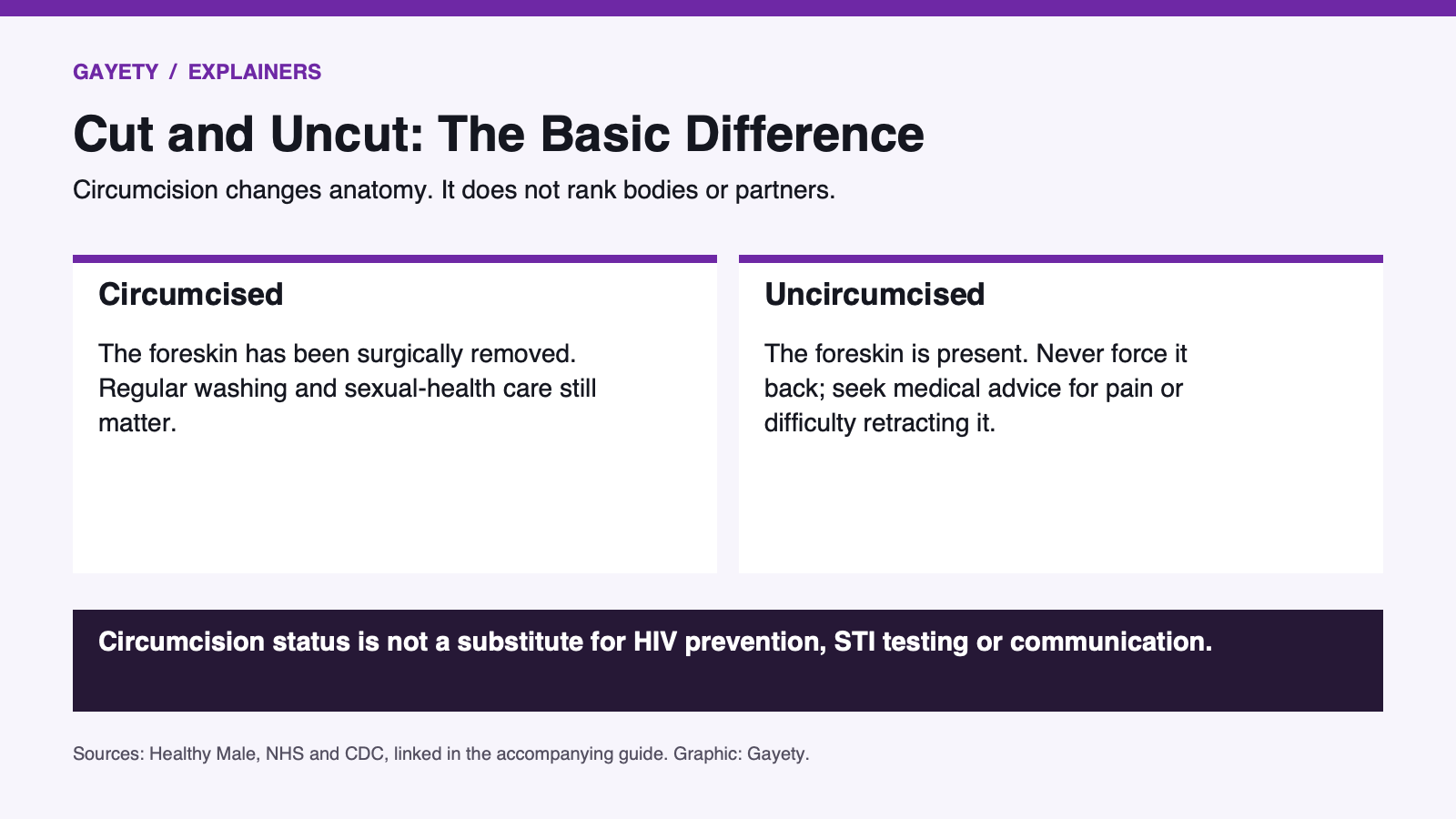
The short answer: Circumcision removes the foreskin covering the head of the penis. An uncircumcised penis retains it. Both need regular washing. Circumcision can reduce some medical risks, but it is surgery with possible complications. HIV prevention still calls for established options such as PrEP, condoms and treatment that keeps HIV undetectable.
Jump to: Anatomy · Hygiene · Health risks · HIV prevention · Sensitivity · When to get care · FAQs
Foreskin Basics: What Circumcision Removes
The foreskin is the sleeve of skin that covers the head of the penis, or glans, according to Healthy Male, an Australian men’s health group funded by the national government. In children it’s naturally attached to the glans and separates on its own over time. Families choose circumcision for medical, cultural, religious or personal reasons.
Circumcision does not remove the erectile tissue that determines erect size, and it is not a fertility treatment. It changes the amount of skin covering the head. If you are considering surgery, discuss the expected appearance, healing and possible effects on sensation with the surgeon rather than relying on before-and-after photographs.
People arrive at adulthood with different circumcision histories for family, cultural, religious and medical reasons. You may have chosen the procedure, or the decision may have been made when you were too young to take part. Either way, your preferences about your own body deserve respect.
Uncircumcised Penis Hygiene and Foreskin Care
For adult foreskin care, the NHS recommends gentle washing and retracting only as far as is comfortable. After cleaning, bring the foreskin forward over the head again. Never force a tight foreskin.
Circumcision does not replace washing, and having a foreskin is not inherently unhygienic. Avoid perfumed products that irritate the skin. Pain, discharge, swelling or a new rash deserves assessment rather than more vigorous scrubbing.
Circumcised vs Uncircumcised Health Risks, Side by Side
Healthy Male reports lower rates of some urinary and foreskin problems after circumcision. Many people with a foreskin never develop those problems. Penile cancer is rare, so a lower relative risk should not be mistaken for a high likelihood of cancer without surgery.
| Topic | With a foreskin | After circumcision |
|---|---|---|
| Daily care | Gently wash underneath and return the foreskin over the head. | Gently wash the exposed head and surrounding skin. |
| Foreskin conditions | Tightness or inflammation may need treatment. | The removed foreskin cannot develop phimosis. |
| Sexual sensation | Individual experience varies. | Individual experience varies; surgery changes anatomy. |
| HIV prevention | Use established prevention options. | Use established prevention options; circumcision is not complete protection. |
Surgery has risks, including bleeding, infection, anesthetic complications and an outcome you may not like. Adult circumcision also requires healing time and a period without sexual activity. Ask the surgeon about your own risks and follow-up plan.
Circumcision and HIV: Strong Evidence for Men Who Have Sex With Women
The strongest circumcision data comes from three randomized trials in Africa. A March 2024 research synthesis from the Clearinghouse on Male Circumcision for HIV Prevention summarizes them:
- Orange Farm, South Africa (2005): about 3,000 men aged 18 to 24; about 60% lower HIV risk
- Rakai, Uganda (2007): 4,996 men aged 15 to 49; about 51% lower risk
- Kisumu, Kenya (2007): 2,784 men aged 18 to 24; about 59% lower risk
Those trials concerned HIV acquisition through vaginal sex. Their findings cannot simply be transferred to receiving anal sex. The prevention benefit also does not amount to complete protection.
Does Circumcision Protect Gay and Bi Men From HIV?
An updated meta-analysis in the Journal of Acquired Immune Deficiency Syndromes found a protective association among men who predominantly had insertive anal sex. Its unadjusted analysis reported an odds ratio of 0.57, or 43% lower odds. That is not a promise of a 43% reduction in an individual’s chance of acquiring HIV. That analysis showed evidence of publication bias. A separate analysis adjusting for confounding also found a protective association, without detectable publication bias. Most included studies were observational, which limits what they can establish.
The authors also discussed a small randomized trial in China with only five new HIV infections. Their paper supports further consideration of circumcision for predominantly insertive men, but it is research, not a new CDC clinical recommendation. It does not establish protection for someone receiving anal sex.
Whatever your anatomy or preferred role, PrEP and condoms remain options. A partner with HIV who maintains an undetectable viral load does not transmit HIV through sex, known as U=U. Read HIV.gov’s explanation of viral suppression and the CDC’s testing guidance.
Does Circumcision Reduce Sensitivity? The Contested Research
In 2016, Queen’s University psychology researchers Jenn Bossio and Caroline Pukall published a Journal of Urology study of 62 men aged 18 to 37, 30 circumcised as newborns and 32 uncircumcised. They tested four sites on the penis for touch, pain, warmth and heat pain, and found no link between newborn circumcision and penile sensitivity. The foreskin was more sensitive to fine touch, but not to the other stimuli.
Ethicist Brian Earp’s response on The BMJ medical ethics blog challenged how that study was reported, including its sample size. A laboratory threshold for detecting touch is not the same as pleasure during sex. Neither study results nor a partner’s preference can predict exactly how surgery would feel to you.
Adult Circumcision, Foreskin Problems and When to See a Provider
If a tight foreskin or repeated inflammation is bothering you, discuss options with a clinician. Treatment can include prescription steroid creams or surgery, depending on the cause. Circumcision is not automatically the first or only answer to every foreskin problem.
A foreskin that is pulled back and cannot return over the head is a medical emergency. This is called paraphimosis and can restrict blood flow. Seek emergency care. For persistent tightness, painful erections or recurring inflammation without that emergency, book a primary-care or urology appointment.
Cut vs Uncut FAQ: Hygiene, HIV and Sensation
Is it better to be circumcised or uncircumcised?
There is no overall ranking. Circumcision has potential medical benefits and surgical risks. Personal circumstances and preferences matter.
Does circumcision reduce sensitivity?
Research measures different aspects of sensation and sexual function. A small laboratory study cannot predict an individual’s pleasure or experience after surgery.
Does circumcision prevent HIV in gay men?
Research suggests a possible partial benefit for predominantly insertive men. It does not establish protection during receptive anal sex or replace PrEP, condoms and U=U.
How do you clean an uncircumcised penis?
Gently retract as far as comfortable, wash underneath and return the foreskin over the head. Never force it. A retracted foreskin that becomes stuck needs emergency care.


